
Douglas
Three of the most recognisable Irish faces of the 21st century came out of Douglas: Cillian Murphy, Jack Gleeson, and Ronan O'Gara. One stars in Christopher Nolan films. One played King Joffrey on Game of Thrones. One won two Heineken Cups with Munster and now coaches in La Rochelle. None of that is what Douglas advertises about itself, but it is the kind of suburb that quietly produces this density of talent and then watches the local rugby team take it in stride. Douglas is a southern district of Cork city, four kilometres from Kent Station, woven through with the N40 ring road and the long memory of woollen mills that closed in the 1970s.
Nemo and the Saturday Religion
Nemo Rangers GAA was historically associated with Turners Cross, but the club moved to the Trabeg area of Douglas in the 1990s and never looked back. Nemo are one of the most successful Gaelic football clubs in Ireland's history. Douglas GAA, the other club, handles the hurling and football of the village proper. In 2004, 2007 and 2012, Douglas swept the under-10 Community Games at Cork, Munster and all-Ireland level. That's a particular kind of statistic - what it tells you is that the place takes children's sport seriously enough to produce winners three times in eight years across three age brackets. The rugby club, Douglas RFC, was founded in 1902, originally drawing members from the workforce of St Patrick's Woollen Mills. The mills closed in the 1970s. The rugby club did not.
A Suburb of Names You Recognise
Cillian Murphy, born and raised in Douglas, made his name in Peaky Blinders and then in Christopher Nolan's films. Jack Gleeson, also from Douglas, was thirteen when he was cast as Joffrey Baratheon in Game of Thrones - the antagonist millions of viewers love to hate. Ronan O'Gara, the Munster and Ireland fly-half, came out of these streets to become one of the great rugby kickers of his generation. Donncha O'Callaghan, his Munster teammate, is also Douglas. Rob Heffernan, Olympic race walker, trained on these roads. Lennox Robinson, the playwright who directed the Abbey Theatre in the early 20th century, lived here. Gerald Goldberg, who became the first Jewish Lord Mayor of Cork, was Douglas. Allie Sherlock, the young street singer whose Cork city busking went viral, started here. The list keeps going.
The N40 and the Stranded Direction
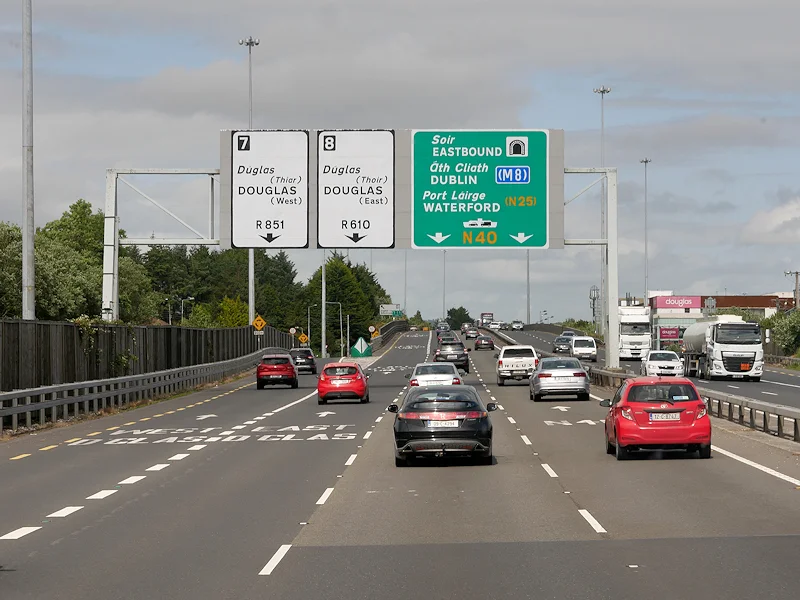
The N40 - Cork's southern ring road - passes through Douglas, and the local quirk of the interchange is the kind of thing that gets repeated at every Douglas dinner party. You cannot join the N40 at Douglas to travel east. Westbound traffic can't exit at Douglas either, having to use Junction 9 instead. The result is that residents have memorised a slightly absurd set of alternate routes. The R609 carries you toward Carrigaline. The R610 leads east to Passage West. The R851 connects to the N27. The R853, the Well Road, takes you to Ballinlough, Mahon and Blackrock. Bus Eireann does the rest: routes 206, 207, 216, 219, 220 and 223 thread through Douglas at different angles. The Kent Station train is four kilometres away. Until 1932, the Blackpool-Douglas tram of the Cork Electric Tramways and Lighting Company served the village directly. The tram is gone. The ring road remains.
The Mills That Made It
Douglas grew around water and wool. St Patrick's Woollen Mills, which closed in the 1970s, was the largest local employer for generations. The mills are gone but their footprint shapes the modern village - the housing patterns, the placement of the rugby club, the streets that radiate from where they once stood. From the 1960s onward, residential development overwhelmed the older village core. St Columba's Catholic Church, originally Douglas's main parish church, became overcrowded enough that the Church of the Incarnation was consecrated in Grange in 1976. St Patrick's Catholic Church in nearby Rochestown followed in 1991. St Luke's Anglican church dates to 1875. The Holy Trinity Anglican in Frankfield dates to 1838. Methodist, Baptist, Pentecostal and Redeemed Christian Church of God congregations all have homes in Douglas - the suburb is more religiously varied than its 78.6 percent Catholic majority might suggest.
Village Centre and Shopping Centre
Douglas calls itself a village despite being unmistakably a suburb. The Douglas Village Shopping Centre opened in the 1970s and has been the social and commercial anchor since - in 2019 a fire kept it closed for months and the absence was noticed across the city. The village core has pubs, cafes, what is sometimes called Ireland's best chip shop, and the kind of small-town density that suburbs rarely achieve. Schools, sports clubs, three church traditions, a community school for boys and Regina Mundi College for girls, two GAA clubs, a half-dozen soccer clubs, golf, tennis, basketball, gymnastics, hockey, cricket. The N40 hums in the background. The wool mills are gone. The village does its quiet work of being a place that produces consequential people without making a fuss about it.
From the Air
Located at 51.88°N, 8.44°W on the southern edge of Cork city, between Cork Harbour to the south and the River Lee corridor to the north. From altitude the N40 ring road defines Douglas's northern edge, with the suburban grid spreading south toward Rochestown and Carrigaline. Cork Airport (EICK) is about 4 km west; Kent Station in the city centre is about 4 km north. Best viewed at lower cruising altitudes where the village core and the surrounding modern development are clearly distinguishable.
Nearby Stories
- St. Declan's Monastery 0.8 km away
- Aghavrin House 2.4 km away
- Mitchelstown Castle 7.4 km away
- Clonakilty 9.5 km away
- Inislounaght Abbey 16 km away
- Walter Siepmann 23 km away
- Newcastle West 33 km away
- SM U-27 110 km away