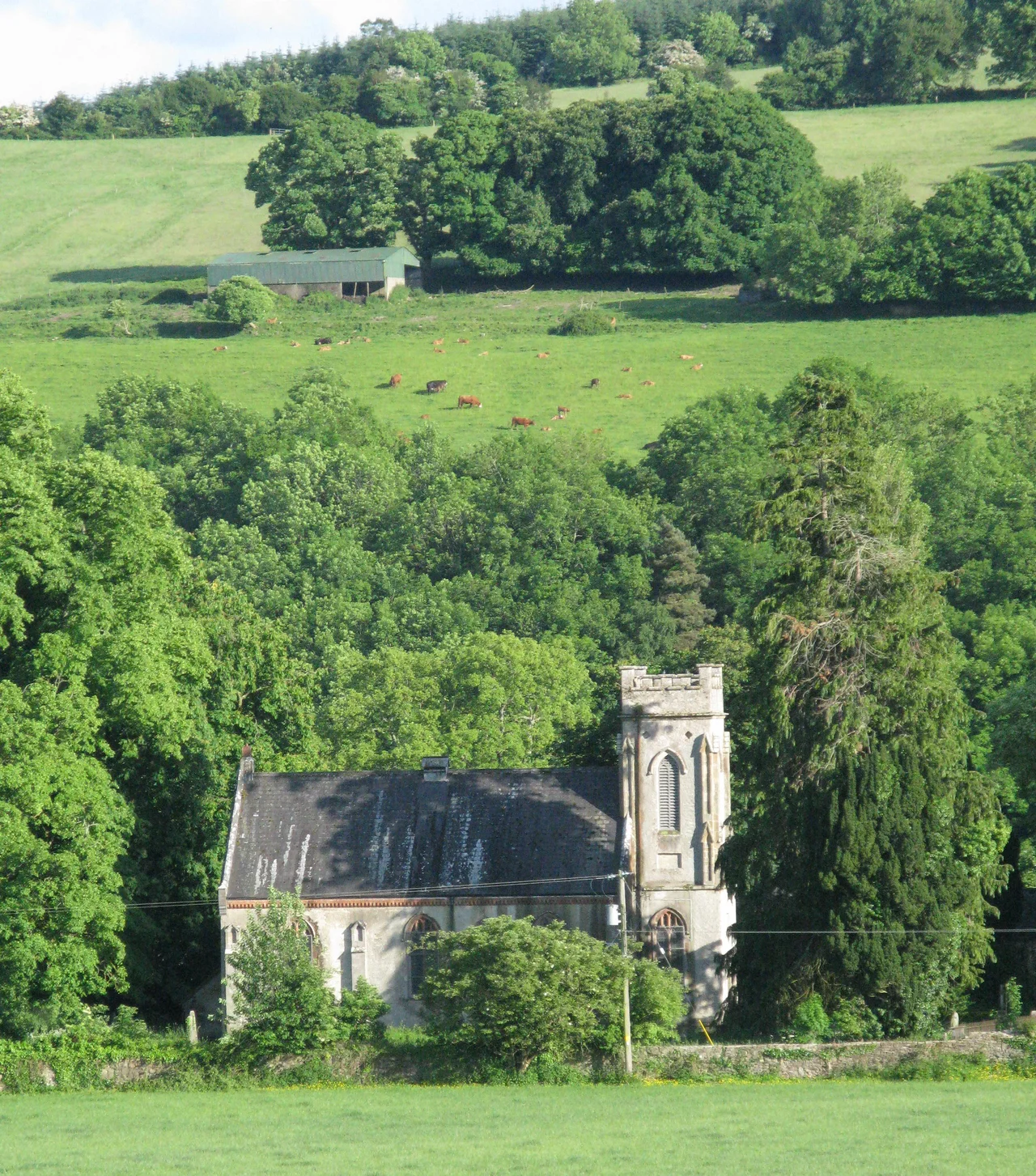

Inislounaght Abbey
Its name in Irish was Mainistir Inis Leamhnachta - the Monastery on the Island of Fresh Milk. The Cistercian abbey of Inislounaght sat in some of the richest pasture in Ireland, three kilometres west of Clonmel on the north bank of the Suir, where dairy cattle have given up cream by the bucketload for a thousand years and probably longer. Today, almost nothing of the abbey remains. The stones were carried off to build mills, a 19th-century parish church, and the columns of the Main Guard in Clonmel. But the abbey may have left behind something stranger than ruins: a medieval poem about a paradise of running rivers of milk and roast geese flying through the air, possibly written about - and at the expense of - this very monastery.
Two Foundations
The Cistercians were not the first religious community at Inislounaght. An earlier monastic settlement had been founded on the same site before 656 by St. Pulcherius - the Irish name was Saint Mochoemoc - and operated under whatever rule attached to it across the long centuries before the great 12th-century European reformation reached Ireland. The Cistercian refoundation came between 1142 and 1148, on lands donated by Malachy O'Phelan, lord of the Decies, and Donald O'Brien, King of Munster. The Cistercians had been founded in France only a generation earlier and were spreading explosively across Europe; their arrival in Ireland transformed monastic life. Inislounaght's first abbot, Congan, was apparently a friend of St. Bernard of Clairvaux himself - it was Congan who asked Bernard to write the Life of St. Malachy of Armagh, the work that introduced much of Christendom to one of medieval Ireland's most important saints.
Trouble with Dunbrody
Even the early years were not peaceful. In 1234 the abbot of Inislounaght was excommunicated following a legal quarrel with the abbot of Dunbrody Abbey in Wexford - the kind of dispute that the Cistercian General Chapter in France could not always resolve from a distance. The crisis grew. In 1240 a group of English monks from Furness Abbey in Cumbria were sent over to take charge, and nine years later the Vatican formally transferred responsibility for Inislounaght from its previous mother house at Mellifont to Furness instead. Through the 14th and 15th centuries the abbey held its position in the local landscape: in 1397 the Earls of Desmond and of Ormond met here to seal a treaty of peace - one of many such, all of them short-lived. Mairín Ó Briain, a former Archbishop of Cashel, chose Inislounaght for his burial in 1236.
Land of Cokaygne
Sometime in the early 14th century, a satirical Hiberno-English poem began circulating that has fascinated medievalists ever since. It describes a fantasy paradise called Cokaygne in which monks live in idleness, geese fly already roasted to the dinner table, and rivers run with milk and honey rather than water. The Land of Cokaygne survives in a single 14th-century manuscript at the British Library, MS Harley 913. The literary historian Patrick Leo Henry argued that the poem may have been written about Inislounaght specifically - the monastery on the island of fresh milk - and aimed as a sharp critique of the lifestyle that some of its monks had allegedly adopted. The connection is not certain, but the parallels are striking. If Henry is right, this small Tipperary house is part of the prehistory of every later fantasy of a land where 'big rock candy mountains' wait for the wandering hobo, and the fountains of wine never stop pouring.
Scandal and Suppression
Whatever the truth about Cokaygne, the abbey's reputation had collapsed by the 16th century. In October 1537 a jury from the city of Waterford reported to the King's Commissioners about James Butler, Abbot of Inislounaght and Dean of Lismore: that he 'hath sundry times disobeyed the King's writ' and was 'a man of odious life, taking yearly and daily men's wives and burgess' daughters, and keepeth no divine service but spends the goods of his church in voluptuosity, and mortgages the lands of his church.' The historian William P. Burke wrote in 1907 that of all the hundreds of religious houses in Ireland at the Reformation, Inislounaght alone 'stood distinguished and alone in evil prominence.' The dissolution finished the abbey as a community. Its lands passed to the Butler dynasty. The last Cistercian abbot, Laurence FitzHarris of New Ross, was consecrated as late as 1625 by Archbishop Fleming of Dublin and fled to France in 1649 to escape the Cromwellian conquest.
Stones Walking Away
The stones of the abbey did not stay put. Through the 17th and 18th centuries they were quarried for mills, houses, and bridges along the Suir. The columns and architectural elements of the Main Guard - the 17th-century palace of justice in central Clonmel - came from here. The arch over the entrance to the present St. Patrick's parish church at Marlfield is reused abbey work. Down Survey maps of the 1650s mark the site as 'Abby Slunnagh,' just west of the modern village. An Ordnance Survey team tried to find the foundations in the 1840s and failed. A single arch is reported to have still been standing in the early 19th century; even that is gone now. What remains is the field name, the Marlfield graveyard nearby, and Geoffrey Keating's mention of the place in his great 17th-century history Foras Feasa ar Éirinn. And, perhaps, a single anonymous medieval poem that may have done more to immortalise the abbey than any of its own monks ever did.
From the Air
Inislounaght's site lies at 52.35°N, 7.73°W on the north bank of the River Suir, about 3 km west of Clonmel in southern County Tipperary, near the modern village of Marlfield. The Comeragh Mountains rise to the south across the river. From the air, look for the rich green pastureland of the Suir valley between the Galtees to the north-west and the Comeraghs to the south. Nearest airports: Waterford (EIWF) about 50 km east, Cork (EICK) about 80 km west-south-west, Shannon (EINN) about 100 km north-west.
Nearby Stories
- Young Ireland rebellion 3.7 km away
- Clonmult Ambush 4.2 km away
- Dunbrody Abbey 5 km away
- Old Parish 5.8 km away
- Doon, County Limerick 12 km away
- Mitchelstown Castle 13 km away
- County Carlow 18 km away
- Ramsey Island 117 km away