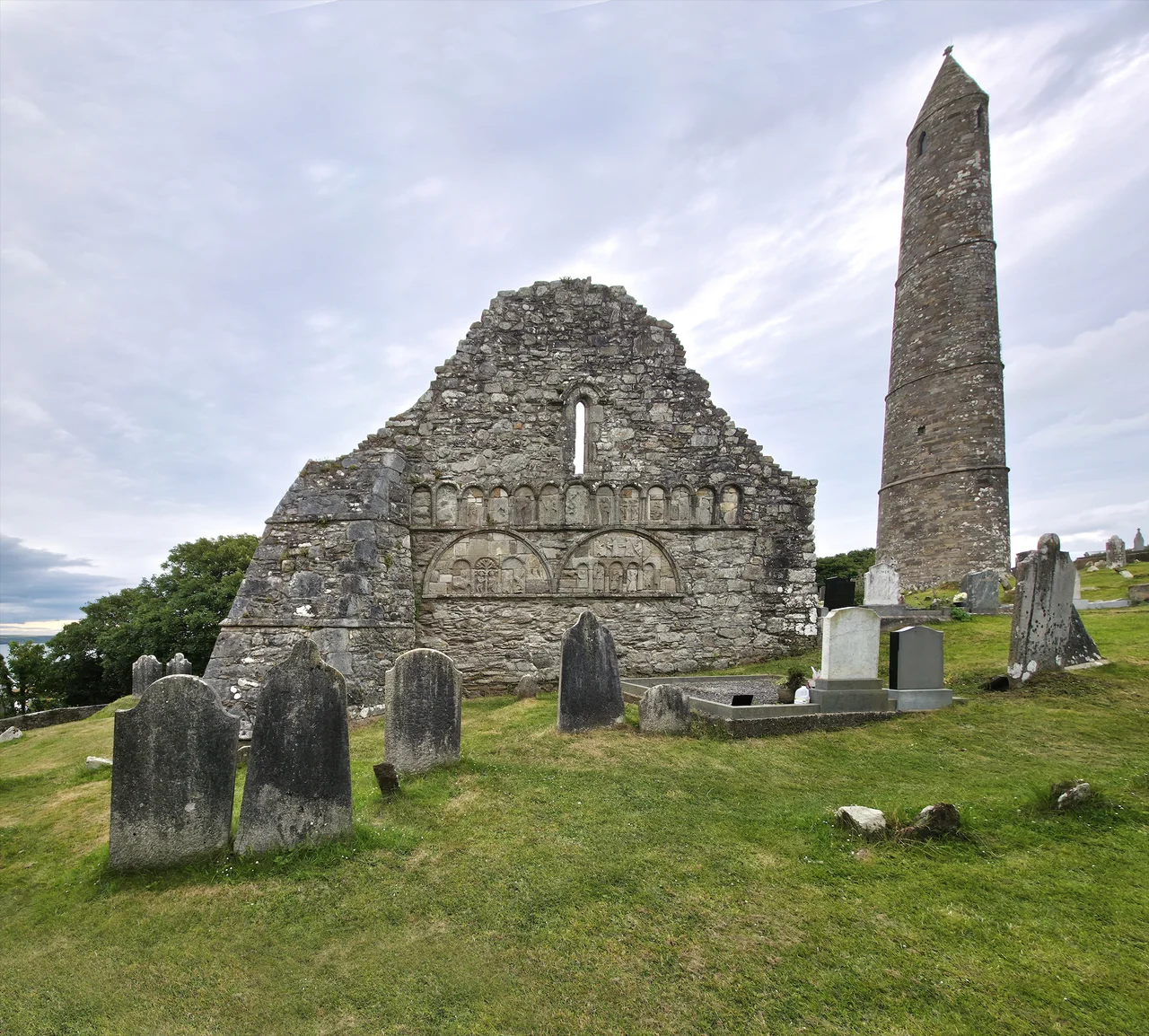

St. Declan's Monastery
Tradition holds that Saint Patrick was not the first. A century or so before Patrick crossed the Irish Sea, a man named Declán is said to have already been baptising the Déisi people on this windswept Waterford headland. The monastery he founded sits 400 metres southwest of modern Ardmore, on a hill that overlooks the cliff path, the wreck of the Samson on Ram Head, and the Atlantic running flat to the horizon. Three of Munster's pre-Patrician saints get this claim; Declán is the one with the ogham stones to prove people were here, writing in a code of notched lines, by the 5th or 6th century at the very latest.
Before Patrick
The story is older than the buildings. Declán was a contemporary of Saints Ailbe, Ciarán, and Ibar - the four bishops said to have brought Christianity to Munster before Patrick's mission of 432. Whether any of them is historical in the strict modern sense is a question medievalists still argue, but Declán's cult was strong enough to outlast a millennium of conquest. His relics were enshrined in a stone oratory built in the 9th or 10th century, a tiny gabled cell whose lintel is a single long stone. Pilgrims used to scrape earth out of an empty grave recess inside it, taking the dust away as a sacred thing. By 1152, Ardmore was a cathedral and seat of its own bishop, Máel Étaín Ua Duib Ratha. By 1210, the diocese had been swallowed into Lismore. Today "Ardmore" survives in the Catholic Church only as a titular see - a bishopric in name, with no flock.
The Round Tower
The thirty-metre round tower above Ardmore is among the last ever built in Ireland, raised in the 12th century when the form was already old. Four storeys rise inside, each separated by a string-course, with three small slit windows along the body and four at the very top - one facing each compass point. The original purpose of Irish round towers is still debated: bell-towers, refuges from Viking raids, landmarks for arriving pilgrims, monastic strongboxes. Probably all of these. From the ground the tower seems impossibly tall and thin, a stone needle threading the sky above the headstones. From the sea it would have been the first thing a Viking longship saw - which may be why it stood so far above the village.
An Open-Air Bible
On the west gable of the unroofed cathedral, the 12th-century masons carved a story-book in stone. Two lunettes and a blind arcade once held the entire Christian narrative as a medieval pilgrim would have known it: Adam and Eve in the garden, the Adoration of the Magi, the Judgment of Solomon, the Archangel Michael weighing souls, a bishop blessing a kneeling warrior. Eight hundred years of Atlantic wind and rain have eroded them almost beyond recognition, and the original bright paint that once covered the stone is long gone. Scholars believe the carvings were inspired by similar reliefs that pilgrims had seen at Rome or at Santiago de Compostela and brought home in memory. Inside the cathedral, three ogham stones lean in alcoves. One mentions a vice-bishop named Dolativix; another bears the Latin word amātus, "beloved." They are older than the church around them by half a millennium.
Graves of the Far-Travelled
The graveyard tells its own version of Irish history. Declán's traditional resting place is here. So is Declan Hurton of the Old IRA, killed at Thurles in December 1921 during the War of Independence. Able Seaman Michael Moylan of the Royal Navy, who died on active service in 1916, lies a few rows away. And in February 1947, the cargo ship SS Ary broke up off the coast in a gale; several of its mostly Polish crew were drowned, and the parish buried them on this same hilltop, far from home. A 5th-century saint, a Republican volunteer, a sailor of the British Empire, and Polish merchant seamen - all sharing the same patch of cliff, watched over by the same tilting tower.
Walking the Hill
The monastery sits at one end of the Ardmore cliff walk, a marked path that begins near the Cliff House Hotel and loops back through the village. Along the way the path passes St Declan's Cell and Holy Well, an abandoned 20th-century coastguard lookout, the rusting remains of the crane ship Samson, and Fr. O'Donnell's Well with its stone canopy. From the saint's hill, the whole peninsula tips away toward the sea. On a clear day you can see the round towers of distant churches catching the same light, and read the same wind that filled Viking sails and Norman pilgrim cloaks, and understand why the people who built this place chose to build it here.
From the Air
Located at 51.95°N, 7.73°W on a headland 400 metres southwest of Ardmore village, County Waterford. Best viewed from 1,500-3,000 ft AGL, with the 30-metre round tower visible as a thin pale shaft against the green hilltop. The unroofed cathedral lies beside it, with the much smaller stone oratory just to the north. Nearest airports: Cork (EICK) approximately 60 km / 32 nm to the southwest, Waterford (EIWF) approximately 45 km / 24 nm to the northeast. The site sits east of the mouth of the Munster Blackwater and Youghal harbour, with Ram Head and the wreck of the Samson visible to the south. Atlantic visibility from the headland is excellent in clear conditions; in rain or low cloud the round tower can disappear into the murk in minutes.
Nearby Stories
- Clonmult Ambush 5.9 km away
- Dunbrody Abbey 9.8 km away
- Mitchelstown Castle 15 km away
- All Together Now (festival) 16 km away
- Hook Lighthouse 21 km away
- Walter Siepmann 29 km away
- Alfred Lämmerhirt 60 km away
- Action of 17 November 1917 117 km away