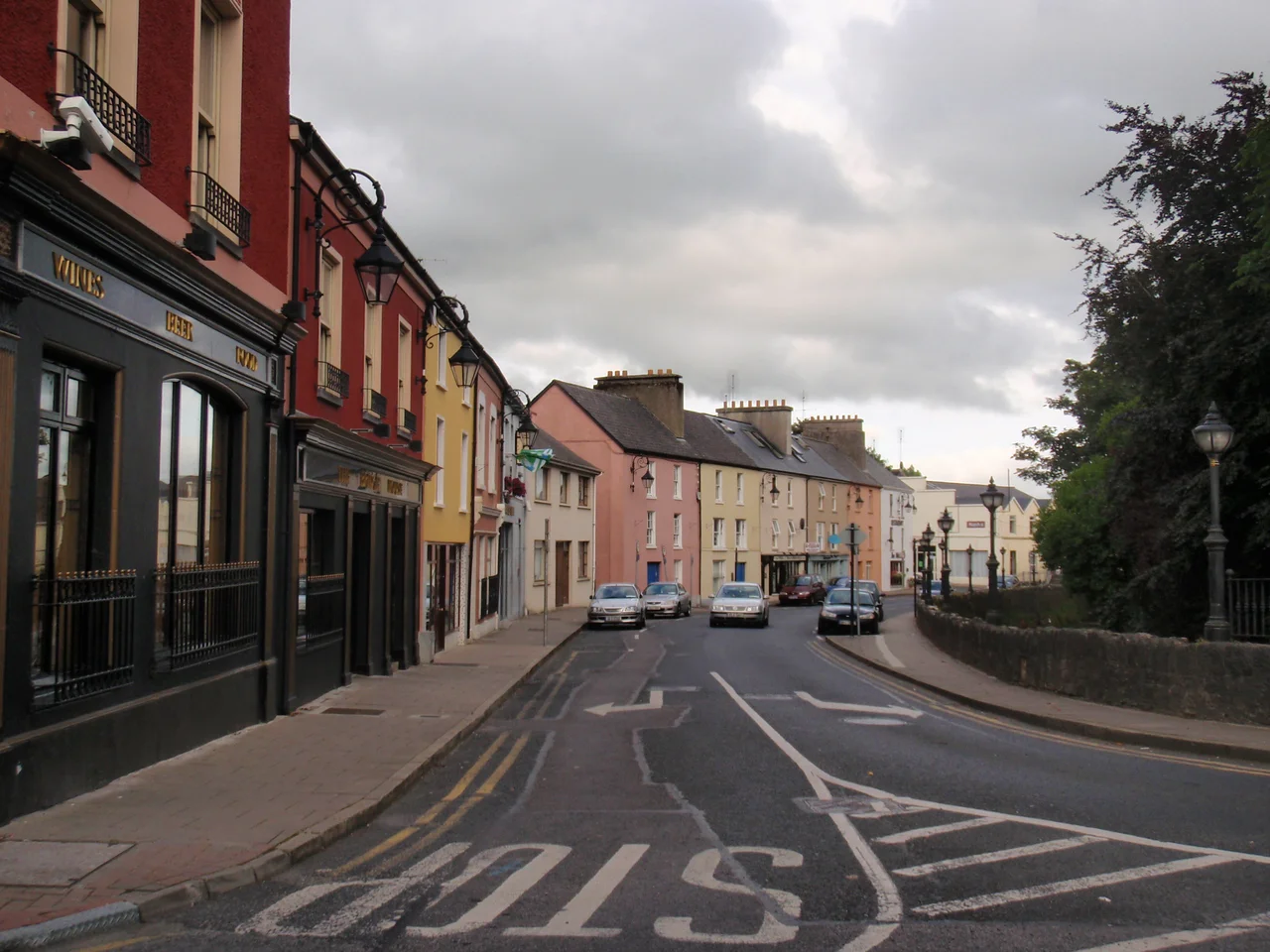

Newcastle West
The crest of Newcastle West carries the image of a wild boar. The old name for the great bowl-shaped valley in which the town sits was the Valley of the Wild Boar, named for the animals that thrived here when the country was still thickly wooded. The trees are mostly gone now and so are the boars, but their image stayed - on the town crest, in the local memory, in the motto curled around the seal: As Duchas Dochas, 'Our hope springs from our traditions.' The town's other inheritance is the Desmond Banqueting Hall, the 13th-century survival at the south end of the main square, where the Earls of Desmond once entertained guests in stone vaulted halls that still stand. Today, 7,209 people live in Newcastle West, the county town of Limerick, in the largest town in the county outside Limerick city itself.
Earls of Desmond
The castle that gave the town its name began in the 13th century. Parts of the present Desmond Castle date from that period, but the great banqueting hall - which dominates the southern end of the main square and which has been partly restored and open to public tours - is largely 15th century, built when the Earls of Desmond were among the most powerful magnates in the south of Ireland. The Earls held court here. The hall has a tall first-floor great room, a stone-vaulted ceiling, a fireplace big enough to roast oxen in, and large windows that look out across what is now a square but was once the working centre of the Desmond estate. The Desmond title was eventually destroyed in the great Desmond Rebellions of the late 16th century; the castle passed through other hands. The area in front of the banqueting hall was the site of the Protestant church, built in 1777 and long gone. The castle's demesne, about 0.4 square kilometres of parkland and sports fields, surrounds it today.
Bridge of Tears
Two bridges in Newcastle West carry the weight of the 19th century. The iron footbridge over the river Arra, opposite the Catholic Church of the Immaculate Conception, was put up by Edward Curling, the landlord's agent in town from 1848 to 1874 - the agent through the worst of the Famine years and the long emigrations that followed. The other is the stone bridge at the south end of town, at the junction of the Cork Road and the Bruff Line. It is known locally as the Bridge of Tears, sometimes the Bridge of Sorrows. During the Famine, this was the last farewell point for emigrants leaving West Limerick. They would say goodbye to their families at the bridge, then walk on toward Cork city to take ship for North America or Australia. A second monument to the Famine survives at the rear of St Ita's Hospital, the old workhouse: hundreds of people who died there are buried in unmarked graves, marked now by a plain old cross and limestone gates sculpted by Cliodna Cussen with scenes from the Famine.
Two Turntables and a Trail
The North Kerry railway line ran through Newcastle West from 1857 until 1975 - 118 years of trains connecting Limerick city to Tralee via Rathkeale and Listowel. The station had an unusual arrangement: two turntables and two water columns for steam locomotives, an inheritance of having been built by two different railway companies. The Rathkeale and Abbeyfeale lines met just outside the station, with a twin-arch road bridge crossing both before they diverged. Passenger trains ended in 1963, regular goods in 1974, the last special train in 1975. The tracks came up in the late 1980s. In 1999 the old station house was restored as a private home within the Bishop Court development. The Great Southern Trail - a 53-mile rail trail through West Limerick and North Kerry - now follows the line of the railway, passing where the twin-arch bridge once stood. The trailhead is on Station Road. The Carnegie Library in the Market Yard, paid for by the Scottish philanthropist Andrew Carnegie and once a secondary school, is now a commercial centre.
People Who Left, People Who Stayed
The town's emigrant story is partly told by the people whose names are still remembered. John Wolfe Ambrose, born locally, went on to become a civil engineer and one of the major developers of New York City - the Ambrose Channel is named after him. Mary, Lady Heath, born Sophie Catherine Theresa Mary Peirce-Evans in Knockaderry nearby before moving to Newcastle West, became one of the most famous women in the world in the mid-1920s as an aviator, completing the first solo flight from Cape Town to London in 1928. Michael Hartnett, the poet, lived and worked here. Max Arthur Macauliffe, the civil servant who became the foremost European scholar of Sikhism, was born here. William Nash earned the Victoria Cross. John St John Long became a notorious London quack who claimed to cure tuberculosis. Philomena Lee, whose story of being separated from her son by an Irish mother-and-baby home became Martin Sixsmith's book and Stephen Frears's 2013 film with Judi Dench, was from here. The Old IRA monument opposite the church, unveiled by President Sean T. O'Kelly in 1955, commemorates seventeen volunteers killed in the War of Independence and the Civil War. Their names are local.
From the Air
Newcastle West lies at 52.45 degrees north, 9.05 degrees west, on the N21 road in west County Limerick, in a great bowl-shaped valley along the River Arra. The nearest commercial airport is Kerry (EIKY), about 50 km west; Shannon (EINN) lies 50 km north, Cork International (EICK) about 100 km south. From altitude, look for the broad valley of the Arra opening toward the larger River Deel to the north, with the Mullaghareirk Mountains rising on the southern horizon and the Galtee Mountains visible to the east in clear weather. The Desmond Castle and banqueting hall stand at the southern end of the main town square.
Nearby Stories
- Ballyhannon Castle 8.4 km away
- Dromagh Castle 8.5 km away
- Siege of Carrigafoyle Castle 11 km away
- Fermoy 13 km away
- County Kerry 15 km away
- Abbey of Woney 18 km away
- Nenagh 22 km away
- Inis Beag 36 km away