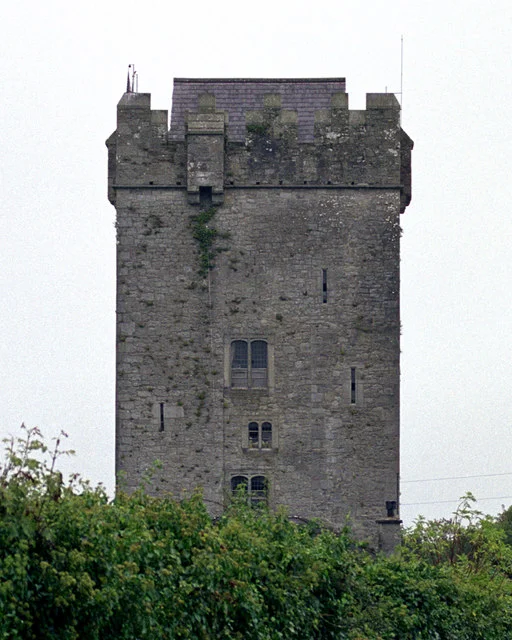

Ballyhannon Castle
Most Irish castles you see today are ruins - rooflines collapsed, floors gone, walls reduced to picturesque silhouettes against the sky. Ballyhannon Castle is not that. The tower built around 1490 by Hugh MacNamara and his brother Síoda still stands as it was meant to stand: four storeys under a stone vault, complete with murder hole, spiral staircase of 72 steps, trefoil-headed windows, and a garderobe in the southeast corner. Walk in the south door and the medieval still works. That is the thing this castle has done best, for five hundred and thirty years - it has refused to fall down.
The Golden Age of Tower Houses
Thomas Johnson Westropp, the antiquarian who walked County Clare with notebooks in the early 20th century, called the late 15th century "the Golden Age of castle-building in Thomond." He meant it technically: the masons of north Munster in that period had reached a level of skill that combined defensive design with proportions worth looking at. Ballyhannon is a product of that moment. The MacNamaras built it on lands they held under the O'Briens, the Earls of Thomond. The townland of Castlefergus (it is sometimes called Castlefergus Castle now, after the nearby River Fergus) lies near Quin, an area thick with tower houses built by Clare's Gaelic chieftains during the decades before Tudor power finally reached this far west.
Plantations and Rebellions
In 1626 the 5th Earl of Thomond rented Ballyhannon to one Robert Hawksworth - one of the English Protestant settlers brought into Clare and planted on lands the O'Briens had nominally retained. This is what triggered, fifteen years later, the Irish Rebellion of 1641: dispossessed Irish Catholic gentry pushing back against the colonisation. The MacNamaras of Ballyhannon were not gentle about it. John Smith of Latoon complained that he had lost £1,354 worth of property, including his lease and his outlays on buildings and sea embankments; the despoliation, he wrote, was "subsequently completed by the MacNamaras of Ballyhannon" among others. When the rebellion failed, Mahone MacNamara of Ballyhannon was among those who forfeited their property. It went to a Protestant settler named Pierce Creagh and to the Earl of Thomond. Cromwell's army arrived shortly after.
The Castle That Cromwell Forgot
Cromwell's Parliamentary forces took most of Ireland's tower houses apart deliberately, knocking off the floors and roofs to render them indefensible. Somehow Ballyhannon was missed. A 1675 sketch in the Edenvale Survey shows the castle still roofed, in good repair, surrounded by a bawn wall with a gate and loophole windows. By the time the Catholic King James II came to the throne in 1685, Sir Daniel O'Brien, Viscount Clare, was listing Ballyhannon as a suitable place to imprison Protestant settlers who were now being dispossessed in turn. A letter from 1689 makes the point bluntly: "put into some strong castle that has a geate to be locked on the outside like Ballyhannon." Pierce Creagh, who had received MacNamara land after 1641, was one of those named for imprisonment. Ireland's history kept changing sides faster than the buildings could change owners.
The Last Inhabited Tower
Hely Dutton, writing in 1808, noted that Castlefergus was "inhabited and lately white-washed." That is an extraordinary line - a 15th-century tower house, still occupied, still maintained, in the era of Jane Austen. It seems to have stayed inhabited until around the 1820s, perhaps the first time in 350 years it stood empty. Samuel Lewis in 1837 described it simply as "the remains of the ancient edifice." Westropp in 1917 found ringfort traces in the surrounding fields. Then the American oil heiress Elizabeth Phillips - of Phillips Petroleum - and her husband Henry D. Irwin bought it. In 1970 they restored Ballyhannon completely, choosing the older townland spelling "Ballyhannan" for the name. Rock musicians and Hollywood film stars stayed during shoots in the region. It now operates as a high-end luxury rental.
What Robert Twigge Saw
Robert Twigge described Ballyhannon in the early 1900s in the technical language of a man who measured what he documented. The castle stands on a low rock, scarped to the west, with no outworks (the 1675 bawn wall had been removed by then). The pointed south door is defended by a shot-hole on the left and a murder hole above. The spiral stair rises 72 steps to the top. Five curved steps from the west corridor lead to a passage along the south wall over the porch and lodge. A handsome trefoil-headed window of two lights graces the southwest angle. A garderobe occupies the southeast. Four main storeys sit under a stone vault forming the roof. A fireplace bears the date 1576 - added a century after the building went up - which is how Twigge knew, because medieval stones don't normally carry their dates. The hand that did Ballyhannon's fireplace did. The castle remembered.
From the Air
Coordinates 52.80°N, 8.91°W. Ballyhannon Castle sits in the Castlefergus townland near Quin in County Clare, about 5 km east of Clarecastle and 10 km southeast of Ennis. Shannon Airport (EINN) lies 13 km south. From altitude the castle appears as a roofed rectangular tower set on flat farmland near the River Fergus and Latoon Creek. The surrounding landscape is the open pastoral plain of east Clare, dotted with other tower houses (Knappogue, Bunratty) and the nearby Craggaunowen reconstructed ringfort village. Best viewed at 1,500-2,500 ft AGL in clear weather.
Nearby Stories
- Kinvara 6.1 km away
- William Smith O'Brien 9.3 km away
- Newport, County Tipperary 13 km away
- Aran Islands 14 km away
- Portumna 15 km away
- Kilkee 19 km away
- Tipperary (town) 21 km away
- Kilflynn 25 km away