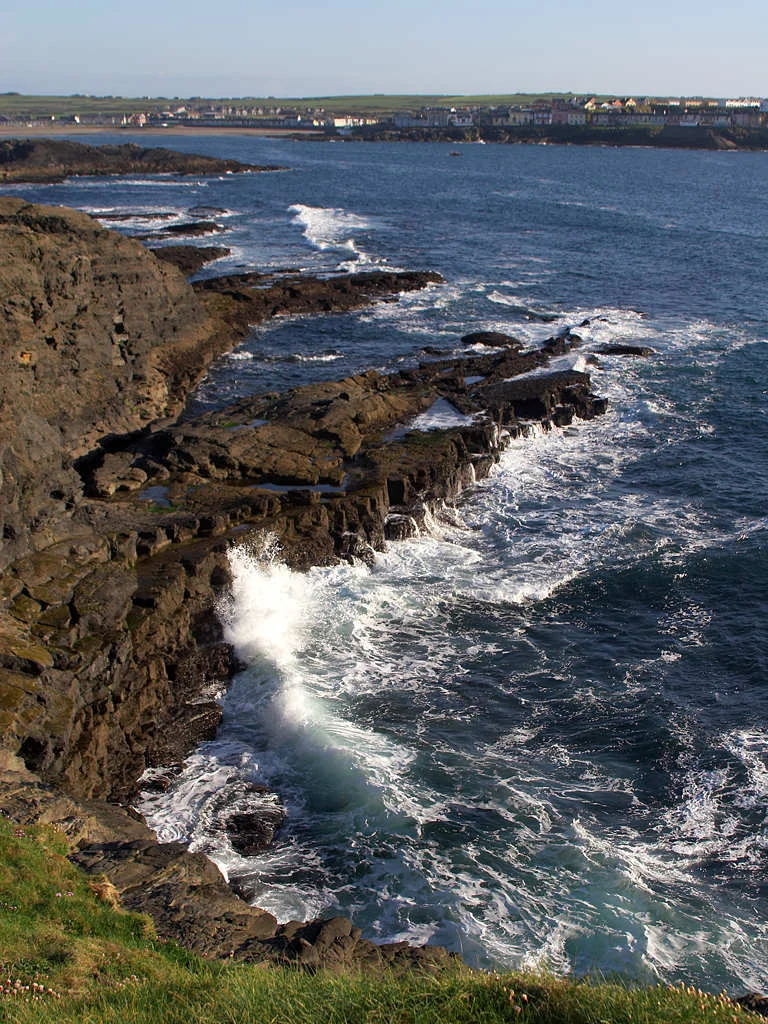

Kilkee
Charlotte Bronte came to Kilkee on her honeymoon in 1854 and walked the cliffs. Tennyson came too. So did Henry Rider Haggard, the novelist who wrote King Solomon's Mines, and the actor Richard Harris - who, before he went to Hollywood, won the local racquetball tournament four years running from 1948 to 1951. In 2006, Russell Crowe unveiled a statue of Harris in the town. Kilkee, on the County Clare coast facing the Atlantic, is the kind of seaside resort that has been a seaside resort long enough to have layers - a horseshoe bay protected by a reef, Victorian terraces along the strand, three churches built in three different decades, and an annual diving competition that lets people fling themselves 13 metres into the open sea.
Bronte's Honeymoon
In the early 19th century, Kilkee was a fishing village. Then in the 1820s, paddle steamers started running from Limerick to Kilrush, and the connecting carriage road brought visitors the last few miles to Kilkee. Catty Fitzgerald opened the first hotel - a single woman running an inn was unusual enough to be remembered by name - and it survived for forty years. By the 1830s, two more hotels had opened. A Catholic church was built in 1831, a Protestant church in 1843, a Methodist church in 1900. The resort was attracting the Anglo-Irish gentry and, increasingly, British tourists. Charlotte Bronte arrived in July 1854 with her new husband Arthur Bell Nicholls, the Irish curate she had finally agreed to marry after years of refusing him. She spent part of her honeymoon walking the Atlantic cliffs at Kilkee, where she could be alone with the surf and the wind and her newly married self. She died nine months later in childbirth. The cliffs are still there. They look much as Bronte saw them.
The Three Wrecks
The same Atlantic that drew tourists also killed ships. Three shipwrecks define Kilkee's maritime memory. On 30 January 1836, the Intrinsic, sailing from Liverpool to New Orleans, was blown into a small bay near Bishops Island and broken against the cliffs; all fourteen crew drowned. The bay is now called Intrinsic Bay. On 19 November 1850, the Edmond - a chartered passenger ship carrying emigrants from Limerick to New York - was driven into Kilkee Bay by a storm and split in two at Edmond Point. Of 216 people aboard, 98 drowned. Most were Famine-era Irish emigrants. Exactly fifty years to the day after the Intrinsic sank, on 30 January 1886, the cargo ship Fulmar went down north of Kilkee in Farrihy Bay; of seventeen crew, only one body was recovered. Between 28 and 29 December 1894, the Inishtrahull simply disappeared somewhere near the Kilkee coast with all hands - a fragment of her hull was found ninety years later, in 1985, when a piece of her port bow with a Glasgow brass plate washed ashore.
The Railway and the Song
The West Clare Railway opened in 1887 and ran trains from Ennis to Kilkee, transforming Kilkee from a difficult day-trip into a weekend destination. The 1890s saw a building boom and a steady stream of dignitaries: Sir Aubrey de Vere the poet, Rider Haggard, Tennyson, the Crown Princess of Austria in 1896. The railway also gave Ireland one of its best comic songs. The entertainer Percy French was supposed to be performing in Kilkee in August 1896, but the West Clare Railway broke down and he arrived hours late to a half-empty hall. He sued the railway for damages and won. He also wrote the song 'Are Ye Right There Michael' mocking the line for its unreliability, which became so popular it forced the West Clare Railway into long correspondence trying to suppress it. The line eventually closed in 1961. By then, every Irish family had a copy of the song.
The Pollock Holes
At low tide, three natural rock pools open up on the Duggerna Reef on the west side of Kilkee Bay - the Pollock Holes. They are deep enough to swim in, big enough that several people can share each one, and fully replenished by every incoming tide with fresh Atlantic water and marine life. The largest is sometimes called the Men's Pollock Hole, the next the Women's, and the third the Children's - a Victorian-era convention that has long since dissolved into 'whoever gets there first'. Just beyond the holes, diving boards at a spot called New Found Out let competent swimmers leap 13 metres into the open sea. The annual diving competition is held there every August, with bombers, swans, and pencil dives judged by people who have watched generations of locals make the same plunge. The Bay Swim, held every summer, sends nearly 200 swimmers across roughly a mile of open water from Byrnes Cove to the western shore.
Hell of the West, and a Racquet
The last weekend in June brings the Hell of the West Triathlon - 1,500 metres of swimming, 45 km of cycling, and a 10 km road race - the longest-running triathlon in Ireland. Upwards of 600 athletes compete. In September, when the summer crowds have gone, the Strand Races bring horses onto the beach, with poles staked into the sand to mark a course when the tide is out. The races started in the 19th century as a celebration when the harvest was in. And in the West End, against the high sandstone walls of the buildings, generations of locals have played a version of racquetball that may predate the international codification of the sport. The Tivoli Cup, first competed for in Kilkee in 1935, was running before the modern rules of racquetball were standardised in 1950. Richard Harris won it four years in a row from 1948 to 1951, a record no one has yet beaten.
Blue Flag, Blue Water
Kilkee's beach has held a Blue Flag from the European Commission for water quality and amenity standards for years on end. The town's population sits around 1,000 in winter and swells in summer with the holiday traffic that has been coming since Catty Fitzgerald opened her hotel. Cois Fharraige, a music and surfing festival, ran here from 2007 to 2009, drawing big crowds before fizzling out in the recession. The greyhound track opened in 1936 and closed by 1942. The paddle steamer service from Limerick ran from 1816 until 1918, killed off by the railway. Each layer of transport added something, then took something away. What remains is a horseshoe bay protected by the Duggerna Reef, a strand suitable for swimming, cliffs walked by Bronte and a hundred thousand others, and the kind of Atlantic light that turns a coastal Irish town into the version of itself it has been selling to visitors for two hundred years.
From the Air
Kilkee sits at 52.684°N, 9.65°W on the southwest coast of County Clare, facing the Atlantic, in a sheltered horseshoe bay protected by the Duggerna Reef. From the air look for the curved sweep of the beach, the long line of seafront terraces, and the cliffs running north and south. Shannon Airport (EINN) is 60 km east. The mouth of the Shannon Estuary lies 20 km southeast. The Cliffs of Moher are 35 km north. Loop Head, with its lighthouse, is 12 km southwest at the very end of the peninsula. Best viewing altitude is 2,500-4,500 feet for the dramatic interplay of Atlantic surf, cliff lines, and bay protected by reef.
Nearby Stories
- Abbeydorney 3.8 km away
- Dysert O'Dea Monastery 5.7 km away
- Burren and Cliffs of Moher Geopark 14 km away
- 1961 President Airlines Douglas DC-6 crash 14 km away
- Ballynavenooragh 19 km away
- Dromagh Castle 30 km away
- RMS Carinthia (1925) 46 km away
- Conor Pass 52 km away