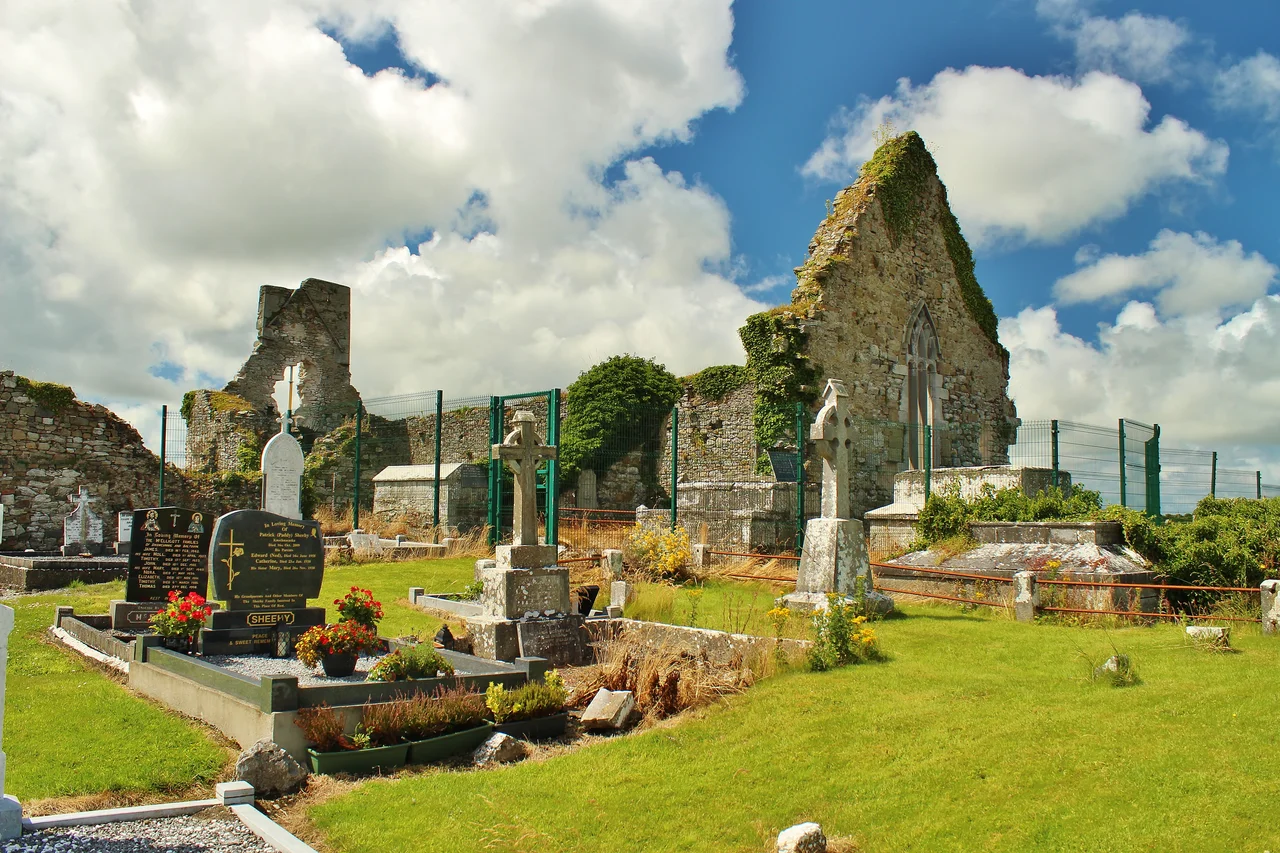

Abbeydorney
In Irish, the name is Mainistir Ó dTorna - the monastery of the Ó Torna people - though the monks who built it in 1154 preferred a Greek phrase: Kyrie Eleison, Lord have mercy. Eight centuries of Cistercian Mass-going dissolved under Henry VIII in 1537, and what's left of the abbey is now a pile of stones in a field north of a village of 418 people. The village kept the name. Abbeydorney sits 9 kilometres north of Tralee in the agricultural flat country of North Kerry, where Bronze Age ringforts still ripple the landscape and a hurling team founded in 1885 just won the county championship after a fifty-year wait.
The Cistercians and Their Mercy
The Cistercian order arrived in Ireland in 1142, brought by St. Malachy of Armagh after he saw the white-robed monks at Clairvaux in France. Within a generation, Cistercian houses were spreading across the island, including Abbeydorney Abbey in 1154. The Cistercians chose isolated, agriculturally promising sites - rivers for power, good soil for crops, distance from the world's distractions - and they were superb farmers. Their Kerry house, like most of the order's Irish foundations, would have raised sheep, cultivated grain, and supported lay brothers who handled the work while the choir monks sang the daily round of seven offices. The nickname Kyrie Eleison probably came from those liturgies. Henry VIII's dissolution in 1537 ended four hundred years of that life in an administrative stroke, redistributing the lands to favoured English settlers. The monks scattered. The abbey buildings, robbed of their roofs and lead, slumped into the fields they had once farmed.
Hayshed and Creamery
By the late 19th century, Abbeydorney was a village of farmers, shopkeepers, and the institutions of cooperative agriculture. The Abbeydorney Co-operative Dairy Society formed in 1895, part of the Plunkett movement that was transforming Irish dairying. A petty sessions courthouse held fortnightly meetings. A GAA club was founded in 1885 to play hurling - the cooperative dairy and the local hurling team became, in their way, the two civic poles of village life. Then came the War of Independence. On 12 October 1920, lorries of Royal Irish Constabulary men - the armed police force of the British administration - evacuated the village creamery, robbed it, and set it alight. The manager, Tim O'Donovan, was hit in the back of the head with a rifle butt for refusing to hand over the safe key. Six days later, in retaliation for IRA activity in the district, RIC constables came back and burned the houses of O'Donovan, the engine man Patrick Tuomey, the publican Peggy Joe Lovett, the carpenter Jeremiah O'Donovan, and several others. Mrs. Griffin, the music teacher, pleaded with the raiders to let her save her furniture.
Rebuilding with American Help
After the burnings, money for rebuilding came from an unexpected source: the American Committee for Relief in Ireland, distributed through the Irish White Cross. American sympathy for Ireland was intense in the early 1920s, particularly among Irish-American communities watching the news from Tipperary and Kerry. The fund paid to rebuild houses, replace tools, and get blacksmiths and carpenters back to work. One of the funded blacksmiths wrote in his claim: 'I am a Blacksmith and live by my trade only.' Amelia Wilmot, a member of Cumann na mBan and a spy for the IRA during the war, came from the village. After independence and the bitter Civil War that followed, Abbeydorney returned to its rhythms - cattle, butter, hurling. The RIC barracks, the local outpost of an empire that had once seemed permanent, was finally demolished in 1981.
The Crossroads Problem
The village is built around a junction where three roads meet: the R556 between Tralee and Ballyduff, the R557 east to Listowel, and the L2002 Bridge Road named for a railway bridge it once crossed. The railway came in 1880 and closed in stages between 1963 and 1978 - first passengers, then freight, then the line itself. The crossroads, meanwhile, has become a problem. Buildings on the corners block sightlines, and locals say there were three incidents in six weeks in late 2024. 'Someone will be killed,' one resident told a reporter. Kerry County Council announced plans in March 2025 for smart traffic lights, widened footpaths, and revised line markings. The intersection is the kind of slow-burning, low-grade civic issue that doesn't make national news but defines life in a small village - the kind of place where the crossroads have been a contingency point since the carts were horse-drawn.
Hurling on a Sunday
Abbeydorney GAA, founded in 1885, is among the oldest clubs in Kerry. In a county famous for Gaelic football - the only football that matters in Killarney - Abbeydorney plays hurling, the faster, fiercer game with its ash sticks and small leather ball. The club has won five county championships, the last in 2024, ending a fifty-year drought. They beat Ballyduff in that final, then won by a single point against Brickey Rangers from Waterford in the Munster Club Intermediate Hurling Championship before losing to Cashel King Cormacs of Tipperary. The Ladies Football team won back-to-back All-Irelands in 2004 and 2005, Junior and Intermediate. The camogie club, called Abbeykillix, draws from Abbeydorney, Kilflynn, and Lixnaw. In Abbeydorney, a sport played with curved sticks on a Sunday afternoon is also a way of remembering who you are.
From the Air
Abbeydorney sits at 52.35°N, 9.68°W in the flat agricultural country of North Kerry, 9 km north of Tralee. From the air look for the cluster of buildings at a three-way road junction in patchwork green farmland, with the distinctive curving R556/R557 roads meeting at the village centre. Kerry Airport (EIKY) is 19 km south at Farranfore; Shannon Airport (EINN) is 75 km north across the Shannon estuary. The nearby Atlantic coast lies 12 km west. Best viewing altitude is 3,000-5,000 feet for clear sight of the village and surrounding ringfort-dotted fields.
Nearby Stories
- Leacanabuaile 9.3 km away
- Ballynavenooragh 10 km away
- Muskerry West 11 km away
- Killarney National Park 11 km away
- Siege of Carrigafoyle Castle 12 km away
- Newcastle West 18 km away
- 1961 President Airlines Douglas DC-6 crash 19 km away
- RMS Carinthia (1925) 80 km away