_-_geograph.org.uk_-_3036462.jpg)
Dromagh Castle
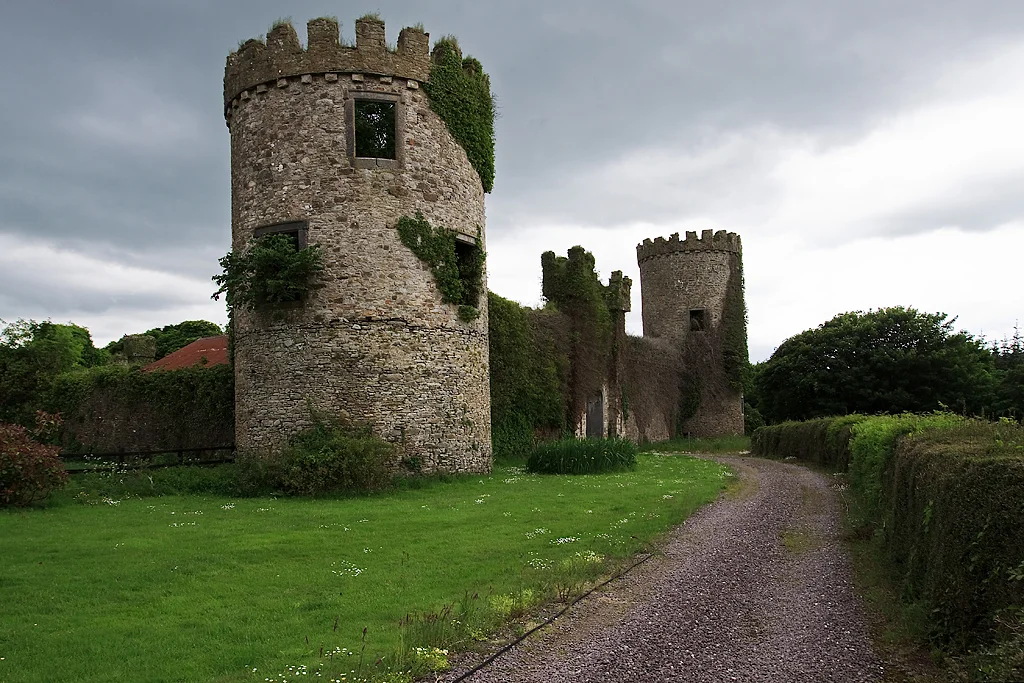
On the night of 16 March 1921, around a hundred men in disguises walked up to Dromagh Castle in north County Cork, doused the building in whatever accelerant they could carry, and set it alight. They had been told the British were about to garrison the Auxiliaries here - the most feared of the British paramilitary forces in Ireland, a unit so brutal it had alarmed even British politicians. The Millstreet Battalion of the IRA could not allow it. The fire took the building. What had been the seat of the Gaelic O'Keeffe clan since the late 16th century, then a country house of the Anglo-Irish Leader family for nearly a hundred years, became - in the course of one night - a ruin in a north Cork field where it has remained ever since.
Daughter of the Banshee Queen
The O'Keeffes traced their ancestry to Cliodhna, the Celtic goddess sometimes called Queen of the Banshees - a figure of west Munster folklore associated with the sea cliffs at Glandore in County Cork. Whether anyone seriously believed in this descent by the 17th century is unclear, but the claim said something about the clan's self-image: ancient, semi-divine, rooted to the place long before any Normans or English settlers arrived. The historical O'Keeffes were a branch of the Eoganacht Raithlind, one of the great medieval Munster dynasties. By the late 16th century, Art O Caoimh - Art O'Keeffe - had built a rectangular tower house with corner turrets at Dromagh, in the Duhallow region of north Cork. It was the kind of fortified residence typical of Irish lords at the time: not as grand as a Norman castle, but sturdy enough to hold off raiders and rival clans, and to declare the family's status.
Cromwell's Battle, Cromwell's Confiscations
On 26 July 1651, Parliamentary forces under Roger Boyle, Lord Broghill, fought Irish Confederate Catholics under Donough MacCarthy, Viscount Muskerry, at the Battle of Knocknaclashy between Dromagh and Kanturk. The Catholic Confederate army was destroyed. Knocknaclashy was a decisive Parliamentarian victory that helped seal the Cromwellian conquest of Munster. The O'Keeffes had been on the losing side - they were Catholic, Gaelic, and politically aligned with the doomed Confederation - and Dromagh Castle, along with their lands, was confiscated. The family went into exile. After the Restoration of Charles II in 1660 brought a partial reversal of the Cromwellian settlement, the O'Keeffes got Dromagh back. They held it through the rest of the 17th century. Then 1688 came - the Glorious Revolution in England, the Jacobite War in Ireland. The O'Keeffes again backed the losing side, this time King James II. In 1703, Daniel O'Keeffe was attainted - declared a traitor - and the castle and approximately 5,000 surrounding acres were confiscated and sold to the Hollow Sword Blade Company, a London financial speculator that had bought up forfeited Irish estates wholesale.
If God Should Be Pleased
Daniel O'Keeffe's will, signed on 10 March 1699 with Conor O'Callaghan as witness, captures the tension of the moment. The document names his wife Joan Everard, his brother Donagh, and various other relatives. It also includes a hopeful, almost prayerful, provision: 'In case God should be pleased to restore my heir to the full estate of his father.' God was not pleased. The estate was not restored. Four years after the will was written, in 1703, the confiscation was complete. Out of this period comes one of the most persistent local legends: that the O'Keeffes hid a treasure of family valuables somewhere inside the castle before fleeing, intending to retrieve it when they returned. Multiple searches over the centuries have turned up nothing. The treasure, like the heir who never inherited, remains buried in the imagination of Duhallow.
The Pasteboard Castle
By the mid-19th century, Dromagh belonged to the Leader family, prosperous Cork Protestants who had bought up large tracts of north Cork. Nicholas Philpot Leader, who owned the castle from 1839 to 1852, was an MP, a justice of the peace, and a member of the Royal Irish Academy. He was also a businessman: the area around Dromagh contained coal and culm (a low-grade coal used for lime burning and household fuel), and Leader extracted both in considerable quantity. He also rebuilt the castle as a country house in the 'Big House' tradition of the Anglo-Irish gentry. The interior courtyard was fitted out with offices. The circular corner towers were extended upward with living accommodation. Battlements were added to the outer walls, but with thinner masonry and larger windows - decoration, not defence. A 21st-century blog called Dromagh 'a pasteboard castle' - convincingly stage-y but not actually fortified. The conversion turned a working Gaelic stronghold into a Victorian country gentleman's residence, with the picturesque suggestion of antiquity used to flatter the family's social standing.
One Hundred Men in Disguises
Across Ireland during the War of Independence, country houses became targets. They were used by Crown forces as billets and barracks; they were also symbols of the Anglo-Irish landlord class that had dominated rural Ireland for centuries. By 1921, the Auxiliary Division of the RIC - a force of former British military officers organised into mobile paramilitary companies - was based across the country, with a reputation for brutality. When the Millstreet Battalion of the IRA discovered that Dromagh Castle was being prepared as an Auxiliary base, they decided to deny the building to its intended occupants. The Freeman's Journal reported afterwards that 'about 100 men, wearing disguises, set the Castle on fire and also the farm buildings.' The fire destroyed almost the entire structure. Only parts of the medieval walls and the corner towers survived. Some of the lower outbuildings remained in use for a while, but the castle itself was never restored. The last Leader owner died without heirs in 1931, and the surrounding lands were transferred to the Irish Land Commission in the 1930s for redistribution to small farmers.
Tunnels and Inscriptions
Today the ruins stand on private farmland near the village of Dromagh, accessible from the N72 road via two paths less than a kilometre apart. The arched gateway still stands, partly covered in ivy. The corner towers have lost their floors and roofs. Vegetation has crept up the walls. The site is registered on the National Inventory of Architectural Heritage but has not been actively preserved. The folklore continues. Some Duhallow residents claim knowledge of an underground tunnel that led from the castle to a nearby farm, supposedly used by defenders to escape during the 17th-century wars - no archaeologist has ever found it. A mysterious inscribed stone bearing four partially legible Irish letters - L, F, G, T - was supposedly once set in one of the corner towers; both the stone and the meaning of the letters have been lost. Eoganacht to O'Keeffe to Cromwell to Leader to IRA to silence. Most of the layers of Irish history that can be told about a single place are present in Dromagh Castle, and most of them are visible if you know what to look for.
From the Air
Dromagh Castle sits at approximately 52.13°N, 8.97°W in north County Cork, near the village of Dromagh on the N72 road. From the air, look for the rectangular footprint of the ruin, with corner towers, set within farmland between Kanturk (5 km east) and Millstreet (10 km west). Cork Airport (EICK) is 55 km southeast. Kerry Airport (EIKY) is 60 km west. The Boggeragh Mountains rise to the south; the Mullaghareirk Mountains to the northwest. Best viewing altitude is 2,500-3,500 feet to take in the ruin and the surrounding Duhallow countryside, which retains the small-field pattern of pre-Famine north Cork.
Nearby Stories
- Aghadoe Cathedral 6.3 km away
- Ringaskiddy 8.7 km away
- Newcastle West 9.7 km away
- Carrignacurra Castle 9.7 km away
- Fermoy 11 km away
- Uragh Stone Circle 15 km away
- Siege of Carrigafoyle Castle 21 km away
- Tipperary (town) 21 km away