
Ringaskiddy
If you took every Viagra pill manufactured for the global market in any given year and traced them backward through the supply chain, almost all of them would lead to a single sprawling Pfizer plant on the western shore of Cork Harbour. Ringaskiddy is the village next to that plant. It is also home to several other pharmaceutical multinationals - Centocor, GlaxoSmithKline, Hovione, Novartis, Recordati - and to the only port in Ireland where Tesla, BMW and Toyota land their new cars from Europe. A century ago it was a fishing village of stone cottages. Today more than 3,800 people work in chemistry plants here, and ferries leave twice a week for Roscoff in France. The transformation is one of the cleanest case studies of small-town industrial reinvention in modern Ireland.
A Castle and a Tower
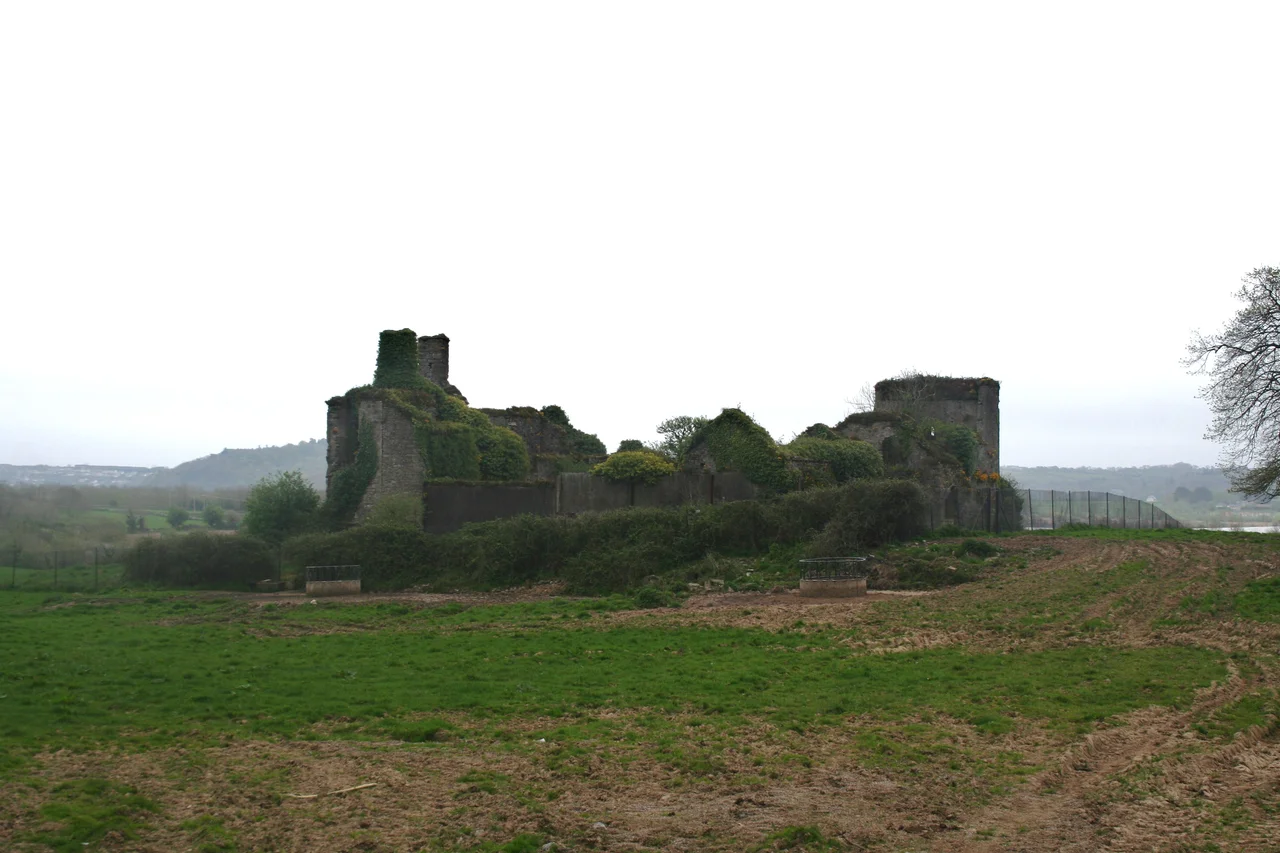
The old village still holds traces of the centuries before the chemists arrived. Barnahely Castle - later known as Warren's Castle - sits in ruins near Ringaskiddy. The site was originally an Anglo-Norman fortification; a new castle was built here in the 15th or 16th century. In 1796 the Warren family bought the land and built a mansion house incorporating the remains of the earlier castle. The mansion is gone, but the rectangular bawn - the walled defensive enclosure that surrounded the medieval keep - still survives in ruined form. A short walk uphill takes you to the Ringaskiddy Martello tower, one of several around Cork Harbour built during the Napoleonic Wars to anchor coastal defence. The tower stands on a high point off the Loughbeg road and offers an enormous view across the harbour to Haulbowline, Spike Island and Cobh. Below the village, two beaches face the harbour - sandy Lough Beach (known locally as Luc Beach) with shallow water for families, and rocky Gobby Beach with direct views over Spike.
From Fish to Pharma
Through the 19th and early 20th centuries, Ringaskiddy was a fishing village, supplying Cork city 15 km up the harbour with whatever the boats brought in. The transformation began after Ireland's 1958 economic shift toward foreign direct investment - cheap land, low corporate tax, English-speaking workforce, EU market access. Pharmaceutical companies discovered Cork Harbour in the 1960s and 1970s. The combination of deep-water port access, isolation from population centres for safety, and proximity to a large university (UCC in Cork city) made Ringaskiddy ideal. By the 1990s Pfizer was manufacturing the precursors and finished forms of sildenafil citrate - the drug marketed as Viagra after its 1998 approval - in scale here. The Irish Independent reported in 2013 that most of the world's supply of Viagra came from this peninsula. Drug-tourism jokes followed, none of them new to the locals.
The Port and the Pier
Ringaskiddy is also a working port. The Port of Cork operates passenger and freight facilities here - the Brittany Ferries service to Roscoff in France runs two sailings a week, and 34,000 trade vehicles were imported through Cork in 2017, most of them across this quayside. A second ferry to Swansea in Wales operated until 2012, when the Fastnet Line collapsed and the route closed with the loss of 78 jobs. A motorway project to upgrade the N28 road from Cork city to the village was finally approved by Ireland's Supreme Court in March 2021 after years of legal challenges - the village wanted the bypass, the affected farmers and homeowners did not.
The Incinerator Fight
For more than a decade Ringaskiddy was the centre of one of Ireland's longest planning disputes. In 2011 An Bord Pleanala - the national planning appeals body - rejected an application by Indaver Ireland to build a domestic waste incinerator near the village. The company tried again. In 2018 it was granted planning permission. Local residents and environmental groups challenged the decision. As of 2021 the High Court was still considering whether the entire planning process needed to be restarted. The fight was, in shape, identical to incinerator and landfill fights in any heavily industrialised peninsula anywhere in the world: yes, the wider region needs waste processing somewhere; no, that somewhere should not be next to the village's primary school, community centre, two beaches, naval base and pharmaceutical plants. The legal proceedings continued.
The Marine Campus
Just east of the village sits the National Maritime College of Ireland - the State's only dedicated maritime college, founded in 2004 on former Department of Defence land next to the Haulbowline naval base. The campus also hosts the Beaufort Maritime and Energy Research Laboratory, run by University College Cork, which describes itself as the largest maritime and energy research centre in the world. Inside Beaufort is Lir - the National Ocean Test Facility - a series of artificial wave basins used to test scaled models of ships, offshore wind turbines and tidal energy devices. The European Space Agency runs a business incubator on the same site. The Irish Naval Service base on Haulbowline is just 3 kilometres along the L2545 local road. Within a small radius of this once-quiet village: a global pharmaceutical hub, the headquarters of the Irish Navy, the country's maritime training college, a wave-energy research centre, and a Norman castle ruin. Most of those things did not exist a lifetime ago.
From the Air
Ringaskiddy sits at 51.833 degrees N, 8.317 degrees W on the western shore of Cork Harbour, 15 km southeast of Cork city. From the air, the village is dwarfed by the surrounding industrial estates - large white pharmaceutical buildings spread along the peninsula, with Pfizer, Novartis and GSK plants visible. The port and ferry terminal sit on the south shore, with the Haulbowline naval base island and Spike Island just 1 to 2 km east. Cork Airport (EICK) is 11 km northwest. The N28 road runs north to Cork city. Best viewed from 2,000 to 5,000 feet on a Cork Harbour approach.
Nearby Stories
- Walter Siepmann 6.3 km away
- Gaeltacht na nDéise 11 km away
- Fermoy 12 km away
- Canovee 14 km away
- Rathcoole Ambush 16 km away
- SS Folia (1907) 20 km away
- Cloghan Castle, Lough Hyne 35 km away
- SM U-27 91 km away