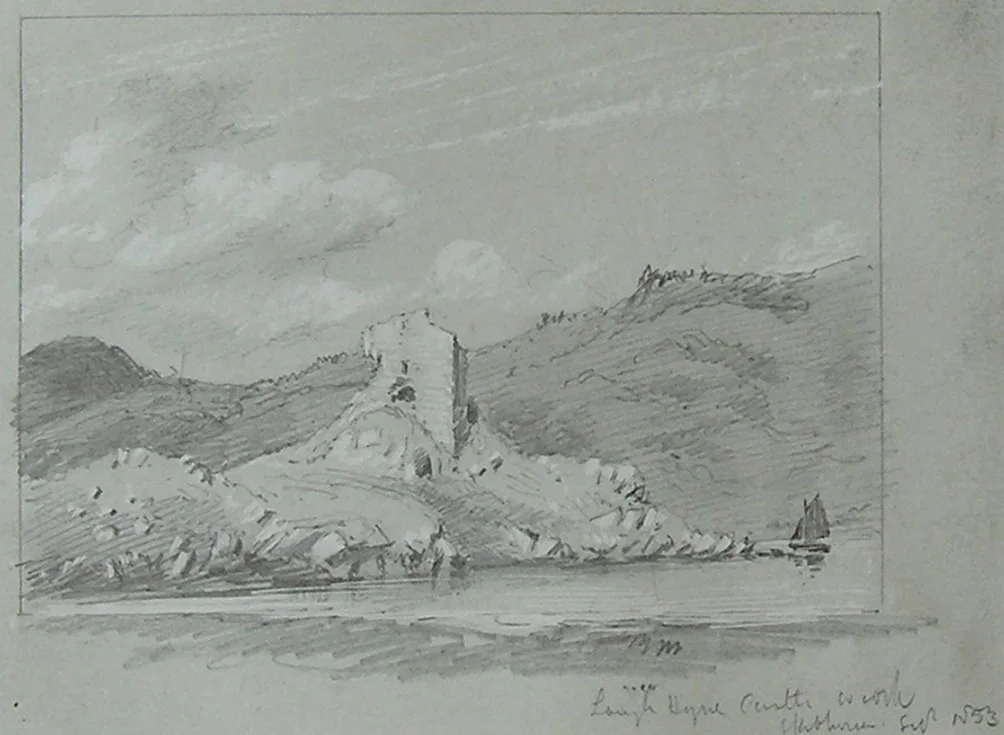

Cloghan Castle, Lough Hyne
Folklore in West Cork is rarely tidy. The story Cloghan Castle is best known for is this: that the tower, after standing on its little wooded island in Lough Hyne for two centuries or so, was brought down in the middle of the nineteenth century by the barking of a black dog that haunted it. The more prosaic version, which historians prefer, is that the mortar was bad. Both stories are probably true. The castle was built fast and cheap from soft local sandstone bonded with a poor-strength mortar lavishly applied. By the 1850s, when the antiquarian George Du Noyer turned up with a sketchbook, the tower was already a ruin, and W. B. Yeats, who passed through in the summer of 1919, found it a ruin still. It is a ruin now -- a south-western corner of the tower and a north-eastern corner of the enclosure, covered in ivy, lying low on Castle Island in a lough that almost no one has reason to visit.
An Unusually Deep Lough
Lough Hyne is not really a lake. It is a sea lough, connected to the Atlantic by a narrow tidal rapids that fills and empties twice a day, and the lough is deep -- up to 44 metres in places, surrounded by hills rising to 200 metres. The combination makes the basin curiously sheltered from both wind and wave while being directly connected to the open sea. Castle Island sits in the middle of it, low and wooded, reachable only by boat. The O'Driscolls put their tower house on the south-east side of the island on a slight mound, where it could be seen from the shore but not easily approached. The Irish name of the castle, An Clochán, means stony place; the village of Baile an Oileain on the lough's eastern shore took its name from the sept land that supported it. This is the kind of position medieval Irish chieftains favoured -- secure, defensible, but visible. The point of a tower was partly to be seen.
Mortar Like a Memory
What survives of the tower is enough to read it. It was a square-sided four-storey house with a small enclosure attached to its eastern side, built of rough-hewn blocks of the local Old Red Sandstone. The blocks were small enough to be lifted by hand. The mortar holding them together was poor and used in excess -- the mason's instinct when the binder is weak. A single loophole survives in the western wall of the ground floor, with a stone slopstone for washing positioned directly beneath it. The first floor was carried on eight timber joists whose sockets remain in the stonework. The second floor, probably the principal chamber, was supported on a barrel vault. The enclosure to the east, built of smaller and more carefully fitted stone, may have been the better accommodation. The castle has never been excavated. There may be more underneath the ivy than anyone has looked for.
Sir Fineen's Last House
The O'Driscolls were one of the richest Irish clans of the medieval period, controlling the waters off this corner of Cork and the lucrative pilchard fisheries that swam through them. By 1629 Cloghan Castle had become the seat of their family chief, Sir Fineen O'Driscoll, who had moved here after leasing Baltimore Castle to the English Puritan settlers under Sir Thomas Crooke. Sir Fineen had been chief since 1573 -- a long career across a century in which the Gaelic order in Ireland was being systematically dismantled. He died at Cloghan shortly after moving in. The castle disappears from the historical record almost immediately. With the chief dead and the clan broken, the tower had no role left to play. It sat empty through the 17th and 18th centuries and into the 19th, when the mortar finally gave up and the upper storeys came down, with or without the help of a ghost dog.
Donkey-Eared Kings and Black Dogs
Folklore around Cloghan is rich for a building that no one important lived in for very long. The black dog (in the wider Irish tradition, the Cù-sìth, a fairy hound of the otherworld) is one. Another, more obscure story claims the castle was once the home of a legendary king with the ears of a donkey -- a motif found in folktales across Europe, attached locally to whichever ruin needed a story. Cloghan Castle is probably the building referred to in the 17th-century English propaganda work Pacata Hibernia as a hotbed of rebellion during the reign of Elizabeth I, rather than the other Cloghan Castle at Lissangle, which belonged to the Coppingers who were loyal to the crown. Today the ruins lie abandoned, covered in ivy, undisturbed. The lough around them is Ireland's first marine nature reserve, established in 1981. Nothing much happens here. That is the point.
From the Air
Cloghan Castle sits on Castle Island in Lough Hyne at approximately 51.50N, 9.30W in southwest County Cork, about 5 km northeast of Baltimore. Cork Airport (EICK) is approximately 85 km east-northeast; Kerry Airport (EIKY) is around 95 km northwest. From the air, look for the small dark sea lough set inland from the coast, surrounded by green hills rising to 200 metres -- the ruined tower is a tiny grey-and-ivy mark on the island near the lough's southern shore. Best viewed at lower altitudes in clear conditions. Roaringwater Bay opens to the southwest; the open Atlantic and Fastnet Rock lie south and west.
Nearby Stories
- Bear (barony) 2.5 km away
- Castle Donovan 2.7 km away
- Bandon, County Cork 8.1 km away
- HMHS Llandovery Castle 14 km away
- The Sinking of the Lusitania: The Torpedo That Changed the War 17 km away
- Wolfpack Prien 61 km away
- SM U-27 111 km away
- 1356 Lisbon Earthquake 1629 km away