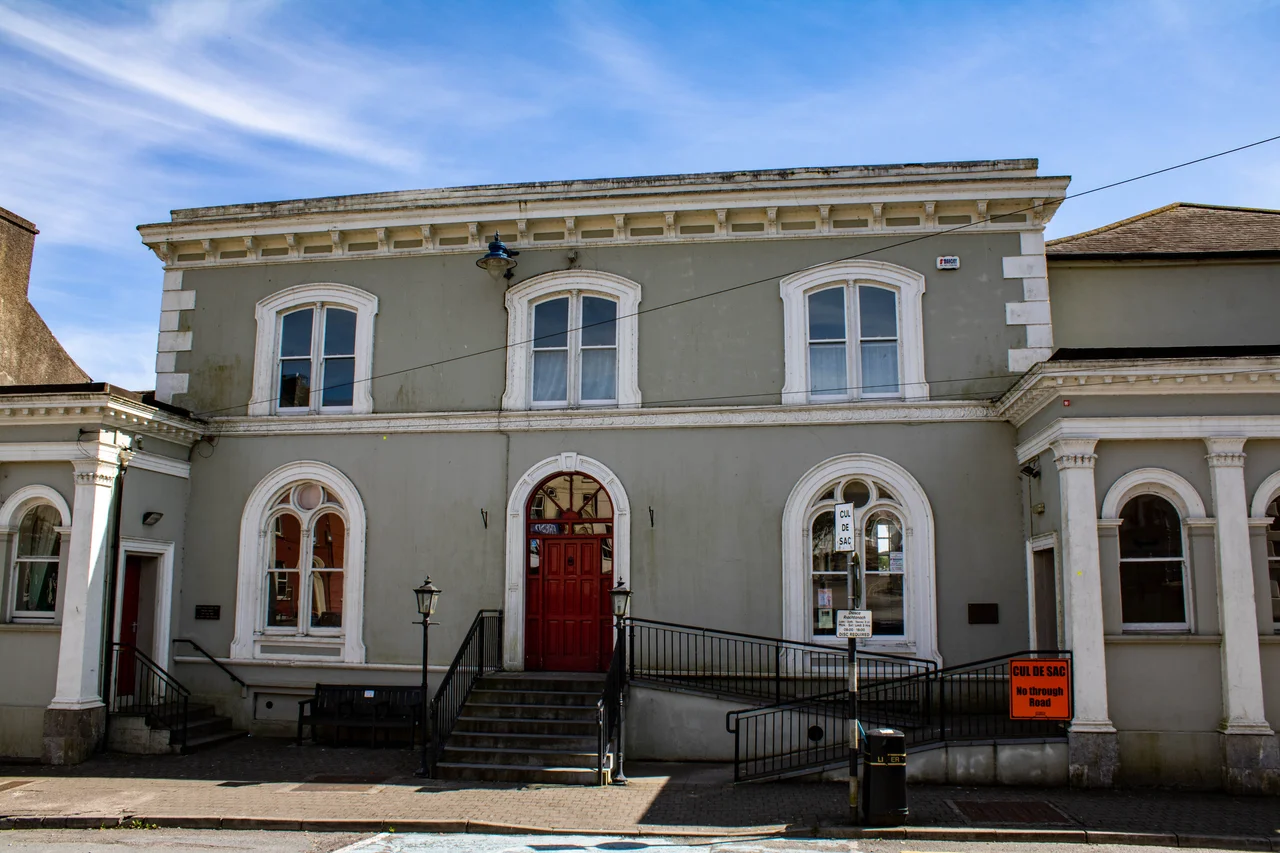

Bandon, County Cork
On the gates of Bandon, when it was a walled Protestant settlement in the early 17th century, somebody carved a warning: Entrance to Jew, Turk or Atheist; any man except a Papist. Below the inscription, somebody else scrawled an answer: The man who wrote this wrote it well, for the same thing is writ on the gates of hell. Both inscriptions are gone. The wall is gone. But the dialogue between the two of them is what Bandon has been about for four hundred years. It is a planted town built deliberately as a Protestant settlement on the River Bandon, and the long argument over what that means, who belonged here and who did not, has shaped almost every chapter of its history.
Bridge on the River Bandon
The Irish name means bridge of the Bandon, a reference to the river crossing that gave the town its first reason to exist. Bandon was incorporated as a municipal borough by a charter of James I in 1614. Buildings sprang up on both sides of the river and a series of bridges linked them. Like other Cork towns, Bandon benefited greatly from the patronage of Richard Boyle, the first Earl of Cork, although he was not, as he liked to claim, its founder. The town celebrated its 400th birthday in 2004. Christ Church, Kilbrogan, is the oldest church in Bandon and also the oldest purpose-built post-Reformation Protestant church in Ireland. In 1689, during the War of the Two Kings, Protestant inhabitants expelled the local Jacobite garrison, only to be retaken by a larger force under Justin McCarthy, Viscount Mountcashel. The town survived. The walls did not.
Whiskey, Weaving, Industry
In the 19th century Bandon became one of the leading industrial centres of West Cork. Allman's Distillery at its peak produced more than 600,000 gallons of whiskey a year. Brewing, tanning, corn and cotton milling all flourished. The Industrial Revolution and the railways brought enormous social and economic change. Local weaving operations could not compete with mass-produced cheap imports from England; the cottage industry that had supported many families collapsed. St Peter's Church was built in 1847, in the years following the Great Famine. The town hall went up in 1862. Sir John Moore, who later led the British Army and died at the Battle of Corunna in 1809, was governor of Bandon in 1798, during the United Irishmen rebellion. The man who created modern infantry training methods spent a year as governor of a small Irish town.
Percival and the Surrender of Singapore
Major General Arthur Ernest Percival commanded the British garrison in Bandon in 1920 and 1921, during the Irish War of Independence. The connection feels almost too neat: Percival would go on to become the British commander in Malaya in 1942, where he surrendered Singapore to the Japanese in what Winston Churchill called the worst disaster in British military history. After the war, in 1945, Douglas MacArthur invited Percival to witness the Japanese surrender in Tokyo Bay, the formal end of the Second World War. The man who once tried to suppress the IRA in West Cork stood on the deck of USS Missouri and watched the Japanese officers sign the instrument of surrender. Closer to home, Michael Collins was killed in an ambush at Beal na Blath, about 13 km outside Bandon, on 22 August 1922.
The 1922 Killings
Between 1911 and 1926, the non-Catholic population of Bandon fell from 688 (22 percent of the total) to 375 (13 percent), a drop of 45.5 percent. Some of that fall was emigration, marriage, ordinary demographic change. Some was not. In April 1922, in the brief gap between the truce and the start of the Civil War, ten Protestant men were shot over three nights, 27 to 29 April, in what became known as the Dunmanway killings or the Bandon Valley massacre. The historian Peter Hart argued in 1998 that they were killed because they were Protestant. Other historians, Niall Meehan and Brian Murphy, have argued that British intelligence records identify Protestant farmers in the Bandon area who gave information to the British, and that the killings were responses to informers rather than purely sectarian. The debate goes on. Either reading leaves families bereaved and a community fractured. The men were shopkeepers, farmers, neighbours. They had names. They are buried in West Cork.
Graham Norton, Gorse, and the Flood
Bandon today is a town of around 8,000 people, the Gateway to West Cork, sitting 27 km southwest of Cork city on the N71. Its twin city across the Atlantic, Bandon, Oregon, was founded in 1873 by Lord George Bennett, a Bandon native who named the American town after his home and is also remembered as the man who introduced gorse to the Oregon coast, with disastrous ecological results. The BBC chat show host Graham Norton grew up in Bandon and attended Bandon Grammar School; his mother still lives in the town. The River Bandon has flooded repeatedly: November 2009, December 2015 during Storms Desmond and Frank. The Bandon Flood Relief Scheme finally completed in December 2022 after years of work, protecting more than 390 homes. The brewers, the weavers, the distillers and the chat show host all lived along the same river. The river keeps trying to come back inside.
From the Air
Located at 51.75 degrees N, 8.74 degrees W in West Cork on the River Bandon, 27 km southwest of Cork city. Cork Airport (EICK) lies about 25 km northeast. The town sits at a river crossing between two low hills, with the Bandon flowing east toward Kinsale harbour and the Celtic Sea. Best viewed at 2,000-4,000 feet on the Cork-Bantry axis (N71). From altitude the river meander through the town centre is the defining visual feature, with the town stretching along both banks. Castle Bernard, on its golf course estate, lies just southwest of the town; Beal na Blath, where Michael Collins was killed in 1922, is about 13 km north.
Nearby Stories
- Ballycotton 8.7 km away
- West Cork 8.8 km away
- Cloghan Castle, Lough Hyne 11 km away
- Mourne Abbey 12 km away
- The Sinking of the Lusitania: The Torpedo That Changed the War 12 km away
- Headford Ambush 14 km away
- Lismore Castle 16 km away
- SM U-27 101 km away