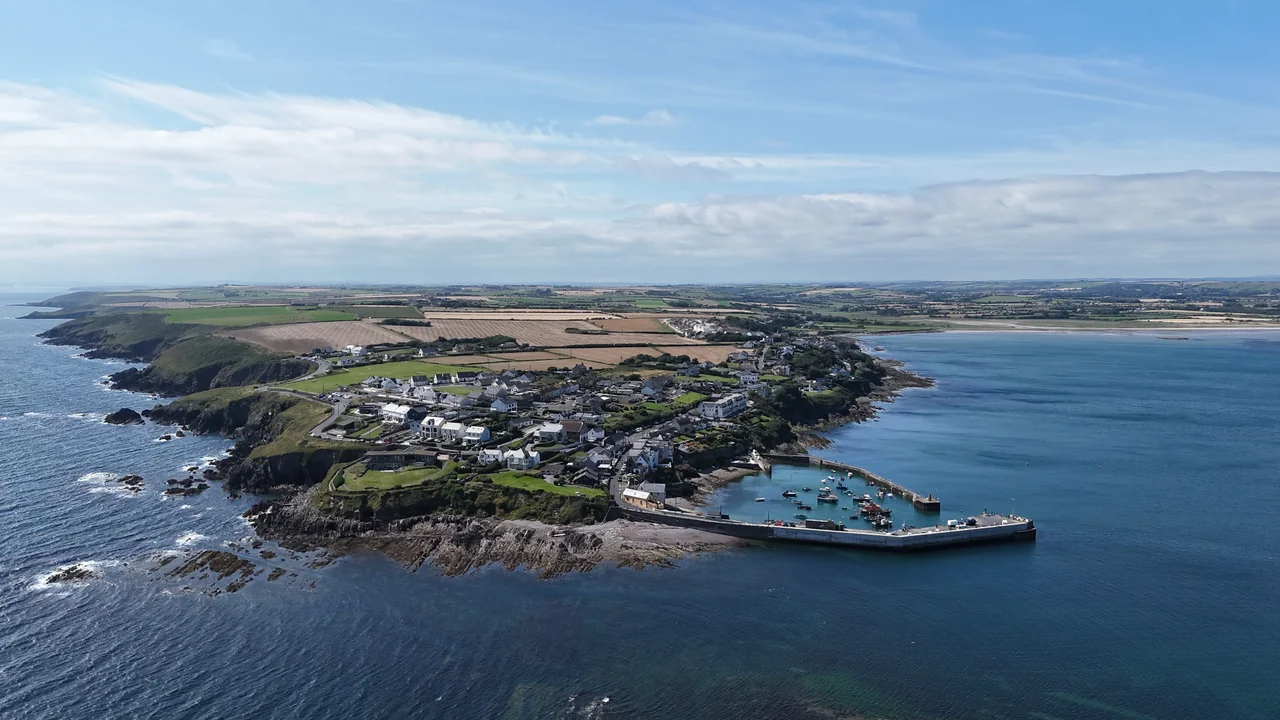

Ballycotton
Ballycotton is a village built twice. The first one, somewhere in the medieval period, sat closer to the sea than the current settlement does. It is now entirely underwater - claimed by the slow erosion that still takes metres of the East Cork cliffs every few years. The current village, the rebuilt one, sits forty kilometres east of Cork city on a rocky ledge above the bay, with a small working harbour, a black lighthouse on an offshore island, and a long sandy beach curving east toward Knockadoon Head. International coastal geologists come to Ballycotton to study erosion. International lifeboat historians come to study its rescue records. And in a glass case in the British Museum in London sits a small ninth-century Irish cross found in a bog near here, with an Arabic inscription on its central jewel that nobody has fully explained.
The Black Lighthouse
On Ballycotton Island, half a kilometre offshore, stands one of the few black-painted lighthouses in the world. It was commissioned in 1851 by the Commissioners of Irish Lights, designed by the prolific Dublin engineer George Halpin Senior, and painted black to distinguish it by day from the white unlit beacon on Capel Island six kilometres east. The lighthouse keeper and his family originally lived on the island year-round; the children rowed across to school in the village when weather allowed. By 1899 the four keepers had moved their families to mainland houses, rotating duty across the channel. The light was electrified in 1975, automated in 1991, and the keepers were withdrawn on 28 March 1992 - ending 141 years of human occupation of the island. The lighthouse is open to summer visitors via boat from the harbour, and from the lantern at the top of the tower the view sweeps from Cork Harbour to the Comeragh Mountains in clear weather.
The Daunt Rock Rescue
The Royal National Lifeboat Institution opened the Ballycotton station in 1858, though local fishermen had been winning bravery medals for sea rescues here since the 1820s. The station's defining moment came on 10 February 1936. A hurricane was blowing across the East Cork coast. The Daunt Rock lightship, anchored to mark a treacherous ledge offshore of Cork Harbour, broke from her moorings and began drifting toward the rocks. Coxswain Patrick Sliney and his crew - mostly relatives, mostly Slineys and Walshes - launched the Ballycotton lifeboat Mary Stanford into seas so high that spray was blowing over the top of the lighthouse, sixty metres above sea level. They were at sea for forty-nine hours over three days, made six separate attempts to come alongside the lightship, and took off her crew of eight one at a time. Patrick Sliney received an RNLI gold medal for the rescue - one of the rarest awards in lifeboat history. His crew received silver and bronze. The episode remains, more than ninety years later, one of the most decorated rescues in the institution's two-hundred-year existence.
The Ballycotton Cross
In 1875, an antiquarian named Philip T. Gardner donated a small object to the British Museum that he said had been found 'in or near Ballycottin Bog.' It was a ninth-century Irish Celtic cross of bronze and glass - the kind of small ceremonial cross used as a pectoral pendant or amulet - with a central glass jewel. On that jewel, etched in Kufic Arabic script, was the Islamic phrase Bismillah - In the name of Allah - or possibly As God wills. The cross is roughly contemporary with the period when Viking raiders carried trade goods back and forth between the Mediterranean and the North Atlantic. The glass jewel may have come from the Islamic world via Viking trade and been incorporated into a local Christian object without the maker fully understanding the script. Or it may indicate direct early contact between Ireland and the Islamic Mediterranean. Cited in academic papers on early medieval trade routes and in some excitable speculative websites, the cross remains the only known object of its kind. It sits today in the British Museum's brooch collection.
The Famous Film That Never Was
In the summer of 1995, a film crew arrived in Ballycotton. Marlon Brando, Johnny Depp and Debra Winger were the stars; the picture was called Divine Rapture; the producer had raised significant money to shoot what was supposed to be a quirky comedy set in a small Irish village. The cast and crew filmed for two weeks in the village. Brando, by then in his early seventies, lived in a rented house and ate dinner at the local pub. Then the production company ran out of money. Bank transfers from the financier did not arrive. Cheques bounced. After fourteen days of shooting the film simply stopped - actors, equipment and crew packed up and dispersed. Divine Rapture was never finished, never edited, never released. A handful of film stills and the memory of Marlon Brando ordering a pint in a Ballycotton bar are all that survive. The locals tell the story to anyone who asks, and a few who do not.
Cliffs, Cliffs, and More Cliffs
The cliffs around Ballycotton draw a different kind of visitor. A thirteen-kilometre cliff walk runs west from the village to Ballytrasna along the top of the sea wall, opening views over a coast that still loses metres of land to the Atlantic every storm. Seals haul out on the rocks below; dolphins are regular in the bay; whales are sometimes visible from the cliffs in December and January as migrating species pass on their way south. The nearby beach at Ballynamona is a designated wildlife sanctuary - herons, oystercatchers and shorebirds work the strand at low tide, peregrine falcons hunt over the rocky inlets at dawn. The annual Ballycotton Ten-Mile Road Race, run between 1977 and 2017, drew runners from across Ireland and the world to compete on a ten-mile loop of country backroads. The race ended after forty years, the organisers retiring on their own terms. The cliffs, the wildlife, the lighthouse and the lifeboat station remain. A village built twice still works at being a village.
From the Air
Located at 51.83 degrees N, 8.00 degrees W, on the south coast of County Cork, forty kilometers east of Cork city. Cork Airport (EICK) lies thirty-three kilometers west-northwest. Best viewing altitude 2,000 to 5,000 feet to see the village on its cliff ledge, the small harbour with the lifeboat moored, the black-painted lighthouse on Ballycotton Island half a kilometer offshore, the long sandy beach extending east toward Knockadoon Head. Capel Island lies further east with its white beacon visible in clear weather.
Nearby Stories
- Charles Fort 9 km away
- Lismore Castle 12 km away
- Bridgetown Priory 13 km away
- The Sinking of the Lusitania: The Torpedo That Changed the War 14 km away
- 1999 Tramore helicopter crash 23 km away
- Walter Siepmann 30 km away
- Hook Lighthouse 50 km away
- SM U-27 88 km away