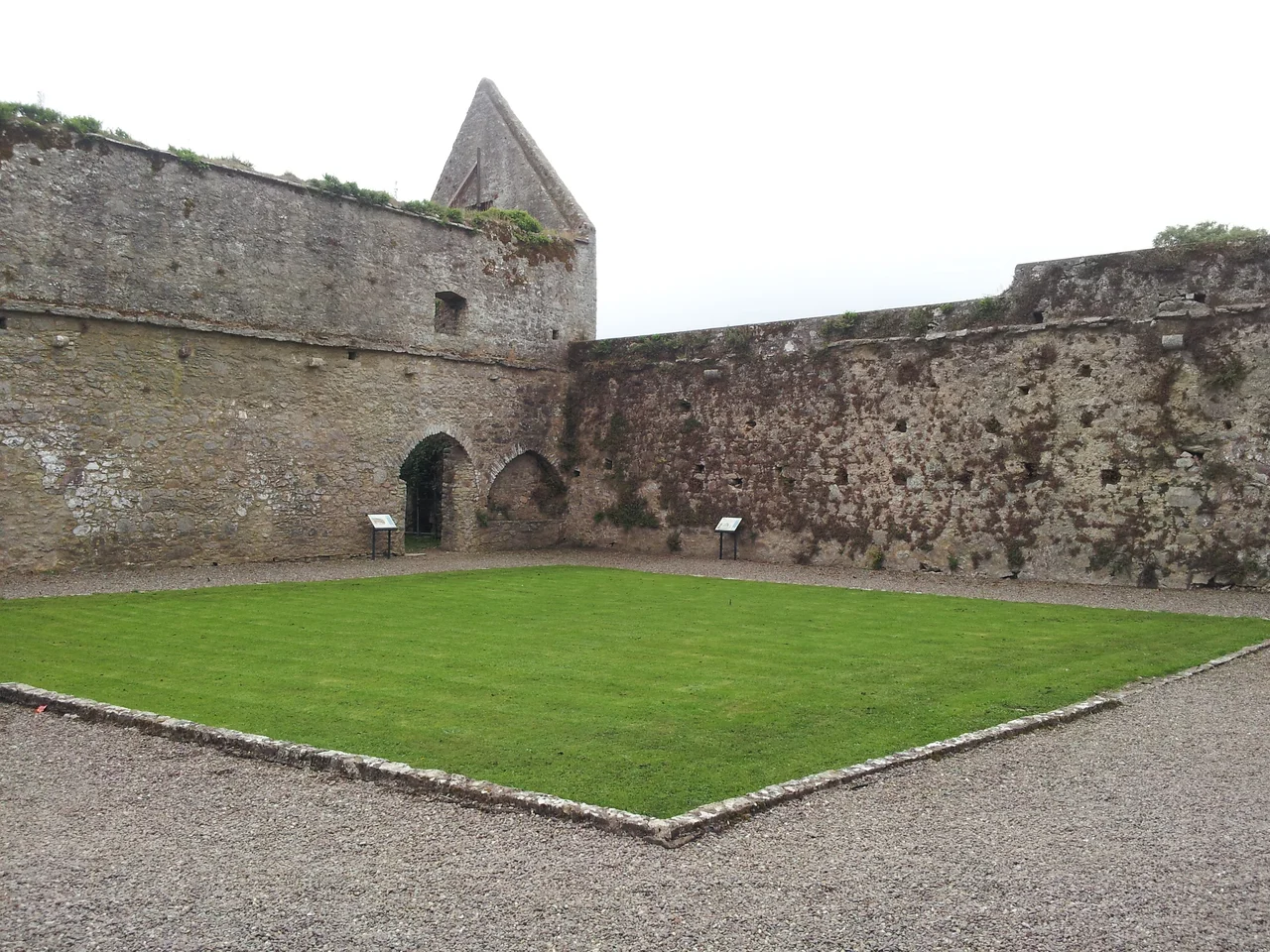

Bridgetown Priory
Saint Mary of the Bridge took her name from two timber bridges that no longer exist. Their foundation stones still poke out of the south bank of the River Awbeg in County Cork, where Bridgetown Priory once held land on both sides of the water. Founded by the Augustinians sometime after 1202, it became, in a Henrician survey three centuries later, the second-most valuable monastery in the diocese - richer than almost anywhere else its monks could have prayed. Then came Henry VIII's dissolution, the suppression of 1546, and a long slow falling apart that included a man called Edmund Spenser, Cromwell's army, a Protestant church built and then dismantled, and a destitute woman who took up residence in one of the burial tombs.
Founded on a Bridge
The grant came from Alexander fitz Hugh, the Cambro-Norman who had also built the early castle at Castletownroche. He gave land where the Awbeg meets the Munster Blackwater to the Augustinian Canons Regular of Saint Victor, and a colony of monks came down from Newtown Abbey in County Meath to take possession. The dedication was to Saint Mary of the Bridge, because of the timber crossings that linked the priory's holdings on both banks. Around 1219 the patronage passed by marriage to the Roches of Castletownroche - Synolda fitz Hugh's wedding to David de la Roche moved the whole barony, and the priory with it, into Roche hands. The Gothic claustral plan that took shape over the next century is unusual: H-shaped, missing its west range, with the southern range jutting eastward. Cork County Council calls it the county's finest 13th-century monastery built to a claustral plan.
Henry's Surveyors
By the time Henry VIII's commissioners arrived in the 1530s, Bridgetown was rich. The Henrician survey ranked it second only to the Cistercian priory at Abbeymahon in the diocese - and Abbeymahon was an old Cistercian house with vast lands. Bridgetown had a church with belfry, a dormitory, a hall, a buttery, a kitchen, a cloister, a cellar, and what the surveyors described as 'divers other chambers.' The dissolution moved through Ireland later and more chaotically than through England. Bridgetown was officially dissolved between 1540 and 1541, formally suppressed in 1546. The surveyors noted by then that the buildings were already in ruinous condition. What followed in the next half-century is a tangle of contradictory accounts - whether it was surrendered to Sir Henry Sidney, reclaimed by the Roches, seized by Robert Cecil, granted to Lodowick Bryskett the Lord President of Munster's secretary, or sold to Edmund Spenser in 1597 as a gift for his son. The truth is probably some combination, told from different angles.
Cromwell and the Cats
Oliver Cromwell's army knocked down the bridge that gave the abbey its name during the campaigns of the 1640s and 1650s. By the 18th century the priory itself was in pieces. The 19th century made it worse. The cloister, where the canons had once walked in silent procession, became a ball alley used by local boys for handball. In the 1830s, a destitute woman moved into one of the priory's burial tombs with two cats and lived there for at least two years, supported by charity from local residents. A Protestant church was built on the ruins in 1846, but the roof was removed almost immediately, and the church itself was eventually taken apart - its stones carted to nearby Ballyhooly to build Christ Church between 1800 and 1801. The dates here come from sources that do not quite agree, which is fitting for a place where every century seems to have left a different version of itself.
Reversing the Trend
In 1901, the parish priest, the Very Rev Michael Canon Higgins, complained publicly that the Church Temporalities' Commission, which then owned the ruins, was letting them collapse under ivy. It would take almost another century for that to change. Cork County Council took the priory into care in 1992. Restoration works followed in the 1970s, 1990s, and 2010. The archaeologist O'Keefe, writing in 1999, said the council's work had 'reversed the trend of neglect.' Excavations in 1998 uncovered buildings west of the church, probably late additions or post-abandonment structures, and confirmed that the original 13th and 15th-century floor surfaces had been destroyed long ago. Walls built largely of uncoursed limestone rubble, some with hollow cores, have stood up across eight centuries of Cork weather despite their reportedly poor construction. Sandstone and oolithic limestone, brought in for the sculptural work, still carry their carving. The two timber bridges are gone. The priory of Saint Mary of the Bridge remains.
From the Air
Bridgetown Priory lies at 52.15 degrees north, 8.45 degrees west, just outside Castletownroche in north County Cork, near where the River Awbeg flows into the Munster Blackwater. The nearest commercial airport is Cork International (EICK), about 35 km south; Shannon (EINN) lies roughly 110 km northwest, Kerry (EIKY) about 100 km west. Look for the broad valley of the Blackwater curving east toward Fermoy, with the smaller Awbeg joining from the north. The priory ruins sit on the river's edge, less than two kilometres downstream of Blackwater Castle on the same promontory system.
Nearby Stories
- Battle of Kilmallock 3.2 km away
- Crossbarry Ambush 6.3 km away
- Ballycotton 6.5 km away
- Bansha 7.4 km away
- Lismore Castle 11 km away
- Headford Ambush 16 km away
- West Cork 19 km away
- Listowel 25 km away