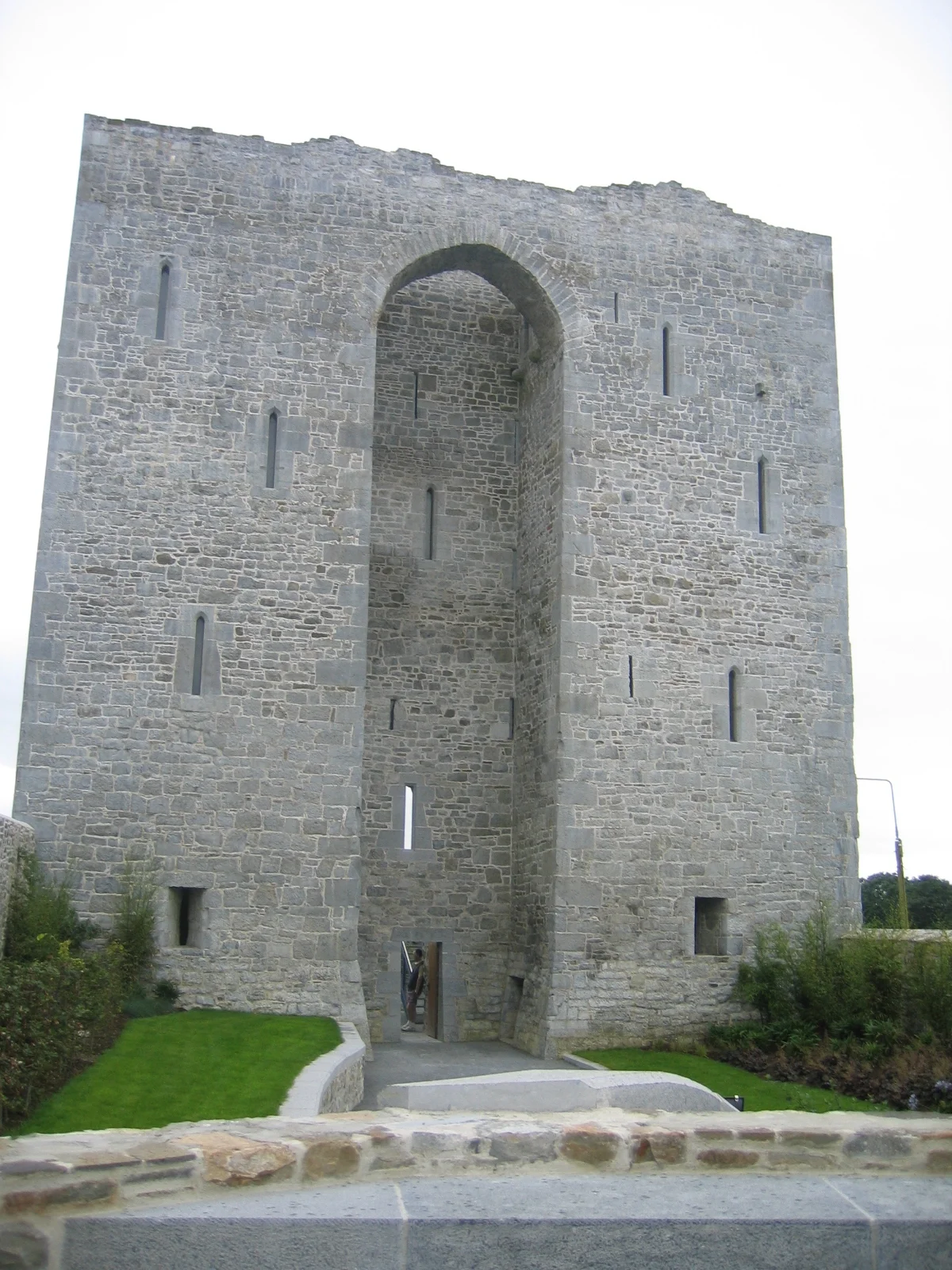

Listowel
From 1888 until 1924, a strange machine rattled the 14 kilometres between Listowel and the seaside resort of Ballybunion. It was a monorail - the world's first commercially operating monorail, in fact - designed by a French engineer named Charles Lartigue, who had reportedly been inspired by watching camels carry double-pannier loads across the Algerian desert. The Lartigue track was an A-frame trestle with a single rail along the top. The locomotives and carriages straddled it like saddle bags, half on either side. Passengers shouted across the central rail at one another. Cattle had to be balanced - one cow on one side, sandbags on the other, or two cows of equivalent weight. It worked for 36 years. Listowel, on the River Feale in north Kerry, is now mostly remembered for other things - its writers, its races, its annual Writers' Week - but the monorail still gets first billing.
Lios Tuathail
The name is Lios Tuathail in Irish - Tuathal's ringfort - and the ringfort is presumably buried somewhere beneath the Norman castle that the FitzMaurice family built here in the 13th century. Two of the four towers of Listowel Castle still stand, connected by an unusual arch over what was once the main passage between them. The castle was held by Geraldine rebels during the Desmond Rebellion of 1580 - the same rising that ended at Carrigafoyle further north along the Shannon. After the rebellion was crushed, Listowel passed into other hands and the castle slumped into picturesque decay. It now stands on The Square in the centre of town, open daily, looking like something a Romantic-era painter might have set up an easel in front of. Behind it runs the River Feale, which gives Listowel its location and, in flood, occasionally its excitement.
The Lartigue
Charles Lartigue's monorail solved a real engineering problem. A conventional railway needed flat, stable ground; the bog and soft soil between Listowel and Ballybunion would have required expensive embankments. A monorail on trestles could ride over uneven terrain, with the load distributed in balance on either side of the A-frame. The Listowel and Ballybunion Railway, as it was officially called, opened on 5 March 1888. It was the first commercial Lartigue-system monorail in the world. The locomotive had two boilers and two fireboxes - one on each side of the rail. Passengers boarded carriages by stepping up to seats positioned over each rail-side. The arrangement was novel enough to be photographed obsessively. It also had an awkward feature: anything carried had to be balanced. If a farmer brought a piano on one side, the railway had to find a piano-equivalent of weight to put on the other. The line carried passengers and Ballybunion-bound tourists for 36 years before closing in 1924, killed off by Civil War damage and competing buses. A short reconstructed section is now a museum near Listowel station.
John B. Keane's Town
Listowel is John B. Keane's town. The playwright, who died in 2002, kept a pub here on William Street and wrote some of the most performed Irish plays of the 20th century - Sive, The Field, Big Maggie, Sharon's Grave. The Field, about a Kerry farmer's obsessive attachment to a piece of leased land, became a 1990 film starring Richard Harris and was nominated for an Oscar. The Kerry Writers Museum next to the castle celebrates Keane along with Bryan MacMahon (short story master and teacher), Brendan Kennelly (poet and Trinity professor), Maurice Walsh (whose story 'The Quiet Man' became the John Ford film) and George Fitzmaurice (early 20th-century playwright). For a town of 4,794 people, Listowel produces an improbable density of writers. Listowel Writers' Week, held every June since 1971, draws contemporary authors from around the world and is one of Ireland's oldest literary festivals.
The Races and the Pubs
Listowel Races, held just south of town across the river, have been run since the 19th century. There are two main meetings: the Summer Festival on the May/June bank holiday weekend, and the Harvest Festival in late September. The Harvest Festival is the bigger event, with the Guinness Kerry National as the premier race. The Harvest Festival is also when Listowel's pubs do their best business of the year: Dillon's, the John B. Keane pub on William Street, Tankers, Christy's, Flanagan's, Kevin's, the Star & Garter, and the New Kingdom Bar. The town packs out, the local accommodation books up, and a thousand stories are exchanged in licensed premises that, in some cases, are largely unchanged from the days when Listowel was John B. Keane's working backdrop. The Listowel Food Fair in November is the quieter, more sober alternative.
Ballybunion and the Cliffs
Twelve kilometres west, on the Atlantic coast, lies Ballybunion - a seaside resort of 1,618 people that swells in summer with surfers, families, and golfers. The town has two beaches separated by the shell of a 16th-century tower-house: Ladies Beach to the north and Men's Beach to the south, names that no longer reflect any actual segregation. Both are exposed to the Atlantic and good for surfing. Two kilometres north of Ballybunion, the Bromore Cliffs rise more than 50 metres above the sea, with offshore stacks and circling fulmars and gulls. Beal Strand, three kilometres of beach backed by sandhills at the mouth of the Shannon, marks the boundary between the Atlantic and the river. At low tide, the remains of the brig Thetis can sometimes be seen - she ran aground in an 1834 storm, and her crew were jailed when their cargo of Quebec timber was found to be concealing contraband tobacco.
Round Tower, Round Trip
Just southwest of Listowel, at Rattoo, stands Kerry's only intact medieval Round Tower - a 28-metre-tall stone cylinder from the 10th or 11th century, narrow at the door (about three metres up, accessed by ladder), conical-roofed, built by the monks of an early Christian monastery as both bell-tower and refuge during Viking raids. Round towers are one of Ireland's most distinctive medieval building types, and Rattoo's is one of the best preserved. North along the Shannon estuary is Carrigafoyle Castle, the site of the brutal 1580 siege that effectively ended the Desmond Rebellion's organised resistance. Tarbert, further north, has a Queen Anne house from the 1690s, an 1834 lighthouse on a tidal rock, and a former county jail (the Bridewell) that's now a museum. The Shannon Ferry runs from Tarbert across to Killimer in County Clare hourly in winter, every half hour in summer - a 20-minute crossing that often turns up dolphins. Listowel is the centre of a region that rewards a slow drive in a good car.
From the Air
Listowel sits at 52.45°N, 9.49°W in north County Kerry, 28 km northeast of Tralee on the River Feale. From the air, look for the town centred on a square dominated by the ruined Listowel Castle, with the Feale running through. The Shannon estuary opens 15 km to the north. Kerry Airport (EIKY) at Farranfore is 30 km south. Shannon Airport (EINN) is 50 km north. Ballybunion lies 14 km west on the Atlantic coast. Best viewing altitude is 3,000-5,000 feet to take in the town, the river valley, and the surrounding north Kerry farmland and bog country.
Nearby Stories
- Sixmilebridge 1.6 km away
- County Limerick 4.2 km away
- Horse Racing in Ireland 11 km away
- Cromane 12 km away
- Rineen Ambush 17 km away
- Headford Ambush 19 km away
- Illauntannig Monastic Site 20 km away
- Saint Macdara's Island 64 km away