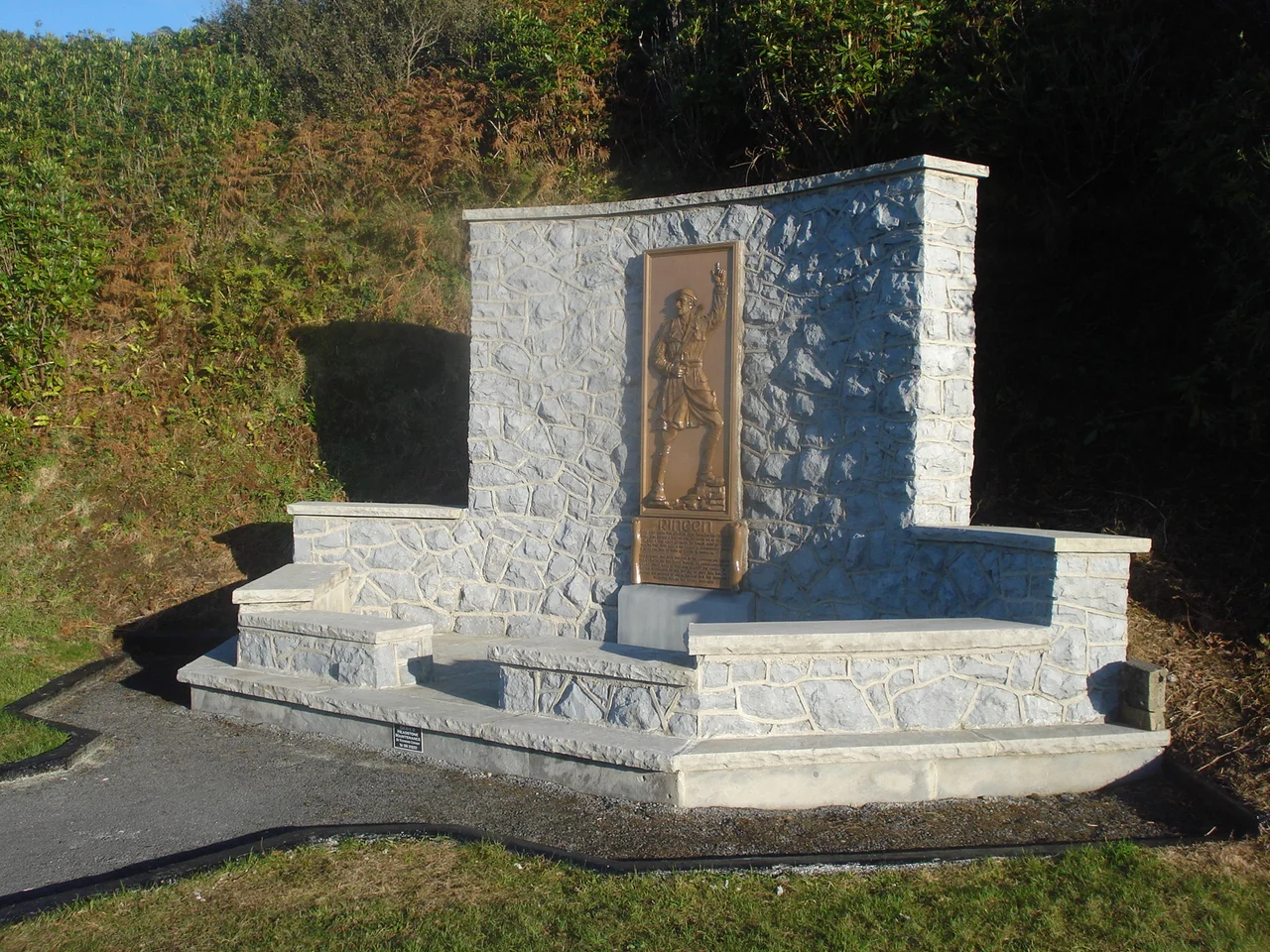

Rineen Ambush
Six Royal Irish Constabulary officers died at a curve of road near Drummin Hill on the afternoon of 22 September 1920. The ambush that killed them was over in seconds. Five fell where the lorry was hit by a grenade and raked with rifle and shotgun fire; the sixth ran about 300 yards before he was shot dead. By the same night, five civilians were also dead - including a 15-year-old boy and a man burned alive in his attic - killed by British forces in reprisal across three Clare villages. Sixteen houses and shops had been burned. The names on both sides are now carved on monuments. The road still bends through the same hill.
The Road Between Ennistymon and Milltown Malbay
The Irish Volunteers in County Clare had been active since 1917. By late 1920, after months of attacks on isolated Royal Irish Constabulary barracks, the RIC had abandoned most of its small rural posts in the county. The British government's answer was to flood Clare with Black and Tans - hastily recruited British ex-soldiers in dyed uniforms - and the more elite Auxiliaries. By the time of the ambush, five RIC men, eleven IRA volunteers, and four civilians had been killed in the county over the previous two years.
The IRA's Mid Clare Brigade had noticed a pattern: a single RIC lorry travelled the road between Ennistymon and Milltown Malbay once a week. John Joe Neylon, the local battalion leader, was put in charge of the ambush. The actual attack was led by Ignatius O'Neill, the brigade's Officer Commanding - a veteran of the Irish Guards in the First World War. The party had nine rifles, some grenades, and shotguns and handguns for everyone else. They took position on a boreen above the road at Rineen and waited.
An Unrelated Killing
While the Mid Clare Brigade lay in wait, something happened twenty miles away that would shape what followed. Alan Lendrum, the local resident magistrate, was driving toward Doonbeg when he came to a railway crossing at Caherfeenick. The West Clare Brigade - a separate IRA unit - had set up an unrelated roadblock. They demanded Lendrum surrender his car. He drew an automatic pistol. They shot him twice in the head.
He was a man with a job and a name and probably people who loved him. The IRA weighted his body with stones and dumped it in a nearby lake. A British military inquest later established the cause of death as gunshot. RIC officers in Clare nevertheless spread a story that Lendrum had drowned. The killing was not part of the Rineen ambush plan and the two battalions had not coordinated. But Lendrum's disappearance was noticed quickly, and the British military in Ennistymon dispatched ten lorries of soldiers to find him - lorries that would arrive at Rineen just after the ambush ended.
Twenty Seconds
The single RIC lorry passed safely through the ambush position on its way from Ennistymon to Milltown Malbay - confusion in the IRA party about whether more vehicles were behind. When they understood it was only the one, they prepared for its return. The lorry was hit by a grenade and then by close-range rifle and shotgun fire. Five RIC men were killed outright. The sixth got out and ran. He was shot down 300 yards on. Five were Irish RIC officers. One was an English Black and Tan. The IRA took their weapons, set fire to the lorry, and prepared to leave.
Then the ten British Army lorries arrived, expecting to be searching for Lendrum. A running fight broke out. Four IRA riflemen kept the soldiers at bay while the rest of the party withdrew in an orderly retreat. Two IRA volunteers were wounded. Several British soldiers were also wounded. The ambush had lasted about twenty seconds. The fighting that followed lasted long enough for the IRA to disappear into the County Clare hills. The Mid Clare Brigade had executed a textbook engagement against a vastly larger force. What came next was not a battle.
The Night of Reprisals
Within hours, British forces went looking for revenge. They burned the O'Gorman family's house and farm. They shot a local farmer, Sean Keane, who died of his wounds. That same night, a mixed force of police and soldiers raided the home of Dan Lehane in Lahinch - his two sons had been in the ambush party. They shot Dan dead and set fire to his house. His son Patrick Lehane, who was inside, burned to death in the attic. Several other houses in Lahinch were burned. Eight more were razed in Milltown Malbay.
Another raid hit Ennistymon. Tom Connole, secretary of the local Irish Transport and General Workers' Union branch, was killed and his home burned. PJ Linnane, a fifteen-year-old boy, was shot dead by the police. The Labour Party in the House of Commons tabled a resolution condemning the reprisals and calling for an investigation. The resolution was defeated, 346 votes to 79. The Chief Secretary for Ireland, Hamar Greenwood, told the House the burned houses had belonged to "notorious Sinn Feiners" and that the people of those villages had known of the ambush in advance. He was lying about the burned houses. He may or may not have been right about advance knowledge.
Stones at Drummin Hill
On 22 September 1957, thirty-seven years to the day after the ambush, a cut-stone monument depicting an IRA soldier was unveiled at Drummin Hill by the Bishop of Killaloe. The cost - just over 1,200 pounds - was raised by veterans, public subscription, and Irish-Americans in the United States. Ignatius O'Neill, then in his sixties, gave a short address. Dr Patrick Hillery, then a young politician who would later be President of Ireland, was in the crowd.
The centenary in 2020 was muted by COVID restrictions. A deferred 100th-anniversary commemoration on 22 September 2023 was addressed by Micheal Martin, then Tanaiste, and a plaque to Commandant Ignatius O'Neill was unveiled on Milltown Malbay's main street. At the ninetieth anniversary, the Minister of Defence Tony Killeen had welcomed descendants of the six RIC officers killed in the ambush, naming the dead on both sides. The Catholic priest Sean Gaynor, looking back on the whole episode, said of Alan Lendrum's death in particular that it "was not to our credit." After his body was recovered from the lake, the local IRA placed it in a roughly made coffin and left it on the tracks at Craggaknock railway station for British forces to find.
From the Air
The Rineen ambush site sits at 52.88 N, 9.41 W, at Drummin Hill on the old N67 road between Ennistymon and Milltown Malbay in County Clare. Shannon Airport (EINN) is 50 km southeast; Galway (EICM) is 70 km northeast. Recommended viewing altitude is 1,500 to 3,000 feet AGL. The terrain is rolling green west-Clare farmland - low hills, hedgerows, a single road curving toward the coast. Lahinch and the Atlantic are visible to the west. Milltown Malbay is about 4 km southwest of the ambush site; Ennistymon is 6 km northeast. The 1957 monument stands beside the road at the ambush location. The Cliffs of Moher are visible to the northwest from elevated viewpoints. North Atlantic weather here - cloud bases often below 2,500 feet, frequent rain showers off the coast.
Nearby Stories
- The Burren 2.5 km away
- Croom Castle 6.9 km away
- Shannon Region 8.1 km away
- 2003 Derrybrien Landslide 11 km away
- Listowel 17 km away
- Saint Macdara's Island 25 km away
- Illauntannig Monastic Site 29 km away
- Mace Head Atmospheric Research Station 56 km away