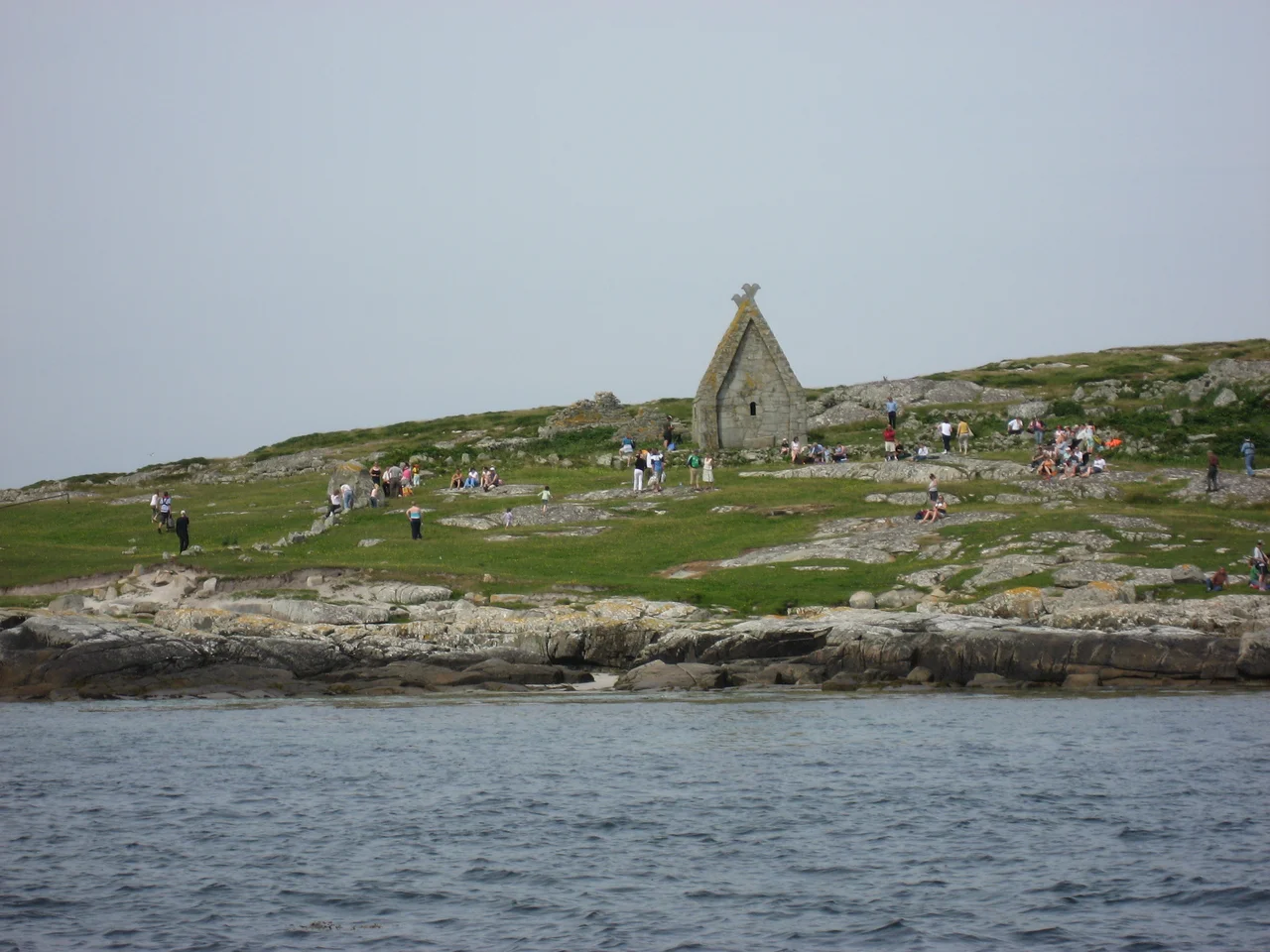

Saint Macdara's Island
For as long as anyone can remember, fishermen passing Saint Macdara's Island have dipped their sails three times. Three times for the saint, three times for the Trinity, three times for the seafarers who would not come home unless the gesture was made. The custom belongs to the people of Carna, six kilometres east across the water, and to anyone else who lives by the rhythms of the Connemara fishing fleet. On a sixty-acre granite island, in a tenth-century stone church whose roof has been cut to look like wooden shingles, Saint Sinach Macdara is still considered the patron saint of those who go to sea here - and he is still asked, every year on the sixteenth of July, to bless the boats that pass below his church.
A Church That Imitates Wood
Saint Sinach Macdara is believed to have built a wooden church on the island in the sixth century. By the tenth century the wooden building was gone, replaced by the stone structure that still stands. What makes the church remarkable is not just its age but a single architectural decision: the stone roof was cut and laid to mimic wood shingles. The masons clearly knew what a wooden roof looked like and felt the new stone church should not abandon that visual memory. It is a small, deliberate piece of conservatism in stone - the past, preserved in the medium of the future. The roof was restored in 1977, after centuries of weather had worked at it, but the imitation-shingle pattern remains visible to anyone who lands on the island and looks up.
Pilgrimage and Drowning
Every 16 July - Feile Mhic Dara, the Feast of Macdara - local people make the crossing for a Mass and a blessing of boats, including the famous Galway hookers that still work this coast. The pilgrimage is older than written records. There is no pier on the island. Pilgrims land where the rock allows, and the weather decides how easy or hard that landing will be. In 1907, during a storm, nine people drowned on a pilgrimage to the island. The bare fact - nine drowned, on a pilgrimage to a saint of seafarers - holds a weight that needs no embellishment. Their names were known to the families who lost them. The crossing continued, then and afterward, because the calendar called for it and because the people who made it did not believe the drowning negated the saint's protection - perhaps the opposite.
The Saint, the Statue, and the Archbishop
A wooden statue of Saint Macdara was once venerated on the island - or perhaps on the nearby mainland - with the kind of devotion that the Archbishop of Tuam, at some point, found suspect. In an act of iconoclasm, he ordered the statue buried. Iconoclasm has a long history in Christianity: the destruction or hiding of religious images, usually because some clerical authority decides that veneration has tipped into idolatry. The local people lost their statue. They kept their saint. Today the island holds, alongside the church, three penitential stations of cross slabs, a holy well, and the ruins of a much later bothy - a simple stone shelter - around which animals were once raised on the island's thin grass. The Irish postal service, An Post, released five definitive stamps depicting the tenth-century church between 1982 and 1986. For most of a decade, anyone in Ireland posting a letter was, without knowing it, also handling a small image of Saint Macdara's stone roof.
Granite in the Atlantic
The island itself is granite - sixty acres of hard, weathered Connemara granite rising from the Atlantic off Carna. From the air it appears small, lonely, almost incidental against the much larger mainland coastline. From the water it is the shape that determines the day. Sailors mark it, dip their sails, and pass. On clear evenings the island catches the long western light, and the church on its summit catches that light a little longer than the rocks beneath it. It is the kind of place that reminds you what a National Monument is for: not just preservation, but continuity - the same building, the same saint, the same gesture from passing boats, year after year, for centuries on a coastline that has otherwise changed almost beyond recognition.
From the Air
Located at 53.30 N, 9.92 W, off the south Connemara coast of County Galway, 6 km west-southwest of Carna village. The island is small - 60 acres of granite - but distinctive from low altitude as a rocky outcrop with the visible silhouette of the small medieval church near its highest point. Nearest airports: Connemara Regional (EICA) at Inverin, about 30 km northeast; Galway (EICM) further east. Best viewed at lower altitudes in clear weather. Atlantic weather here is changeable; the same storms that drowned pilgrims in 1907 still pass through.
Nearby Stories
- County Galway 3.2 km away
- Uggool Beach 9.7 km away
- Doolin 11 km away
- Aughagower 17 km away
- RMS Carinthia (1925) 17 km away
- Inishmaan 29 km away
- Action of 7 May 1794 92 km away
- Inishtooskert 106 km away