.jpg)
Inishmaan
Every Saturday morning at 11am, on a small Irish-speaking island of 184 people in the Atlantic, a few runners gather for a parkrun. It is the only parkrun in the world that starts at 11am. The unusual time exists because the only way onto Inishmaan is the 9am flight from Connemara Airfield, and visiting runners cannot get to the start any earlier. They run their five kilometers across limestone pavement and stone wall and grass, then wait until 4pm for the flight that takes them back to the mainland. This is what it means to live on the middle Aran island - everything is shaped by tides, flights, and weather.
Carboniferous Pavement
The limestone underfoot is 350 million years old. It formed as sediment in a shallow tropical sea during the Visean stage of the Lower Carboniferous, compressed over geological time into the horizontal strata you can see now in every cliff face, embedded with the fossils of corals, crinoids, sea urchins, and ammonites. Inishmaan is geologically an extension of the Burren on the County Clare mainland - the same fissured pavement, the same vertical joints widened into deep grooves by ten thousand years of solutional erosion since the last ice retreated.
The ice did most of the surface scouring. The Midlandian glaciation overran the island during the last ice age, stripping older karst features and leaving a fresh limestone palette for the post-glacial weather to work on. What you see now - flat slabs called clints separated by deep crevices called grikes - is geologically recent, sculpted from about 10,000 years ago. The result is one of the finest examples of glacio-karst landscape in the world. In the grikes, sheltered from wind and holding moisture, arctic plants grow alongside Mediterranean ones, alpine flowers beside species more common to lower latitudes. Late May, when the gentians and avens peak, is the sunniest time and the best for botanists.
Dun Chonchuir and the Forts
Eight sites on Inishmaan carry National Monument designation, packed into a few square kilometers. Doonbeg Ringfort. Carrownlisheen Wedge Tomb, locally called Diarmuid and Grainne's Bed after the mythological lovers who fled across Ireland evading Fionn mac Cumhaill. Templesaghtmacree, a ruined church. Carrownlisheen Cross. Labbanakinneriga, another church. Dun Fearbhai, a stone ringfort. Kilcoonagh Church. And Dun Chonchuir - Conor's Fort - the largest and most dramatic of them.
Dun Chonchuir is a cashel, a circular stone fort whose massive drystone walls still stand to most of their original height. It sits on the central high ground of the island. Archaeologists date it somewhere between the first century BC and the seventh AD; the broad range reflects how hard cashel-dating is when you have neither datable material nor written record. Whoever built it shaped tons of limestone into a wall thick enough that you can walk along its top. The interior was probably home to a chief and his retinue. Stand inside the walls today and the Atlantic wind that scours the island falls away. You can hear birds. You can hear yourself think.
Synge's Chair, Synge's House
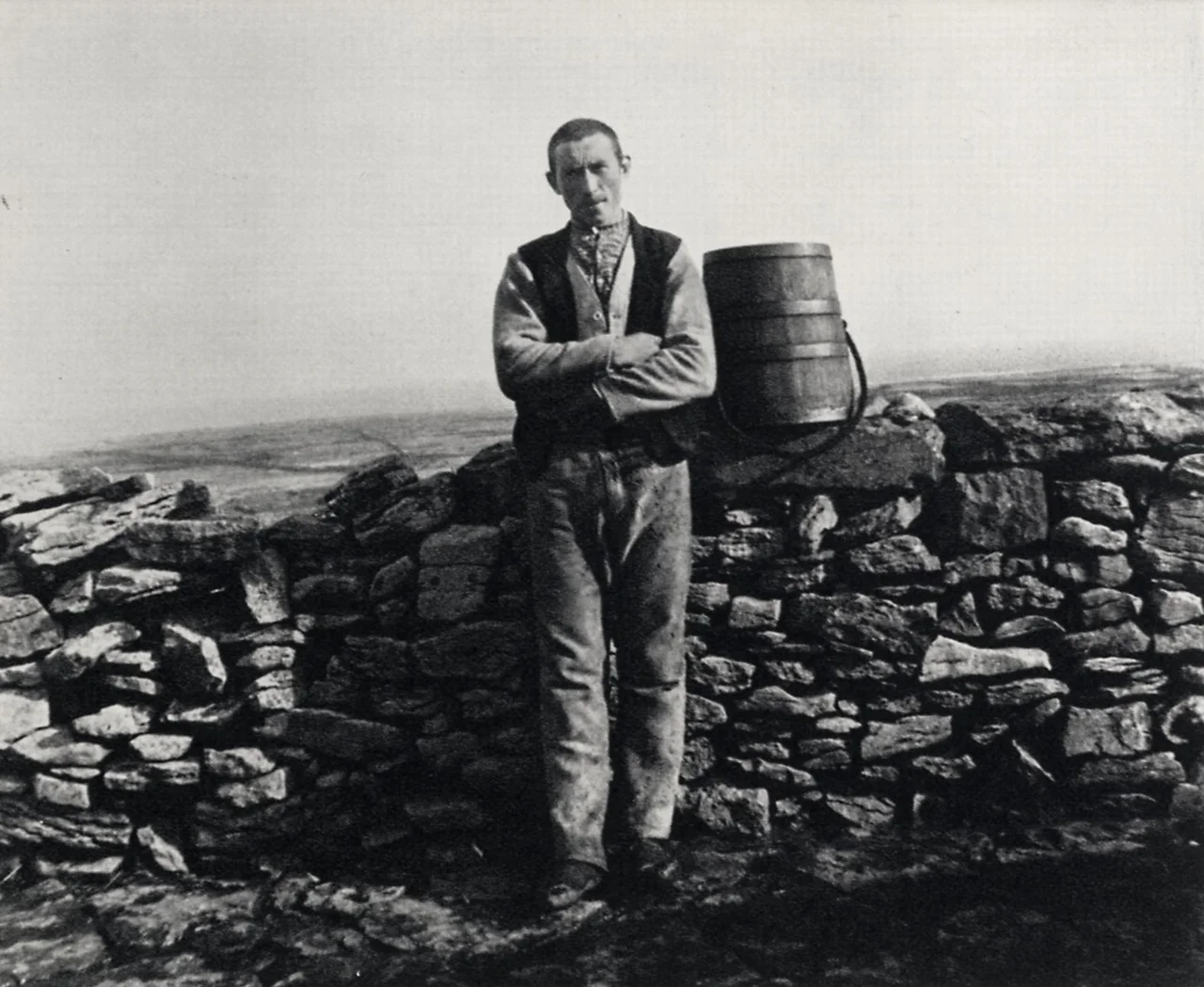
Every summer from 1898 to 1902, John Millington Synge stayed in a small house on Inishmaan as the guest of Brid and Paidin Mac Donnchadha. Synge was a young Dublin Protestant playwright searching for a voice that was not English drawing-room. W. B. Yeats had told him to go where the language and the imagination were still alive. He chose the Aran Islands. The five summers he spent on Inishmaan, listening to islanders tell stories in Irish about drownings and family feuds and the seasonal rhythms of an island life he could only observe from outside, produced the material that became Riders to the Sea, The Playboy of the Western World, and other works that reshaped Irish drama in the early twentieth century.
Teach Synge - Synge's Cottage - was inhabited by descendants of the Mac Donnchadha family until the 1970s, when it fell into disrepair. It has since been restored and is open to the public. Cathaoir Synge - Synge's Chair - was the writer's favourite spot on the island: a notch in the cliffs facing Inis Mor and the open Atlantic, where he sat through long afternoons watching the light change on the water. The play that grew out of those summers, Riders to the Sea, ends with the line that has become Inishmaan's unofficial epitaph: "No man at all can be living forever, and we must be satisfied."
Cead and the Parkrun
Inishmaan is home to a sport played nowhere else - Cead, which means permission in Irish. The competitive form is played only once a year, on Saint Patrick's Day, and only by men. The rules are local enough that no Wikipedia article quite captures them and outsiders rarely see the game. The annual Inis Iron Meain Race held each March covers 5, 10, or 12 km depending on which loop you choose - organised by Colaiste Naomh Eoin, the secondary school the County Galway Vocational Education Committee opened on the island in 2003 to serve all three Aran islands.
The infrastructure that keeps the island running is a small marvel. A submarine cable from the mainland delivers electricity from the national grid. A desalination plant produces drinking water, though shortages still happen. The new Caladh Mor jetty has been in service since 2007, and the airstrip handles the daily Aer Arann Islander flights. Martin McDonagh's 1996 play The Cripple of Inishmaan is set here - a darkly comic story about a disabled young man drawn into the world of a Hollywood documentary filming on the islands in the 1930s. The play has been staged on Broadway and in London, carrying the island's name into theatres that none of the 184 residents will ever sit in.
From the Air
Inishmaan sits at 53.085 N, 9.59 W, the middle and least populated of the three main Aran Islands in Galway Bay. Connemara Airport (EICA) at Inverin is 30 km northeast - daily Aer Arann Islander flights cover the distance in 10 minutes. Galway (EICM) is 50 km northeast; Shannon (EINN) is roughly 80 km southeast. Recommended viewing altitude is 1,500 to 3,000 feet AGL. The island is small - about 9 square kilometers. Look for Dun Chonchuir's circular wall on the central high ground as the most distinctive landmark, and for the limestone pavement that gives the whole island its grey-white character. Inis Mor lies to the northwest; Inis Oirr to the southeast. Cliffs face south and west toward the Atlantic. North Atlantic weather here is fickle - cloud bases under 2,000 feet are common and flights are routinely cancelled in high winds.
Nearby Stories
- Acadamh na hOllscolaíochta Gaeilge 4.6 km away
- Coláiste Iognáid 5.3 km away
- Poulnabrone Dolmen 5.6 km away
- Kilkee 5.7 km away
- 1961 President Airlines Douglas DC-6 crash 15 km away
- Ardoileán 32 km away
- RMS Carinthia (1925) 40 km away
- Ballynavenooragh 57 km away