
Ardoileán
The boat from the mainland is small and the swell is usually rolling. Approach from the east on a calm summer morning and you see a single hump of land rising out of the Atlantic, treeless, perhaps a kilometer across, ringed by cliffs that the gannets and gulls work without pause. There is no jetty. To get ashore you wait for the swell to lift the boat to the rock, then jump. Ardoileán - Ard Oileán, High Island in English - has been like this since long before the hermits arrived in the seventh century. The Irish poet Richard Murphy, who owned the island from 1969 to 1998, wrote that the silence here was 'the silence of a place where prayers have been wearing the rocks for thirteen hundred years.'
Why Hermits Came Here
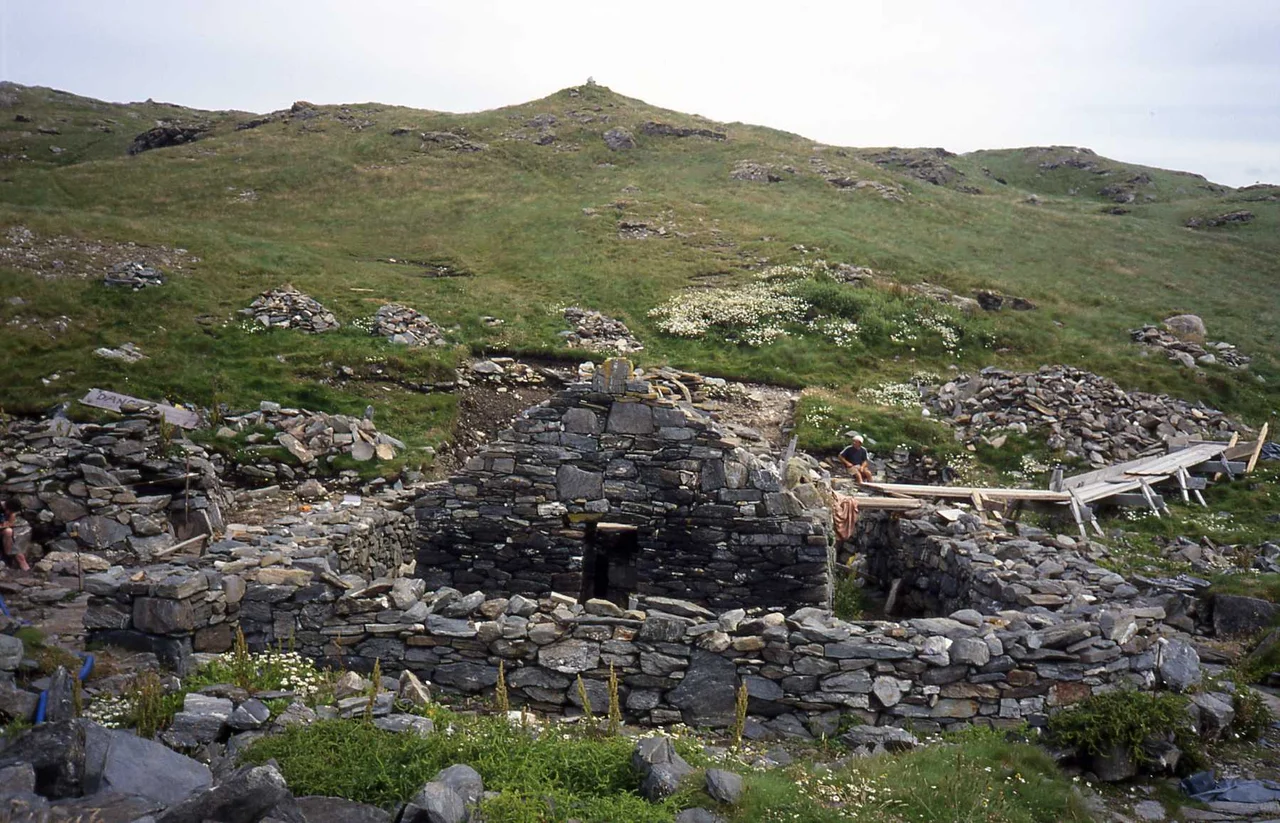
Between the seventh and ninth centuries, Irish monasticism produced a peculiar genius: men who believed the path to God lay in extreme isolation, on rocks where nothing grew, where the wind never stopped, where survival meant collecting rainwater and seabirds' eggs. Ardoileán is one of about thirty such islands strung along the Irish west coast between Inishtrahull off Donegal and Clear Island off Cork. Each held its own small community - a handful of monks, sometimes a single hermit. The remains on Ardoileán include the ruins of beehive cells (clocháin) built without mortar, a small oratory, and an enclosing wall, all attributed to the followers of Gormgal of Ardoileán, who died in 1017 and was buried here. The seventh-century saint Caolánn is also associated with the island. The hermits cultivated nothing. They prayed. The Atlantic did the rest.
Richard Murphy's Island
In 1969 the Irish poet Richard Murphy, then living on Inishbofin to the south, learned that the owner of Ardoileán was thinking of selling. He wrote later in his 2002 memoir The Kick: 'I got excited at the thought of buying this inaccessible holy island, restoring the beehive cells and oratory of its derelict hermitage and preserving the place from destruction either by tourists or by sheep.' He bought it. For nearly three decades he tended it, repairing collapsing stonework, keeping the sheep numbers down, allowing only careful scholarly visits. His 1974 collection High Island was named for it. The poems treat the island as a meeting point between the medieval mind and the modern - the ascetic hermits and the modern poet both choosing solitude on the same rock. Murphy sold the island in 1998 and died in 2018.
For Sale, One Holy Island
In February 2019, Ardoileán went on the market through Spencer Auctioneers for 1.25 million euros. The Guardian's headline read 'Craggy island for sale: gulls, grass, wind and no mod cons.' The listing came with no buildings beyond the ancient ruins, no mains electricity, no fresh water source beyond rain, and one of the most challenging landings in coastal Ireland. The article was widely shared. Whether the asking price was achieved was not publicly disclosed. Whoever now holds the deed inherits Gormgal's ruined cells, the wall the hermits built, the beehive structures the gulls now nest in, and the same Atlantic that for thirteen centuries has carried prayers, fishermen, monks, poets, and the occasional auctioneer's helicopter out to one of Ireland's lonelier corners.
From the Air
53.5464 N, 10.2572 W. Ardoileán lies roughly 4 km off the northwest tip of the Connemara mainland, just west of Omey Island and north of Inishbofin. From the air the island appears as a small green and brown hump with prominent sea cliffs. Connemara Regional Airport (EICA) at Inverin is about 65 km southeast. Galway Airport (EICM, closed to scheduled traffic) lies further east. Best visibility is on rare clear days when high pressure pushes back the Atlantic cloud - more common in May and June than in winter. The seas around Ardoileán are notoriously rough; even light breezes can produce serious swell against the western cliffs. The island shows the classic shape of a small Connemara holy island - low, treeless, with the marks of stone enclosures visible from low altitude in good light.
Nearby Stories
- Twelve Bens 3.6 km away
- Clew Bay 5.7 km away
- Inishmore 17 km away
- RMS Carinthia (1925) 20 km away
- Clare Island Abbey 25 km away
- The Laki Eruption: The Volcano That Changed World History 1216 km away
- The Northern Lights: The Sky Show That Vikings Thought Was Bridge to the Gods 1325 km away
- Sao Miguel 2055 km away