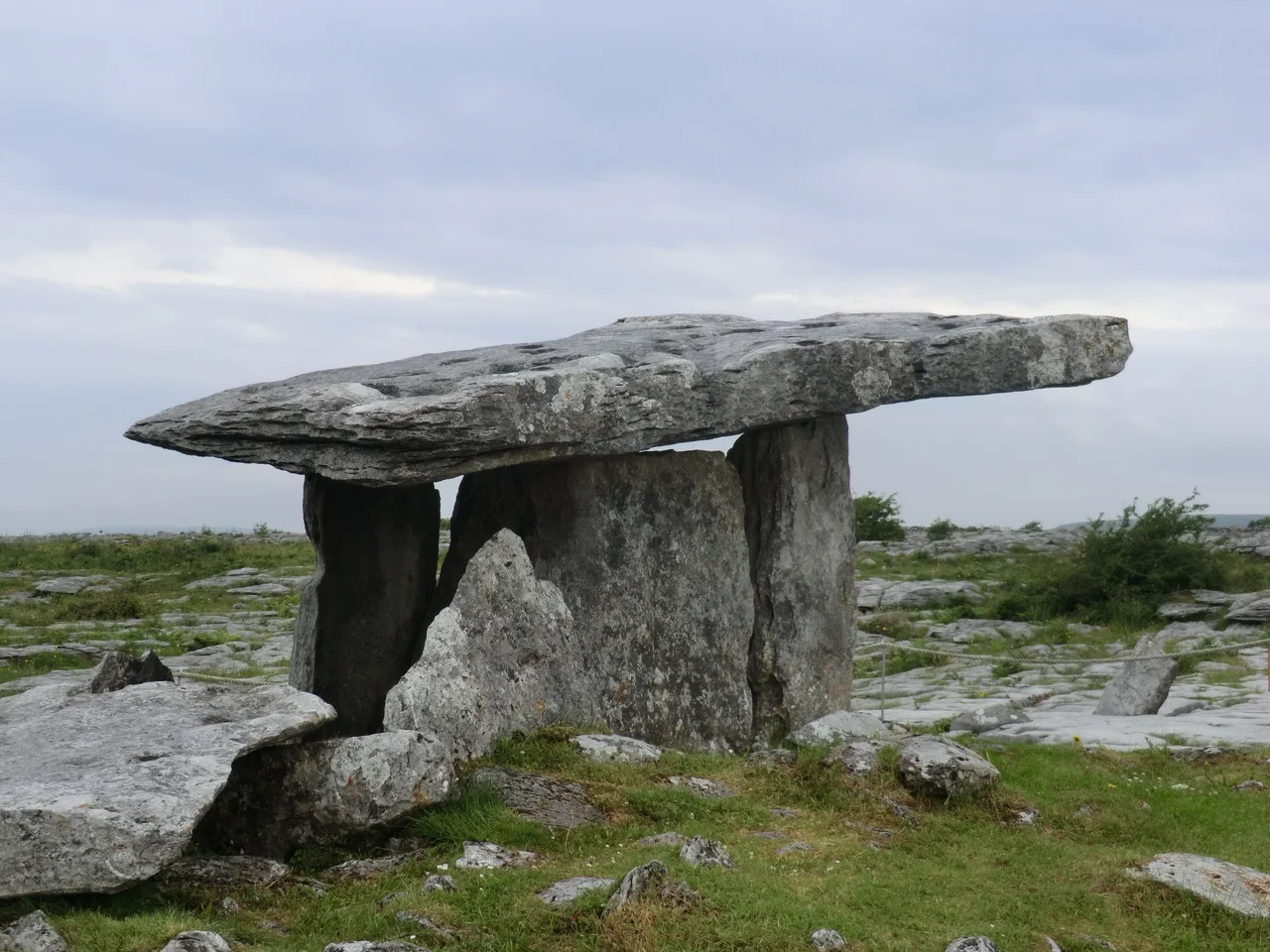

Poulnabrone Dolmen
Thirty-six people lie buried here, give or take. Their bones came out in fragments by the thousand, sifted from the crevice beneath the great tilted slab on the Burren's limestone plain. Most of them were dead before they turned thirty. One had a stone arrowhead lodged in the hip - shot from behind, never healed. A six-month-old baby with Down syndrome was laid in among them, the earliest such case archaeologists have ever found, still showing traces of having been breastfed. The dolmen at Poulnabrone has stood over this small Neolithic congregation for almost six thousand years.
Hole of the Quernstone
The name comes from Poll na Brón - the genitive of bró, an Irish word for the heavy round stone of a hand-mill. Hole of the Quernstone, more or less, though wishful translators have sometimes rendered it as Hole of Sorrows, which fits the mood better than the etymology. The tomb sits on a low circular mound, its chamber tapering eastwards, capped by a single slab so improbably balanced on two upright portal stones that the eye keeps returning to test the geometry. Two more pillars steady the sides; a threshold stone lies across the entrance. Nothing about the construction is incidental. Whoever built this knew exactly what they were doing, four thousand years before the Romans bothered to invent concrete.
A Burial Across Generations
The dating is precise: bodies went into the chamber between 3800 and 3200 BC, across six centuries of use. Six thousand bone fragments came out during the conservation work of 1986 and 1988, when a crack in one portal stone had grown wide enough to threaten the whole structure. Dr Barra O'Donnabhain at University College Cork led the analysis with Dr Mara Tesorieri. They identified at least twenty-eight individuals, more likely thirty-six. Roughly equal numbers of men and women. At least seventeen adolescents or younger. Wear on chest and back vertebrae told of lives spent carrying heavy loads. Only one identified adult had passed the age of forty. The rest died before thirty - in childbirth, in injury, in the slow attrition of a hard agricultural life on thin Burren soil.
The Baby in the Stone
Among the fragments was a child six months old whose skeleton showed the unmistakable markers of Down syndrome - the earliest case yet identified anywhere in the world. The infant had been breastfed. Whoever cared for this baby cared enough to nurse it, and when it died, cared enough to bury it inside the most important monument their community possessed. It is the kind of detail that disassembles modern assumptions about prehistoric cruelty. Five thousand years on, the bones speak quietly of tenderness. Long after the chamber was closed, in the Bronze Age between roughly 1750 and 1420 BC, another infant was buried just outside the entrance - someone still remembered what Poulnabrone meant.
The Burren Around It
The dolmen stands east of the Poulanine and Glensleade valleys, the rocky hills of Baur and Poulnabrucky rising beyond. To the north-east the land lifts into stepped limestone terraces - the karst that makes the Burren what it is. Approach was difficult when the tomb was built and not much easier now. It stood close to the old north-south route from Ballyvaughan Bay down toward what is now Kilnaboy, visible for miles. A marker. A claim. Pottery sherds from the chamber match the early Western Neolithic tradition of roughly 3750 to 3600 BC. A polished stone axe, jewellery of bone and quartz crystal, weapons - the burial goods of an established farming people, the first to plant grain on this stripped pavement of stone.
Still Standing
Poulnabrone is the largest Irish portal tomb after Brownshill Dolmen down in County Carlow, and far and away the most photographed. Two hundred thousand people came in 2005, the year Clare County Council took stock of the traffic and started building the car park that opened in 2007. The archaeologist Ann Lynch, who oversaw the conservation work, has argued for keeping visitor facilities minimal - to preserve, as she put it, the spiritual quality of the landscape surrounding the tomb. The bones themselves now rest at the Clare Museum in Ennis, on loan from the National Museum of Ireland. The capstone is back in place. The crack is stabilised. Sheep wander the karst as the wind comes off the Atlantic, and the chamber tapers eastwards toward the rising sun, still.
From the Air
Poulnabrone dolmen sits at 53.05 N, 9.14 W on the limestone plateau of the Burren in County Clare, north-west Ireland. The nearest sizeable airport is Shannon (EINN), about 50 km south; Galway (EICM) lies roughly 45 km north-east across Galway Bay. Cruising west along the coast from Limerick, look for the pale grey karst pavement of the Burren rising abruptly above the green farmland - the dolmen itself is too small to see from altitude, but its setting is unmistakable. Best viewed in low oblique light when the limestone catches shadow. Atlantic weather typically dictates short visibility windows; clear mornings in late spring give the cleanest views.
Nearby Stories
- Newport, County Tipperary 3.4 km away
- Shannon Airport 4.5 km away
- 126 Artist-run Gallery 5.9 km away
- Acadamh na hOllscolaíochta Gaeilge 7.1 km away
- Inis Beag 7.1 km away
- Battle of Aughrim 9.1 km away
- Kilkee 12 km away
- Portumna 18 km away