
Acadamh na hOllscolaíochta Gaeilge
For most of the modern history of higher education in Ireland, a student wishing to graduate had to learn in English. Irish - the country's First Official Language under the Constitution, the ancestral tongue of the people who lived here when the universities were founded - was something you studied, not something you studied through. That asymmetry held until 2004, when the University of Galway formally established Acadamh na hOllscolaíochta Gaeilge, the Academy of Irish-Language University Education. For the first time in centuries, a student in Ireland could write their thesis, take their oral exams, defend their research, and accept their degree without switching languages once.
An Asymmetry Made Symmetrical
The premise behind the Acadamh is straightforward and quietly radical: a language without higher education is a language with a glass ceiling. You can speak Irish at home, on the playground, on Raidió na Gaeltachta, on TG4. But if every credentialed profession requires you to take your degree in English, the language loses status year by year, generation by generation. The founders of the Acadamh - working under the auspices of what was then the National University of Ireland, Galway - looked across the Irish Sea at Sabhal Mòr Ostaig, the Scottish Gaelic constituent college of the University of the Highlands and Islands, and saw what was possible. Sabhal Mòr Ostaig's rise had coincided with a measurable resurgence of Scottish Gaelic vitality. The Acadamh aimed to do something similar for Irish.
Four Houses, Two Counties
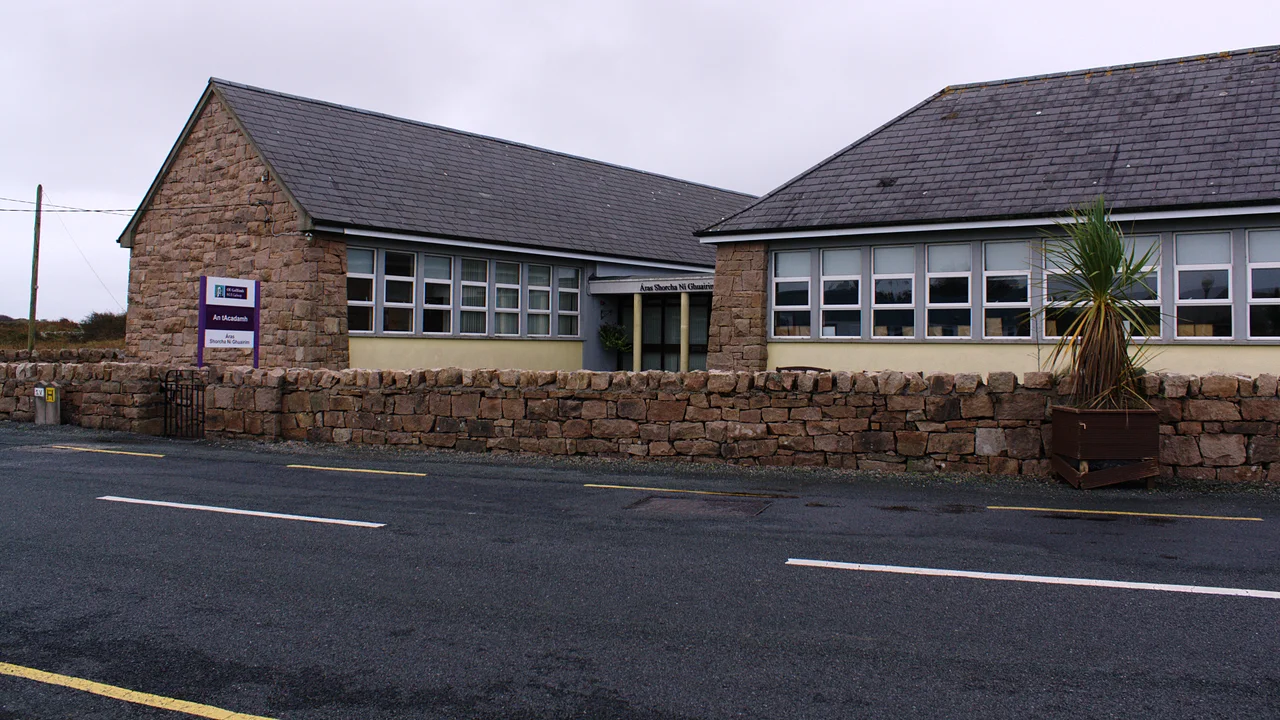
The Acadamh operates from four centres, each one a deliberate placement in or near a Gaeltacht. Áras na Gaeilge sits on the University of Galway's main campus in Galway city. Áras Mháirtín Uí Chadhain in Carraroe (An Cheathrú Rua) is named for the great Connemara novelist whose 1949 Cré na Cille is the towering work of 20th-century Irish-language fiction. Áras Shorcha Ní Ghuairim in Carna honours the sean-nós singer who carried the songs of Connemara to wider audiences. And far up the western coast, Ionad an Acadaimh in Doirí Beaga (Derrybeg) in the Gaeth Dobhair Gaeltacht of County Donegal extends the work into the northern dialects. Each centre teaches, researches, and operates in Irish - not as a subject but as the medium.
Translators, Broadcasters, Lexicographers
The Acadamh's research outputs are the kind of unglamorous work without which a language quietly dies. Its staff helped build the New Irish-English Dictionary and contributed to the Digital Repository of Ireland. They administer the national Seal of Accreditation examinations for translators and provide material and data to TG4, the Irish-language broadcaster headquartered in nearby Baile na hAbhann. Postgraduate programmes here include Conference Interpreting, Translation Studies, and Professional Practice in the Media. Diploma courses range across Indigenous Culture, Film and Multimedia, and Language Planning and Preservation. The annual scholarly publication An Reiviú publishes papers on sociolinguistics, pedagogy, and the technologies that minority languages need to survive in a digital age.
Not Alone Anymore
From 2004 until 2013, the Acadamh was the only third-level institution in Ireland where the working language and the language of instruction were the country's indigenous language. In 2013, the educational organisation Gaelchultúr was granted third-level status by Quality and Qualifications Ireland, giving rise to Coláiste na hÉireann. A notable exception of a different kind - Fiontar at Dublin City University, which offers some courses through Irish - has existed since the 1990s. But the Acadamh remains the only fully Irish-medium constituent campus of a major Irish university, and the institutional weight of the University of Galway behind it gives the Acadamh a stability the smaller bodies don't yet have.
What a Language Buys
Why does this matter? Linguists have a phrase for what happens to languages with no professional ceiling: "domain loss." A community keeps speaking the language at home but loses it at the office, in the courts, in the laboratory, in the lecture hall. Eventually the home itself becomes the only domain, and once that becomes embarrassing or impractical, the language has perhaps two generations left. By creating professional-grade Irish-medium qualifications - in translation, in media production, in language planning - the Acadamh hands its graduates a credential whose social weight is comparable to the same qualification taken in English. The Gaeltacht graduate no longer has to switch languages to participate in modern Irish life. That sentence sounds modest. It is anything but.
From the Air
Coordinates 53.26°N, 9.60°W. The main Áras na Gaeilge sits on the University of Galway's campus on the north side of Galway city, on the River Corrib. The Carraroe and Carna centres lie roughly 30-50 km west in the Connemara Gaeltacht. Shannon Airport (EINN) is 70 km south; Galway Airport (EICM), now closed to scheduled services, is 12 km east. Connemara Airport (EICA) at Inverin lies 22 km west and handles Aer Arann Islands flights. Galway city is best identified from altitude by Galway Bay opening to the southwest and the wide River Corrib bisecting the city.
Nearby Stories
- Poulnabrone Dolmen 4.1 km away
- Inishmaan 5.2 km away
- Annaghdown 6.3 km away
- Killary Harbour 8.7 km away
- Claremorris 15 km away
- Ardoileán 22 km away
- Blackrock Island, County Mayo 51 km away
- Ballynavenooragh 96 km away