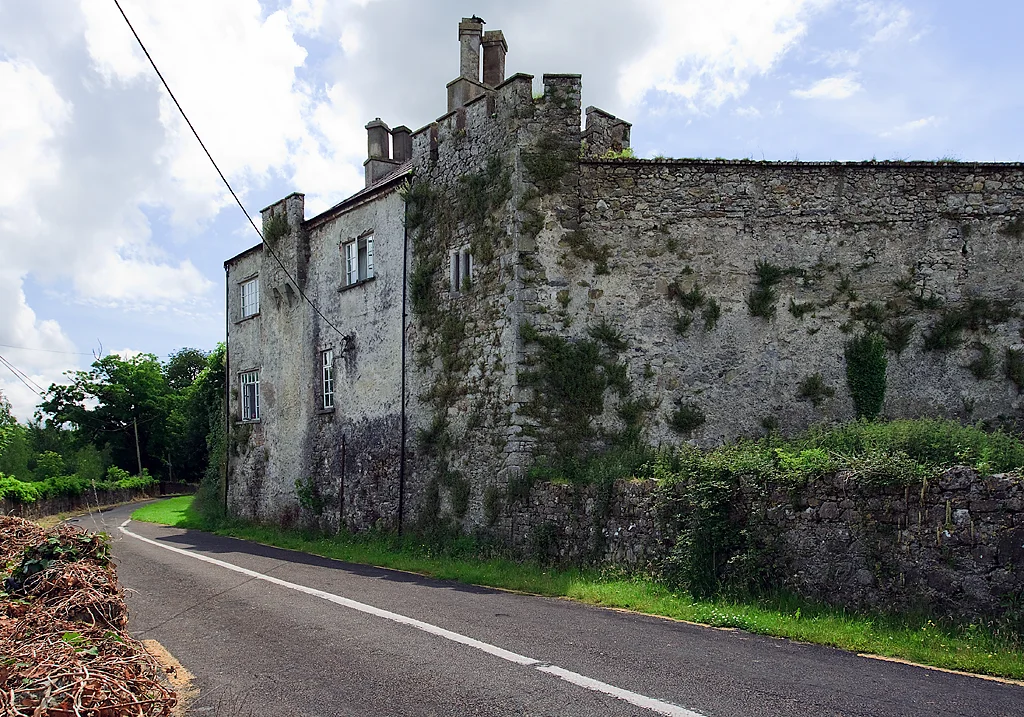

Croom Castle
Crom Abu - 'Croom forever' - was the war cry the FitzGeralds shouted into the chaos of fifteenth-century Irish battlefields. It became, eventually, the motto of the Earls of Kildare and, after them, the Dukes of Leinster, and after that an answer at pub quizzes. The fortress that gave the cry its meaning still exists, in the most diminished form. Two walls of a thirteenth-century tower keep stand in a bend of the River Maigue in County Limerick, collapsed to roughly half their original height. The other two walls have fallen into a great pile of rocks and brick. Cattle graze around it. Visitors come for the name, not for the architecture. But the name is a thread that runs back through Irish history - through the FitzGerald dynasty, through the Norman invasion, through the lost Uí Fidgenti kingdom of pre-Viking Munster.
The Bend in the River
The town and the castle take their name from the geography. Cromadh in Irish means 'bend' or 'curve' - the River Maigue here makes a tight, ornate loop, and a fortress built on the high inside of that loop has river protection on three sides without needing to dig a moat. Before the Normans came, this country belonged to the Uí Cairpre Áebda, a branch of the larger Uí Fidgenti kingdom, and their leading family were the O'Donovans. According to the seventeenth-century antiquarian Samuel Lewis, one Dermot O'Donovan built the first known fortress at Croom during or shortly before the reign of King John of England - securing land the O'Donovans had taken from their MacEniry cousins. The name appears even earlier: a 1130s manuscript called the Caithréim Chellacháin Chaisil mentions an O'Donovan ancestor associated with Cromadgh as far back as around the year 960.
FitzGerald Ground
The political map of Munster turned in 1194 with the death of Domnall Mór Ua Briain, the last great king of Thomond. The Normans took advantage. By around 1200 the FitzGeralds were granted huge swathes of what had been Uí Fidgenti land, and Croom became one of their principal residences. The current tower castle - the one whose ruins still stand - was probably built in the early thirteenth century, after attacks like the one recorded in 1151, when Ruaidhri, son of Toirdhealbhach Ua Conchobhair, raided into Thomond and burned Cromadh, carrying away many cows. The new tower was meant to make such raids harder. It stood for centuries, the FitzGerald banner of the Earls of Kildare flying from its battlements, with the family's chosen battle cry rising from its garrisons. One branch of the O'Donovans, displaced as lords but never quite gone, kept farming the surrounding land - they still hold a farm at Croom that has been in their family for more than four hundred years, though they have not lived in the tower since the FitzGeralds moved in.
Crom Abu
How does a place name become a battle cry? Through repetition, in moments of danger. When a FitzGerald lord rode out from Croom Castle to fight his rivals, his men shouted the name of their stronghold - 'Crom! Crom!' - and the suffix abú meaning 'forever' or 'to victory' attached itself. The cry travelled with the family. The Earls of Kildare carried it into the Wars of the Roses-era Irish politics, into the rebellion of Silken Thomas in 1534, into the centuries of FitzGerald power and FitzGerald downfall. By the eighteenth century the cry had become a heraldic motto, embroidered on the FitzGerald arms. The Dukes of Leinster, descended from the same FitzGeralds, still use it. Most of the people who recite the motto today have never heard of the small Limerick town that gave it meaning.
What Remains
Today Croom Castle is, as the antiquarian record honestly puts it, a large undistinguished ruin. Two walls of the tower stand to half their original height, weather-beaten and shaggy with ivy. The other two have collapsed into a heap of mortar and stone that local farmers have, over the centuries, partly carted off for field walls. There is no formal visitor centre. The castle sits on private land near the modern town of Croom, where the N20 traffic between Limerick and Cork rumbles past a few hundred metres away. What is left to see is not the building but the site - the bend in the river, the strategic high ground, the way the water curves protectively around the ridge. Eight centuries ago this was the seat of one of the most powerful families in Ireland. The river still curves. The cattle still graze. The cry is still on the Leinster arms.
From the Air
Croom Castle stands at 52.51 degrees north, 8.72 degrees west, on a bend of the River Maigue 25 km south of Limerick city. From altitude the Maigue makes a clear, dark, ornate curve through the green farmland of central County Limerick. Shannon Airport (EINN) is 35 km northwest; Cork Airport (EICK) is 70 km south. The modern N20 motorway runs adjacent to the site.
Nearby Stories
- Bansha 3 km away
- Mourne Abbey 8.6 km away
- Sixmilebridge 11 km away
- Lismore Castle 13 km away
- Abbeyfeale 15 km away
- McCan Barracks 18 km away
- Headford Ambush 23 km away
- Rineen Ambush 24 km away