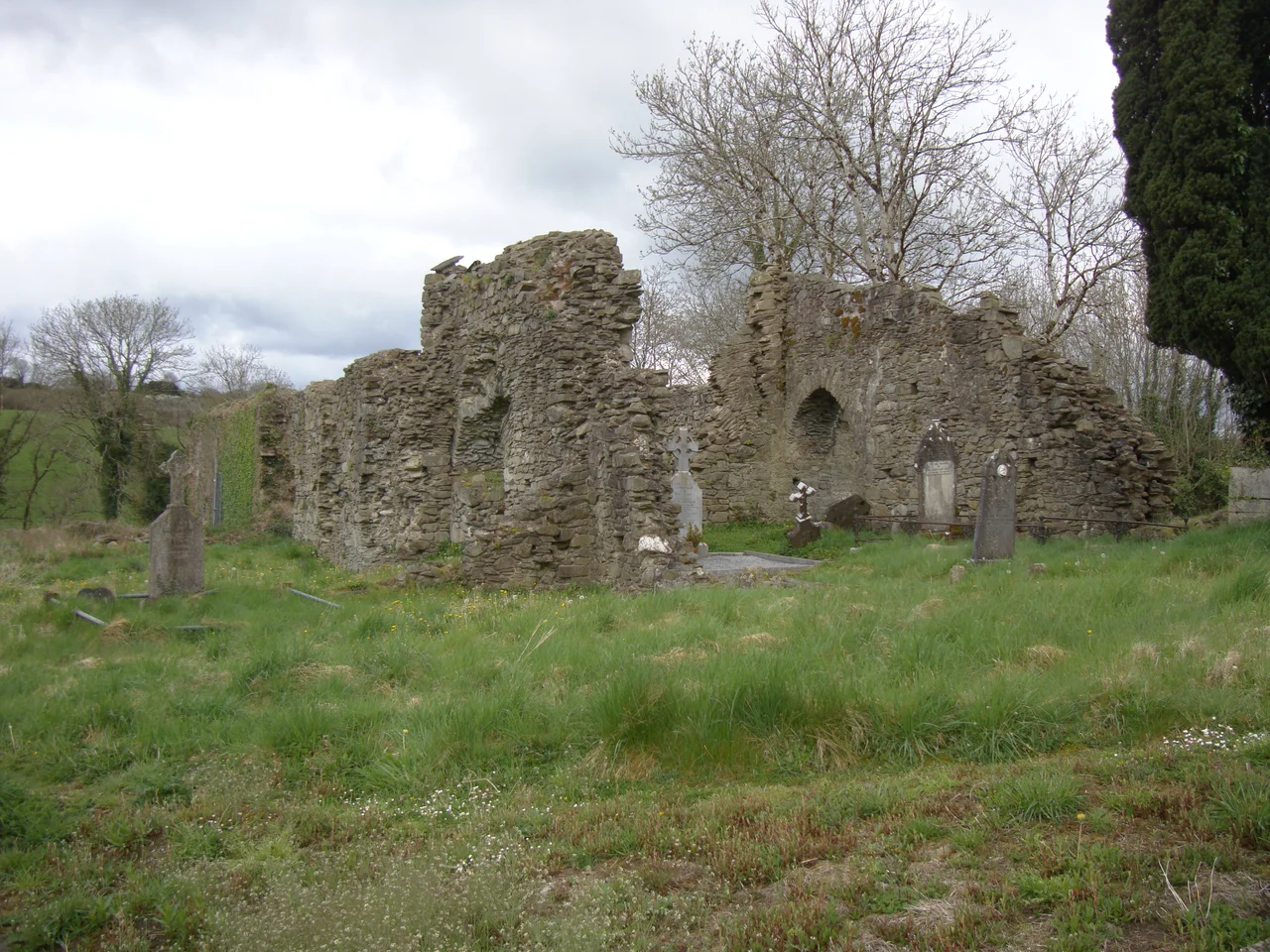

Mourne Abbey
The medieval Irish called the place An Mhoin Mhor, the Great Bog. When the abbey rose here in north County Cork, between Mallow and Cork city, it took the same name in monastic form: Mainistir na Mona Moire, the abbey of the Great Bog. Latin documents shortened it to Mora. There is some confusion about who actually built it - earlier histories credited the Knights Templar around 1199, but the first datable mention comes in 1290, when the 'master of Mora' witnessed a charter for Hospitaller properties in Dublin. By then the Knights Hospitaller of St John were running the place. They held it until Henry VIII's commissioners closed it in 1541. The ruins are still there. Most of the original church is standing.
The Abbey on the Bog
The Hospitallers built more than a church. The original enclosure, much larger than what survives today, would have included a substantial gatehouse, a refectory, an infirmary, a guesthouse, a dormitory, stables, a brewhouse, a forge, and the working buildings any large agricultural community needed. Sections of the original enclosure walls and two of the corner towers still survive. The large square tower at one corner is now believed to have been a mill - in 1334, the wardship of the 'mill of Mora' was granted to Christiana, the wife of Henry Say, for ten years. A ruined building in the field south of the church may have been the monks' hall. The land had been donated to the Hospitallers by the Cogans, the Anglo-Norman lords who also founded nearby Ballynamona and who built Barrett's Castle on a hilltop overlooking the abbey. By around 1500, control passed to the McCarthys, and when Henry VIII suppressed the monastery in 1541, the McCarthys received the grant of its lands. Modern roads and the railway embankment now cut through what was once the abbey close.
Cromwell, and Then a Long Quiet
Barrett's Castle, on the hill above, came down around 1651, when Cromwell's army campaigned through Munster. The abbey itself was already a ruin by then. For the next two and a half centuries, Mourne Abbey was a parish of bog and farmland that travellers passed through on the way between Cork and Mallow. The railway came in 1892, when Mourne Abbey station opened on 1 May, connecting the parish to the main Cork-Dublin line. The station closed on 9 September 1963, another small Irish railway victim of the Beeching-era cuts. The parish today holds about a thousand people across seventeen townlands, two churches, and two schools, at Analeentha and Burnfort. Tomas Mac Curtain, the Lord Mayor of Cork who was assassinated by Royal Irish Constabulary men in his home in March 1920, was born in the townland of Ballyknockane in this parish. His killing helped trigger the war that came back here a year later.
The Morning of 15 February
The Mallow Battalion of the IRA had been trying to ambush British convoys around Mourne Abbey for weeks through January 1921 without success. On the evening of 14 February they received word: a convoy was coming through the next morning, escorting General Cummings, the Officer in Command of British Forces at Buttevant, to a meeting in the Southern Command Area. Some 53 men reported for the ambush - forty-three of them locals from Mourne Abbey itself, most in their early twenties, mostly young farmers. Column member John Moloney later described, in his Bureau of Military History witness statement, taking up position behind a stone-faced fence on high ground west of the Mallow-Cork road. Others gathered at Jordan's Bridge, a mile on the Cork side of Mourne Abbey station, to block the road with carts. At about eleven o'clock on the morning of 15 February, four or five British military lorries appeared from the south. The first two passed Jordan's Bridge before the third halted. Soldiers jumped down on both sides, opened fire on the man trying to push his cart across the road, and began climbing the embankment toward the IRA positions.
Four Young Men
It was over quickly. The Burnfort company, armed only with shotguns, was outmatched. The British troops killed two volunteers on the high ground and shot the Creedon brothers up at Clogheen. The IRA withdrew westward toward Clashmorgan and waited a few hours before going home. The dead were Patrick Flynn of Monee, 25; Patrick Dorgan of Island, 22; Edmond Creedon of Clogheen, 20; and Michael Looney of Island, 30, who died later of his wounds. Several men were arrested - Patrick Ronayne, Tomas Mulcahy, Con Mulcahy, Batt Riordan, and Michael Creedon. Two of them, Patrick Ronayne and Tomas Mulcahy, were court-martialled at Cork Military Detention Barracks, found guilty, and executed on 28 April 1921. They were buried in the yard of Cork Prison. The IRA had captured a British officer, Major Geoffrey Lee Compton-Smith, in Blarney some weeks earlier and held him as a hostage for the lives of Ronayne and Mulcahy; when they were executed, Compton-Smith was shot in turn. The IRA's own Brigade O/C Liam Lynch led the investigation into how the ambush had failed. A British ex-soldier in the Kanturk Battalion was suspected of passing word; the Irish Examiner reported in 2022, drawing on declassified files, that British forces did indeed know in advance. Lynch's own conclusion was more cautious: poor leadership and indiscipline, he wrote, seemed a more likely culprit. The dead are commemorated locally. The abbey ruins still stand, a little to the east of the road, on what used to be the Great Bog.
From the Air
Mourne Abbey lies at 52.13 degrees north, 8.65 degrees west, in north County Cork, on the main Cork-Mallow road and railway line. The nearest commercial airport is Cork International (EICK), about 20 km south; Shannon (EINN) is roughly 90 km north, Kerry (EIKY) about 80 km west. From altitude, the Cork-Mallow corridor is the obvious landmark, running north through the broad valley of the River Awbeg toward Mallow. The abbey ruins sit just east of the road, between Burnfort and Analeentha, with Barrett's Castle on the hill nearby.
Nearby Stories
- Battle of Kilmallock 3.2 km away
- Crossbarry Ambush 6.3 km away
- Ballycotton 6.5 km away
- Bansha 7.4 km away
- Lismore Castle 11 km away
- Headford Ambush 16 km away
- West Cork 19 km away
- Listowel 25 km away