.jpg)
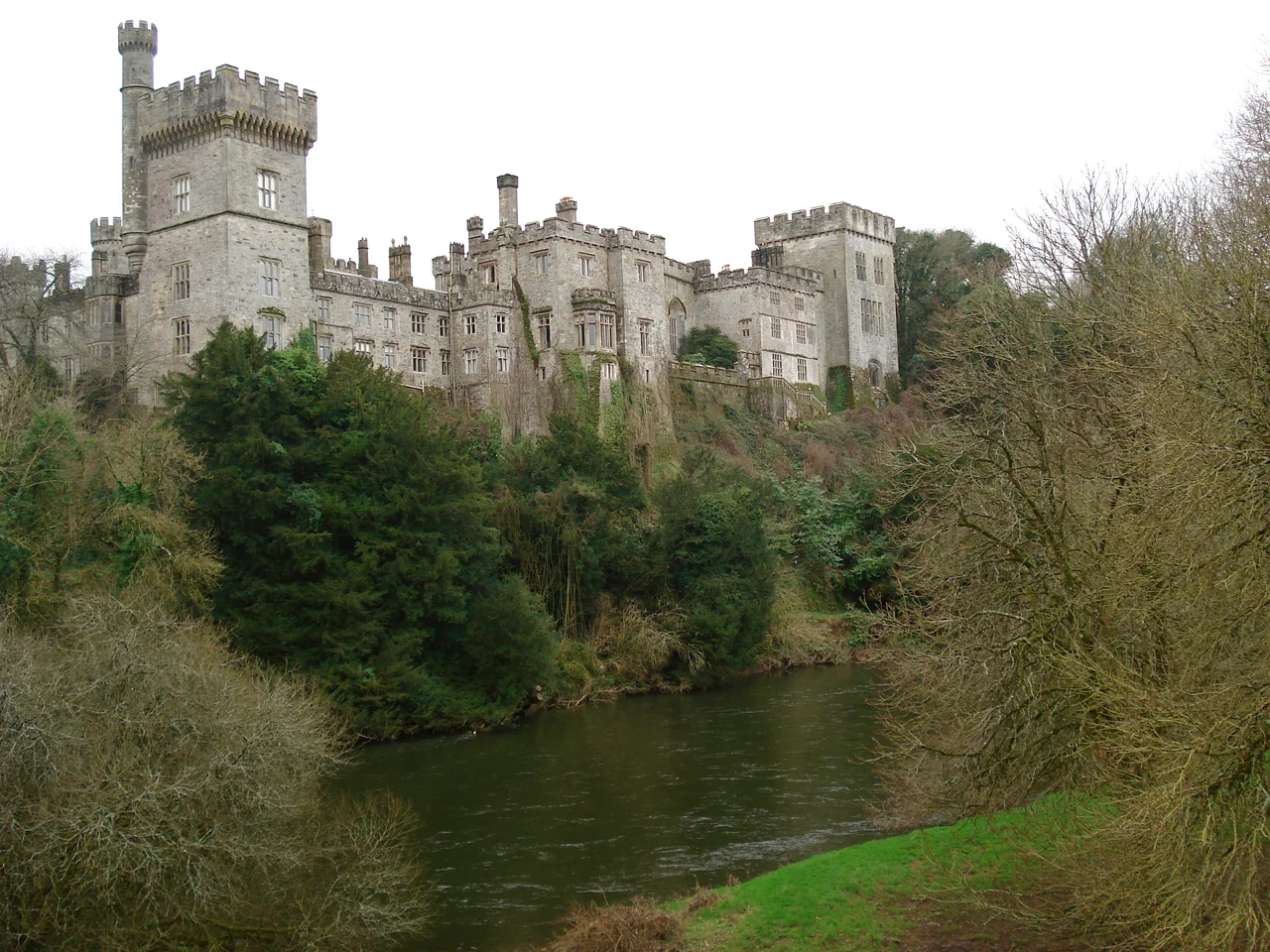
Lismore Castle
Sir Walter Raleigh - the same Raleigh of cloak-on-the-puddle legend and the colony at Roanoke - owned this place. He acquired it in 1589 and sold it in 1602 when he needed money during his imprisonment for treason. The buyer was a Yorkshireman named Richard Boyle, who had landed in Ireland in 1588 with twenty-seven pounds in his pocket and a determination to acquire as much as the kingdom would allow him to acquire. He acquired a great deal. At Lismore he made his principal seat, and on 25 January 1627, in one of its rooms, his fourteenth child was born. The boy was named Robert. He would become Robert Boyle, the father of modern chemistry, the man who gave science Boyle's Law. The castle that produced him still stands above the River Blackwater in County Waterford, mostly the work of a 19th-century duke who fell in love with the place.
Twelve hundred years above the river
Before there was a castle there was an abbey. Saint Carthage founded Lismore Abbey here in the early seventh century, and for hundreds of years it was one of the great schools of early Christian Europe. King Henry II of England stayed at the bishop's residence in 1171. Fourteen years later, his son Prince John - the future King John, Magna Carta's reluctant signatory - arrived in Ireland on his first expedition and built a castellum on the rock above the Blackwater. The same year, John raised a sister castle twelve miles north at Ardfinnan, also over an old monastery. Lismore and Ardfinnan are reckoned the oldest castles built by the English Crown in Ireland - the first physical projections of Plantagenet ambition into Gaelic territory. The site changed hands across the medieval centuries, falling to the Earls of Desmond before their lands were broken up after Gerald FitzGerald, the 14th Earl, was killed in 1583.
The first earl of Cork
Richard Boyle was good at acquisition the way some men are good at music. From his twenty-seven-pound start he assembled one of the largest private fortunes in early-modern Britain and Ireland. He bought Lismore from Raleigh in 1602, made it his seat, and transformed it: gabled ranges flanking the courtyard, a castellated outer wall, a gatehouse called the Riding Gate, principal apartments decorated with fretwork plaster ceilings and embroidered silks. By 1620 he was the 1st Earl of Cork. He fathered fifteen children, the fourteenth of whom, Robert, would join the Royal Society at its founding in 1660 and reshape how Europeans understood gases, pressure, and the chemistry of matter. In 1645 the Cromwellian wars caught up with the castle: Lord Castlehaven, commanding Catholic Confederate forces, sacked Lismore. The 1st Earl of Burlington restored it enough to keep it standing, but for over a century afterwards the family stayed away.
The Devonshires arrive
In 1753 Lady Charlotte Boyle - heiress of the 4th Earl of Cork and 3rd Earl of Burlington - married the Marquess of Hartington. Two years later he became the 4th Duke of Devonshire and, briefly, Prime Minister of Great Britain. Lismore passed with her into the Cavendish family along with a portfolio of other Boyle properties: Chiswick House, Burlington House in London, Bolton Abbey in Yorkshire. The 5th Duke commissioned a new bridge across the Blackwater in 1775 from the Cork-born architect Thomas Ivory. But Lismore did not become what it is now until the 6th Duke inherited in 1811. The 6th Duke - William Cavendish, known as the Bachelor Duke - made Lismore his obsession. From 1812 to 1822 he had William Atkinson rebuild it in the Gothic style, using cut stone shipped over from Derbyshire. In 1850 he hired the most fashionable architect of the age, Sir Joseph Paxton - designer of the Crystal Palace - to extend the castle on a magnificent scale. The skyline you see today is mostly Paxton's.
Pugin's chimney-piece and the Astaire marriage
Inside the castle, the ruined chapel of the old Bishop's Palace was transformed into a medieval-style banqueting hall by the Gothic Revival masters: Augustus Pugin, who designed Westminster's interiors, and J. G. Crace of London. The chimney-piece in the hall is a Pugin masterwork that had been exhibited at the Medieval Court of the 1851 Great Exhibition. It was originally meant for Horsted Place in Sussex but was rejected as too elaborate. Lismore took it instead. The Barchard family emblems on it were chiselled off and replaced with an Irish welcome: Cead Mille Failte - a hundred thousand welcomes. In the twentieth century the castle became, against everyone's expectations, the Irish home of an American dancer. Adele Astaire - sister and former dancing partner of Fred Astaire - married Lord Charles Cavendish, the younger son of the 9th Duke. Charles died in 1944, but Adele kept the castle as her own retreat until shortly before her death in 1981. She is buried in the family vault at Edensor in Derbyshire.
Adele's room and Adele's birthday
The Cavendish family still owns Lismore. The 12th Duke of Devonshire, who succeeded in 2004, lives mainly at Chatsworth, the great Derbyshire house. His son Lord Burlington manages Lismore and lives in an apartment in it. In 2005 he converted the derelict west range into Lismore Castle Arts, a contemporary art gallery, and the gardens - a 17th-century walled upper garden, an informal lower garden from the 19th century, contemporary sculptures by Antony Gormley and Marzia Colonna and Eilis O'Connell - are open to visitors most of the year. In 2018, when the singer Adele - the other Adele - turned 30, she chose Lismore for her birthday party, a fancy-dress affair with a Wonderland theme that drew Hollywood guests to this small Waterford town. Eight hundred and thirty-three years after Prince John raised his first castellum here, the castle was filled with music again, in a way Walter Raleigh and Robert Boyle could not have imagined.
From the Air
Lismore Castle stands at 52.14 N, 7.93 W on a bluff above the River Blackwater in County Waterford, between the Knockmealdown Mountains to the north and the Comeraghs to the east. Waterford (EIWF) is 28 nm east; Cork (EICK) 40 nm southwest; Shannon (EINN) 60 nm north. Recommended viewing altitude 2,000-3,000 ft AGL. The castle and its formal gardens occupy a dramatic site above the river - watch for the medieval bridge, the long terraces dropping toward the water, and the woodland sweeping up the Knockmealdown slopes behind. The Blackwater Valley is one of Ireland's most photographed pieces of countryside.
Nearby Stories
- Bridgetown Priory 3.5 km away
- Manx2 Flight 7100 4 km away
- Ballycotton Lighthouse 6.1 km away
- Battle of Kilmallock 9.5 km away
- Bansha 13 km away
- Ballyhale 15 km away
- All Together Now (festival) 19 km away
- SM U-27 127 km away