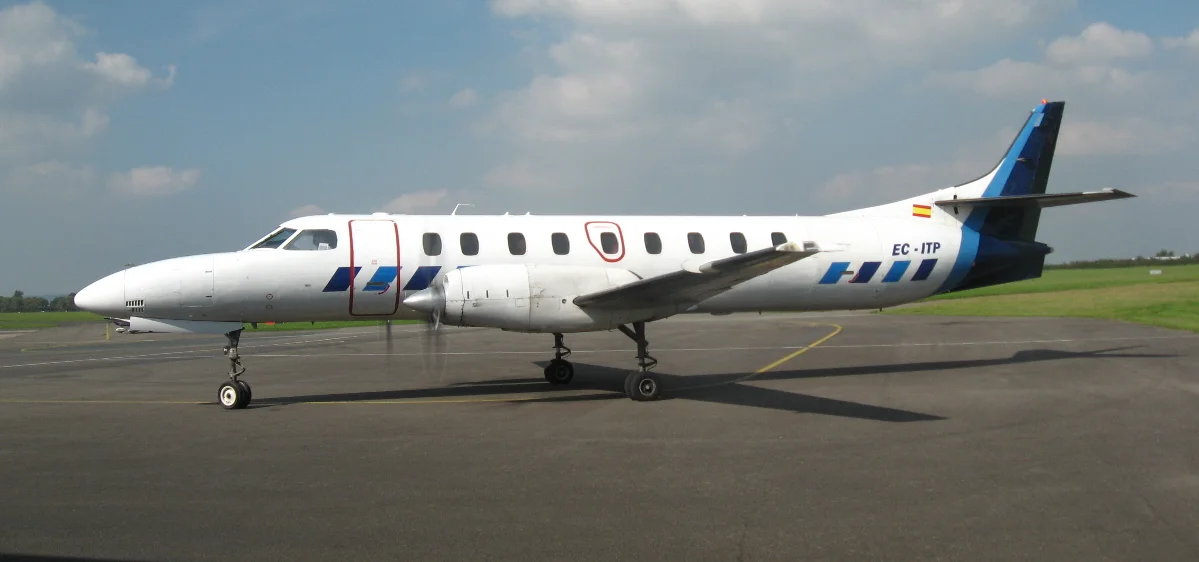

Manx2 Flight 7100
The weather report that morning told the whole story in code. Visibility 300 metres. Cloud broken at 100 feet. Fog. Temperature equal to dew point - the air saturated, the airfield wrapped in grey. At 9:50 on 10 February 2011, after two missed approaches into Cork Airport, the crew of Manx2 Flight 7100 was trying a third time to find the runway through the murk. Six people did not walk away from the aircraft that inverted on the soft ground beside the strip.
The People Aboard
Twelve souls were on the Fairchild SA 227-BC Metro III that morning - ten passengers and two crew. The aircraft was Spanish-registered as EC-ITP, owned by an airline called Air Lada, operated under the certificate of another Spanish airline called Flightline S.L., sold under the brand of the Isle of Man ticket seller Manx2. The passengers were mostly commuters making the routine Belfast City to Cork run, a flight Belfast and Cork business travellers used several times a week. Among the dead were people known on the route. The deputy First Minister of Northern Ireland, Martin McGuinness, later said publicly that he had planned to be on that flight but had changed his travel arrangements. He was due in Cork to campaign for the Irish general election scheduled for 25 February. The randomness of who lived and who died that morning weighed on the people who knew the dead - and on people, like McGuinness, who came to realise how narrowly they had not.
Three Approaches
The Air Accident Investigation Unit's final report, published in January 2014, found that the crew descended below the published decision height of 200 feet on all three approaches before initiating a missed approach - a clear breach of air safety regulations. On the third attempt, the aircraft lost control close to the runway, struck the surface, and came to rest inverted on the soft ground to the right of the runway centreline. Fires broke out in both engines and were extinguished within minutes by the Airport Fire Service. Six people died. Four passengers were seriously injured. Two passengers received minor injuries and were able to walk away from the wreckage. The two pilots were among the six dead.
What Was Wrong With the System
The investigation eventually filled hundreds of pages and made eleven safety recommendations - to the European Commission's Directorate-General for Mobility and Transport, to the European Aviation Safety Agency, to the Spanish aviation authority AESA, and to Flightline itself. The findings concerned fatigue and inadequate training of the flight crew, the relationship between a ticket seller and an operator with no obvious accountability between them, weaknesses in cross-border safety oversight, and the policy of repeatedly attempting an approach in marginal weather rather than diverting. Investigators pointed out that the structure of the operation - one airline's certificate, another's aircraft, a third party selling the tickets - made it hard for anyone to take full responsibility for safety culture. The phrase used in coverage at the time was virtual airline. In March 2011, EASA moved to suspend Flightline's air operator certificate. The certificate was not revoked, but Flightline was banned from operating Fairchild Metro IIIs. Manx2 ceased operations in December 2012. Its successor Citywing kept flying until March 2017, when it too closed.
What Remains
An inquest held in June 2014 returned verdicts of accidental death on all six who died. Family members of the dead and the injured announced their intention to pursue legal action against all three companies involved. The Cork crash entered the long, painful catalogue of small-aircraft accidents that change rules - the kind of accident whose recommendations end up rewriting checklists, training syllabi, and the small print of cross-border regulation. Cork Airport itself, sitting on its 153-metre hill, still wakes some February mornings inside the cloud. The instrument landing system was already at Category II. The runway had been extended to reduce diversions. None of that brought back the six. The pilot who had flown the Belfast-Cork route shortly before the accident, and who had left for another job days before, was reported in the press to have struggled with guilt afterwards and later died by his own hand. He, too, belongs to the human toll of the morning.
From the Air
The accident site is at Cork Airport (EICK), 51.84 N, 8.49 W, elevation 153 m. The crash occurred to the right of runway 17 on 10 February 2011, after three approaches in Cat II conditions: METAR reported visibility 300 m, RVR 350-375 m, fog, broken at 100 ft, with temperature and dew point both at 4 deg C. The site is unmarked from the air today; commercial traffic operates normally over it. Cork lies 7.5 km north of the airport along the N27.
Nearby Stories
- Ballycotton 8.7 km away
- West Cork 8.8 km away
- Cloghan Castle, Lough Hyne 11 km away
- Mourne Abbey 12 km away
- The Sinking of the Lusitania: The Torpedo That Changed the War 12 km away
- Headford Ambush 14 km away
- Lismore Castle 16 km away
- SM U-27 101 km away