,_County_Kilkenny_(geograph_6348519).jpg)
Ballyhale
Eight times the All-Ireland Senior Club Hurling Championship has gone to a single small village in County Kilkenny. The hurler with the most All-Ireland medals in history -- ten of them, with the Kilkenny county team -- grew up here. So did one of the most successful trios of brothers in Irish sport. Ballyhale is a place of fewer than 400 people that has dominated the toughest stick-and-ball game in the world for half a century. And out beyond the playing fields, a sandstone quarry holds fossil ferns 400 million years old.
The Shamrocks of Ballyhale
Ballyhale Shamrocks GAA was formed in 1972 when the village club amalgamated with Knocktopher and Knockmoylan. They proceeded to become the most successful hurling club in the history of the All-Ireland Senior Club Hurling Championship, winning the title nine times -- in 1981, 1984, 1990, 2007, 2010, 2015, 2019, 2020, and 2023. They have taken the Kilkenny Senior Hurling Championship twenty-one times. Henry Shefflin, born and raised in Ballyhale, holds the Irish record for the most All-Ireland Senior Hurling medals won by a single player: ten, all with the Kilkenny county team, between 2000 and 2014. Michael Fennelly has eight Kilkenny medals, T.J. Reid has seven, and the Fennelly family alone has produced Ger, Liam, Kevin, Michael, and Colin -- each with at least one All-Ireland medal. From a village of roughly 366 people in the 2020 electoral division count.
Kiltorcan Quarry
Above the village rises Kiltorcan Old Quarry, a sandstone outcrop that local authorities designated an area of specific interest in Kilkenny County Council's 2002 development plan. The rock is reputed to be around 400 million years old, dating to the Devonian period -- a time when Ireland sat much closer to the equator and was covered in early plants pushing onto land. Since 1853 the quarry has been internationally known for its discoveries of fossil ferns, examples of which are on display at the Natural History Museum in Dublin and the Rothe House Museum in Kilkenny. The quarry was opened commercially in the 1980s. The juxtaposition is quite something: a small Irish village with a 400-million-year-old fossil bed and the All-Ireland hurling trophy.
Creameries and Co-ops
Ballyhale Creamery was founded in 1895, the year after the founding of the Irish Agricultural Organisation Society, which had begun the cooperative movement in Ireland under Horace Plunkett. In 1965 a federation of 25 co-op creameries emerged under the umbrella of Avonmore Creameries Ltd. By 1973 the Ballyhale creamery had been formalised into Avonmore Farmers Ltd., one of 20 founding members. Avonmore eventually merged with Waterford Foods in 1997 to form Glanbia plc, the global dairy giant now operating in 34 countries. The Ballyhale Creamery's 100th anniversary booklet in 1995 records the chain of transitions from village dairy to global agribusiness. In a small way, the food on the tables of more than 100 countries today still passes through the bookkeeping that started in a stone creamery in a Kilkenny village in 1895.
Monster Meeting, 1832
Before hurling, before the creamery, Ballyhale played a part in one of the strangest gatherings of 19th-century Ireland. In 1832, around 200,000 people gathered in Ballyhale for the trial of those charged in the aftermath of the Battle of Carrickshock -- the violent clash between tithe collectors and local farmers that had taken place the previous year about ten kilometres east. Daniel O'Connell, the Liberator, successfully defended the accused and addressed the crowd in Irish. Researchers consider this the first 'monster meeting' of the era, and a significant moment in ending the tithe system in Ireland. Such peaceful, massive gatherings became the trademark tool of O'Connell's Repeal Movement, which would peak at Tara in 1843 with an estimated 750,000 people. From there it is a straight line to Young Ireland, to the Land League, to Home Rule, and ultimately to Irish independence.
From the Air
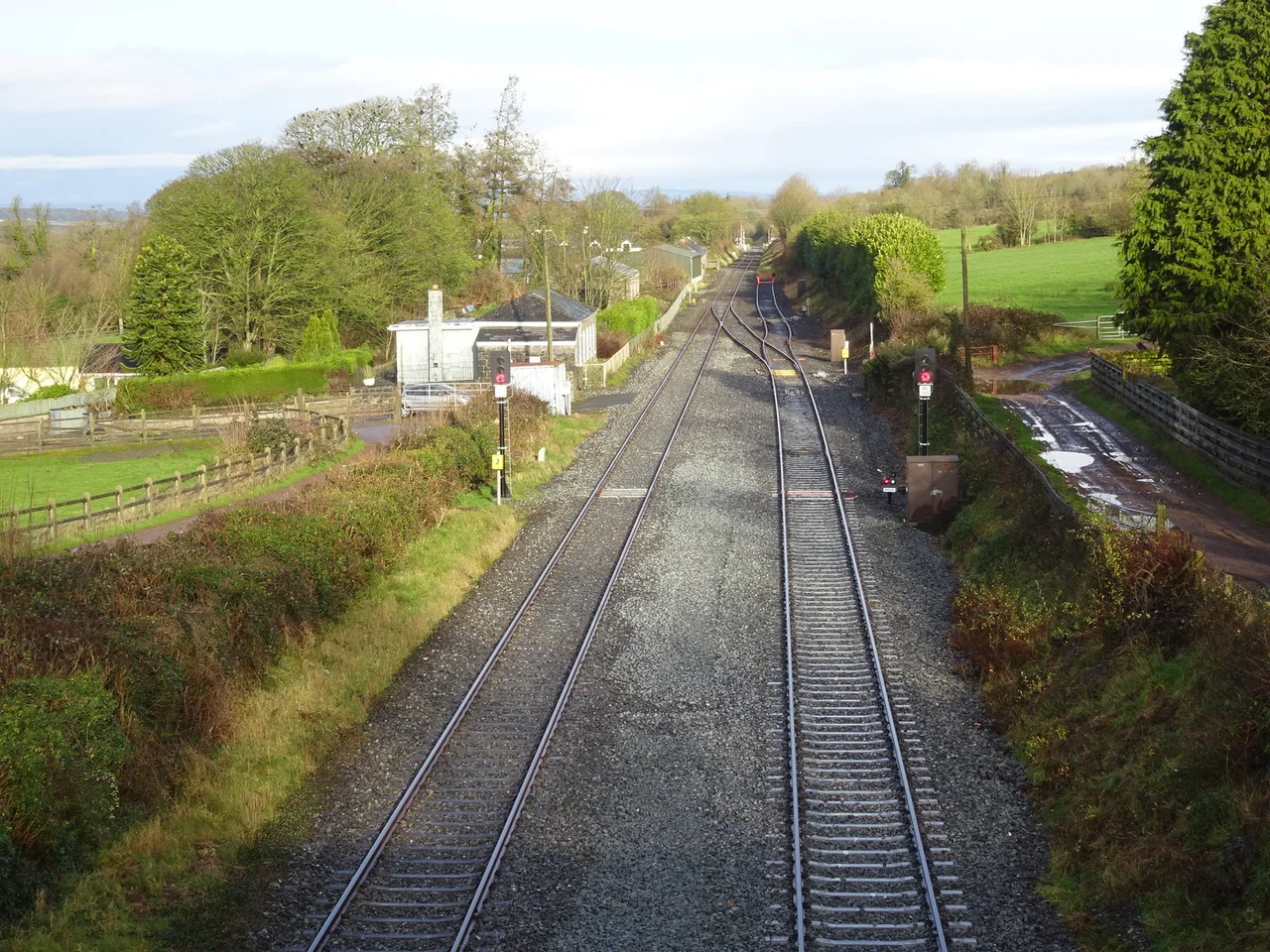
Located at 52.47 degrees N, 7.20 degrees W in County Kilkenny, Ireland, on the R448 road between Knocktopher and Mullinavat. From altitude Ballyhale appears as a small village surrounded by mixed pasture and tillage in the rolling Kilkenny country. The closed Ballyhale railway station (Dublin-Waterford line) sat on the edge of the village from 1853 to 1963. Nearest airports: Waterford (EIWF) approximately 25 km south; Cork (EICK) approximately 105 km southwest. Best viewed below 2,500 ft AGL.
Nearby Stories
- County Wexford 3.4 km away
- Loughmoe Castle 6.6 km away
- Castlecomer 8 km away
- Waterford Airport 8.5 km away
- Mount Melleray Abbey 8.7 km away
- Cashel, County Tipperary 12 km away
- Wicklow Gold Rush 27 km away
- HMS H47 92 km away