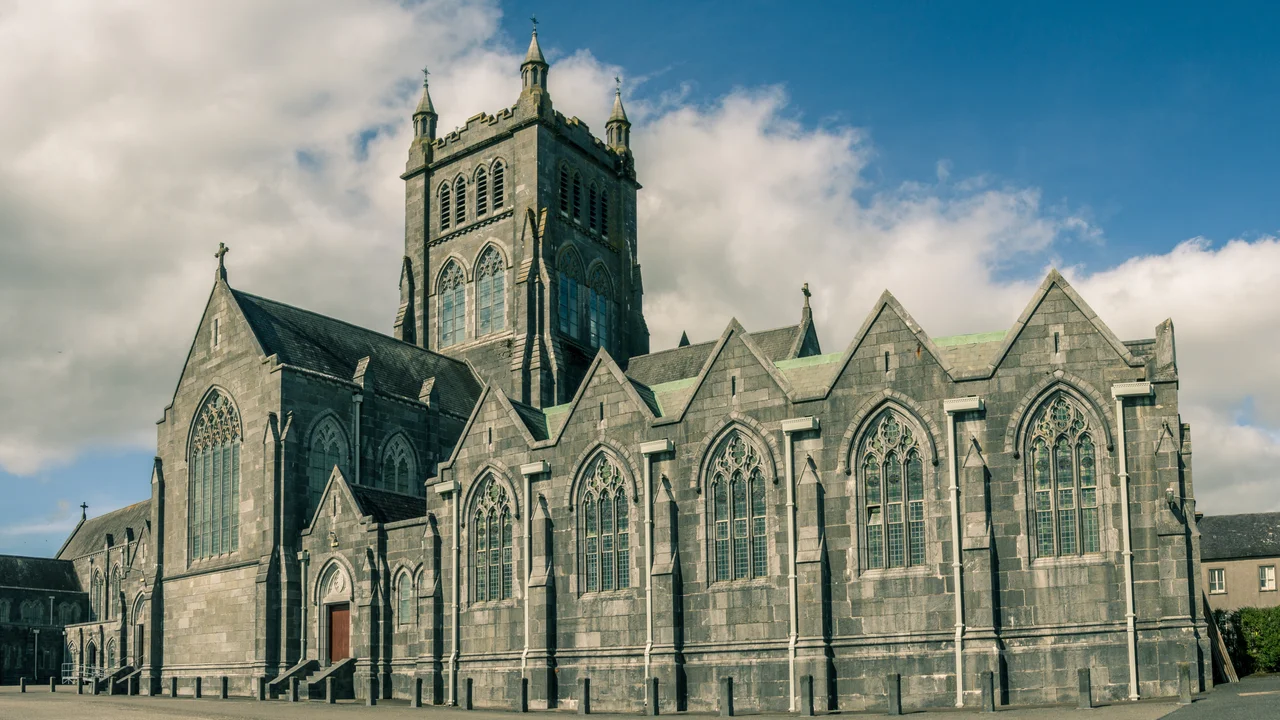

Mount Melleray Abbey
In 1830 the Bourbon king of France fell in a three-day revolution, and within months a French abbot was sending Cistercian monks across the sea to Ireland. The Cistercians at Melleray in Brittany had only just rebuilt themselves after the long persecutions of the French Revolution. Seventy of their two hundred members were Irish. Now another revolution was driving them out again. The abbot sent Waterford-born Vincent Ryan home with a mission: found a daughter house in Ireland. On 30 May 1832, on a bleak slope at Scrahan near Cappoquin, Ryan and his companions broke ground. They called the new place Mount Melleray, for the motherhouse they had been expelled from. The local people - many starving in the years before the Great Famine - came to help reclaim the soil. The Cistercians had returned to Ireland for the first time since the Reformation, and they would stay almost two hundred years.
Building on bare mountain
The site was unpromising: a north-facing slope in the foothills of the Knockmealdown Mountains, treeless and stony, well outside the prosperous valleys. The brethren broke the soil themselves with help from the parish of Modeligo. On the feast of Saint Bernard in 1833 the foundation stone was blessed by William Abraham, Bishop of Waterford and Lismore. In 1835 the monastery was raised to the dignity of abbey and Ryan, unanimously elected, received the abbatial blessing - the first time such a blessing had been given in Ireland since the Reformation three centuries earlier. The same year, monks sent from Mount Melleray founded Mount Saint Bernard Abbey in Leicestershire. Daniel O'Connell, the Liberator who was busy securing Catholic Emancipation, visited the new community in 1838 and made his support public. Within a generation the Irish revival of Cistercian monasticism had been launched.
Stirabout for the starving
In July 1849, with the Great Famine receding but its ruin still everywhere, the Scottish essayist Thomas Carlyle paid a visit. He was on his way back from Dromana House, a few miles down the valley. He noted, with his usual sour eye, what he found at the gates of Mount Melleray: "Entrance; squalid hordes of beggars, sit waiting," and the "nasty tubs of cold stirabout (coarsest I ever saw) for beggars." Carlyle thought the porridge inadequate. The beggars were grateful. He also observed - with grudging accuracy - that the monastery "must have accumulated several thousand pounds of property in these seventeen years, in spite of its continual charities to beggars." Whatever Carlyle thought, Mount Melleray spent the famine years feeding the people the British administration could not or would not feed. Bruno Fitzpatrick, who became abbot in 1848, founded two further communities: New Melleray near Dubuque, Iowa, in 1849, and Mount Saint Joseph at Roscrea in Tipperary in 1878.
Stones from a burned castle
In 1922 the IRA burned Mitchelstown Castle - the biggest neo-Gothic house in Ireland - twenty-eight miles west across the Knockmealdowns. Three years later, with the Civil War over, the Kingstons' heirs decided to dismantle what was left of the ruin and sell the stones. Mount Melleray bought them. The deal made sense for both sides. The monks were trying to build a permanent abbey church to replace their original buildings, and Marius O'Phelan, the abbot, needed great quantities of cut limestone. The Kingstons needed cash. Steam lorries hauled the blocks from Mitchelstown to Cappoquin, two consignments a day for at least five years. O'Phelan died before the work was done. Celsus O'Connell, his successor, finished the abbey church on a prominent site directly above the graves of 180 fellow Cistercians who had gone before. The monks ended up with more stones than they needed. The surplus was stacked in fields around the monastery and stayed there for decades, slowly returning to soil.
A school, a scout camp, a poem
From its earliest days Mount Melleray ran a school for clerical and lay students alike, set in a small house outside the enclosure. Past pupils included James O'Gorman, who would become second prior of New Melleray; W. H. Grattan Flood, the musicologist; and a remarkable line of Irish missionary bishops in Australia. James Joyce mentions the abbey in The Dead - one of the small, exact strokes by which he places his Dublin characters in the larger geography of Catholic Ireland. The Irish-language poet Sean O Riordain devoted one of his most celebrated poems, Cnoc Melleri (1952), to a stay here. The boarding school finally closed in 1974. In 1977 the Catholic Boy Scouts of Ireland held their jubilee at Mount Melleray, and in 1979 they took over the former school buildings as the Mount Melleray National Scout and Activity Centre, which still operates today.
A quiet ending
Eamon Fitzgerald, who served as abbot of Mount Melleray from 1989 to 2008, became the abbot general of the worldwide Cistercian order from 2008 to 2022 - the first Irishman to hold the office. But the slow decline was unmistakable. Vocations had dried up. The community was ageing. In November 2024 the Trappists announced the closure. On 25 January 2025, after almost two hundred years on this slope, Mount Melleray Abbey closed its doors. The six remaining monks moved to Mount Saint Joseph at Roscrea - the daughter house their predecessors had founded in 1878. The buildings stand empty above the Knockmealdown valley. The stones from Mitchelstown Castle, transported here by steam lorry a hundred years ago, are silent again. The story of Mount Melleray begins and ends with monks crossing water in search of a place to live their rule - from Brittany in 1832, and back across the country to Tipperary in 2025.
From the Air
Mount Melleray sits at 52.19 N, 7.86 W on the north-facing slope of the Knockmealdown Mountains, about 5 km north of Cappoquin in County Waterford. Waterford (EIWF) is 30 nm east; Cork (EICK) 35 nm southwest; Shannon (EINN) 55 nm north. Recommended viewing altitude 2,500-3,500 ft AGL. The abbey stands at about 250 m elevation, with the Knockmealdown ridge climbing south behind it to over 700 m. The Blackwater valley spreads to the north and west - the river itself snaking through woodland past Lismore Castle 9 nm to the southwest. Watch for orographic cloud forming on the Knockmealdown ridge in wet weather.
Nearby Stories
- Bridgetown Priory 3.5 km away
- Manx2 Flight 7100 4 km away
- Ballycotton Lighthouse 6.1 km away
- Battle of Kilmallock 9.5 km away
- Bansha 13 km away
- Ballyhale 15 km away
- All Together Now (festival) 19 km away
- SM U-27 127 km away