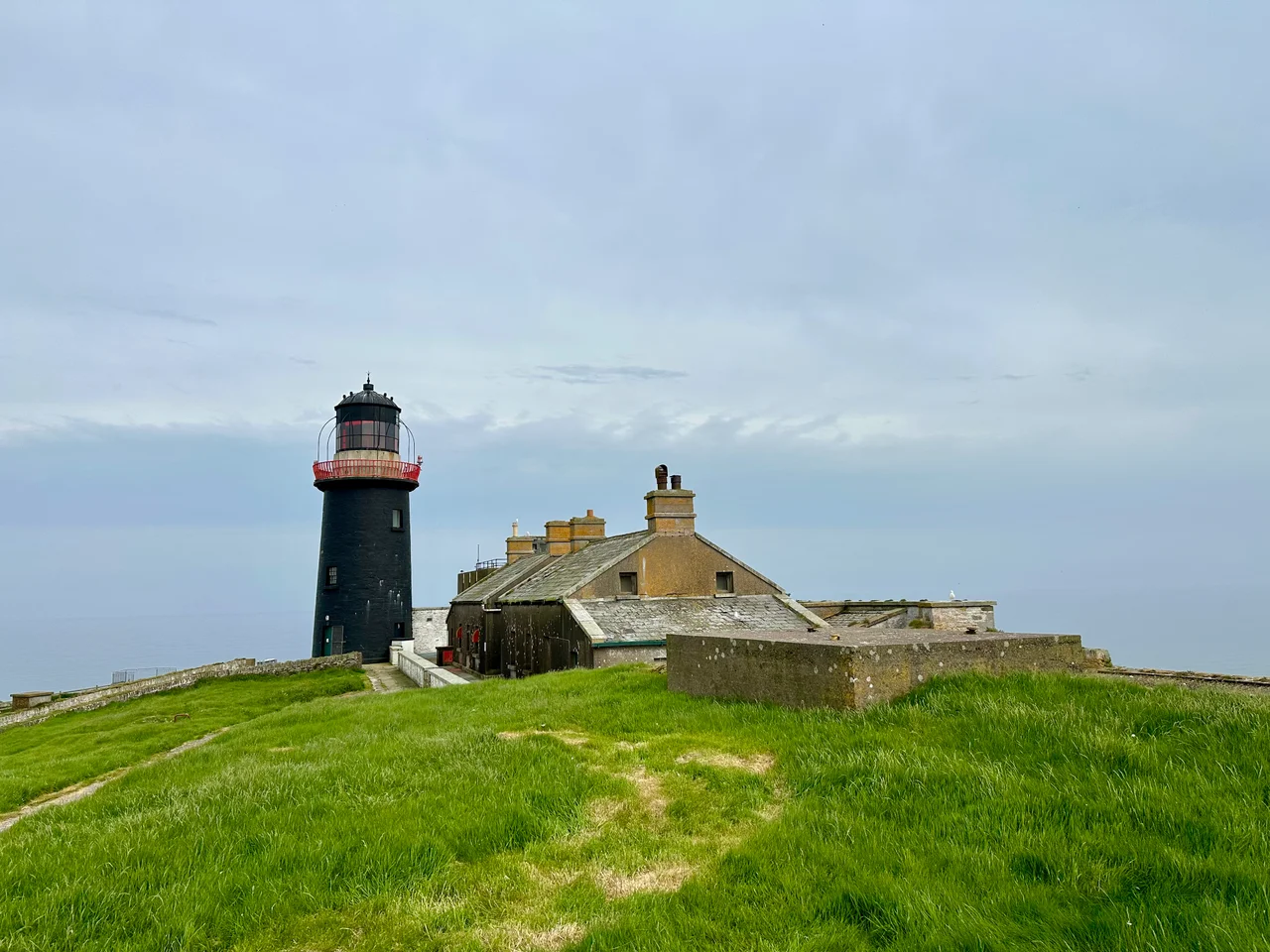

Ballycotton Lighthouse
Look at any picture of Ballycotton from the cliffs and your eye goes straight to the wrong color. Lighthouses are white. They are painted white because white shows up best against the open sea, the empty horizon, the morning sky. Ballycotton's tower, completed in 1851 on a sloping green island half a kilometre off the East Cork coast, has been painted matte black since 1902. It looks impossible from a distance - a vertical strip of darkness against the grass and the bird-streaked rock. The reason is not aesthetic. A few miles to the east is Capel Island, where a separate unlit stone beacon was already painted white. By day the two needed to be told apart, and the Commissioners of Irish Lights chose black for Ballycotton.
The Engineer Behind the Tower
Ballycotton Lighthouse was the work of George Halpin Senior, the Engineer to the Commissioners of Irish Lights from 1810 until his death in 1854. Halpin designed and built more lighthouses than any other engineer in Irish history - somewhere over fifty towers along the Irish coast, including the iconic Hook Head, the Skelligs, the Fastnet, Inishtearaght and the great Tory Island light. He was the master technician of nineteenth-century Irish navigation aids, working at a time when Irish coastal waters were among the most heavily trafficked and most dangerously charted in Europe. Ballycotton was one of his later commissions. The original plan placed the tower on Capel Island, six kilometres east, but in 1844 surveyors decided that Ballycotton Island - higher, more central to the bay, and easier to land at - was the better choice. The light was first lit in 1851. The tower stands sixty metres above sea level, with its lantern at the summit visible from ships up to twenty-two kilometres offshore.
Why the Black Paint
Lighthouse colours are part of the language of navigation. By day, when the lights are off, the shape and pattern of the tower itself becomes the identifier - this is called the day-mark. Ireland's lighthouses are painted in patterns that distinguish them from each other and from any nearby beacons. Hook Head is white with two black bands. The Fastnet is grey unpainted granite. Tuskar Rock is white. The Capel Island beacon, built in the 1820s and never lit, was a plain white tower visible from far out at sea. When Ballycotton's tower went up directly to the west, the Commissioners needed a clearly different daymark. Black was the obvious solution: a tower so dark it could never be confused with a white one at a distance. The change did not come immediately — for its first four decades the tower stood unpainted. In 1892 a single black band was painted around the centre of the tower as a provisional measure. By 1902 the entire tower was painted black, the form it has held ever since. The keepers repainted it every few years. The colour is now one of the most distinctive in Irish lighthouse history. Only a handful of lighthouses in the world are painted black at all.
The Keepers and Their Children
When the light was commissioned in 1851, the keeper and his family lived on Ballycotton Island full-time. The island is small - twenty hectares of grass and rock, with a single steep path from a small landing quay to the lighthouse compound at the summit. In good weather the keeper's children rowed across the half-kilometre channel to attend school in Ballycotton village. In bad weather they did not. The arrangement lasted until 1899, when the system was reorganised - the keepers' families moved to houses in Ballycotton itself, and the keepers themselves rotated duty on the island, doing weeks or months on, weeks or months off. By the 1970s there were typically four keepers on the rotation, with one or two on the island at any given time, watches changed at the morning landing. The light was converted from oil to electricity in 1975, eliminating the heavier maintenance burden. Automation came in 1991. On 28 March 1992 the last lighthouse keepers were withdrawn from Ballycotton, ending more than 140 years of human occupation of the island.
The Foghorn
Beside the lighthouse stood, until 2011, a great mechanical foghorn powered by a thousand-volt overhead line. Foghorns are the auditory equivalent of lights - long deep blasts at carefully timed intervals, each station with a distinctive pattern, so that mariners in fog could not only hear the warning but know which station it came from. The Ballycotton horn was one of the loudest on the south coast, audible for several miles in calm fog. Locals across the channel on the mainland knew the timing of its blasts so well that they could tell the season by the horn alone - the foghorn fired more often in autumn and spring, less in summer. It was decommissioned in 2011 as part of a broader withdrawal of fog signals around the Irish coast; satellite navigation and radar had made horns redundant for serious shipping. There was real local mourning for it. Some Ballycotton residents have said that the silence after the last blast was noticeable for months.
Tours and the Island Today
Since 2014 the island and the lighthouse have been formally open to the public. Boats run from Ballycotton harbour during the summer months, weather permitting, ferrying visitors across the channel to the small quay at the foot of the island. From there a steep path winds up through grass and gorse to the lighthouse compound, where you can climb the tower's interior staircase to the lantern room and look out over Ballycotton Bay - the cliff coast to the west toward Cork Harbour, the long sand beach east to Knockadoon Head, and on a clear day the Comeragh Mountains in County Waterford. The keepers' houses are preserved and converted into visitor accommodation; the original lens, replaced by a smaller modern optic in the automation, is on display. Black on a green rock in a blue sea, the lighthouse is one of the more photographed places on the south coast of Ireland. The day George Halpin chose the colour, the brief was practical. The result became an icon.
From the Air
Located at 51.83 degrees N, 7.98 degrees W, on Ballycotton Island half a kilometer offshore of Ballycotton village in East Cork. Cork Airport (EICK) lies thirty-three kilometers west-northwest. Best viewing altitude 2,000 to 5,000 feet to see the small island with its distinctive black tower, the harbour and village on the mainland to the north, the long sandy beach extending east to Knockadoon Head. The Capel Island beacon lies about six kilometers east-northeast - the white-painted unlit tower that Ballycotton's black paint was chosen to distinguish from.
Nearby Stories
- Charles Fort 9 km away
- Lismore Castle 12 km away
- Bridgetown Priory 13 km away
- The Sinking of the Lusitania: The Torpedo That Changed the War 14 km away
- 1999 Tramore helicopter crash 23 km away
- Walter Siepmann 30 km away
- Hook Lighthouse 50 km away
- SM U-27 88 km away