
1999 Tramore helicopter crash
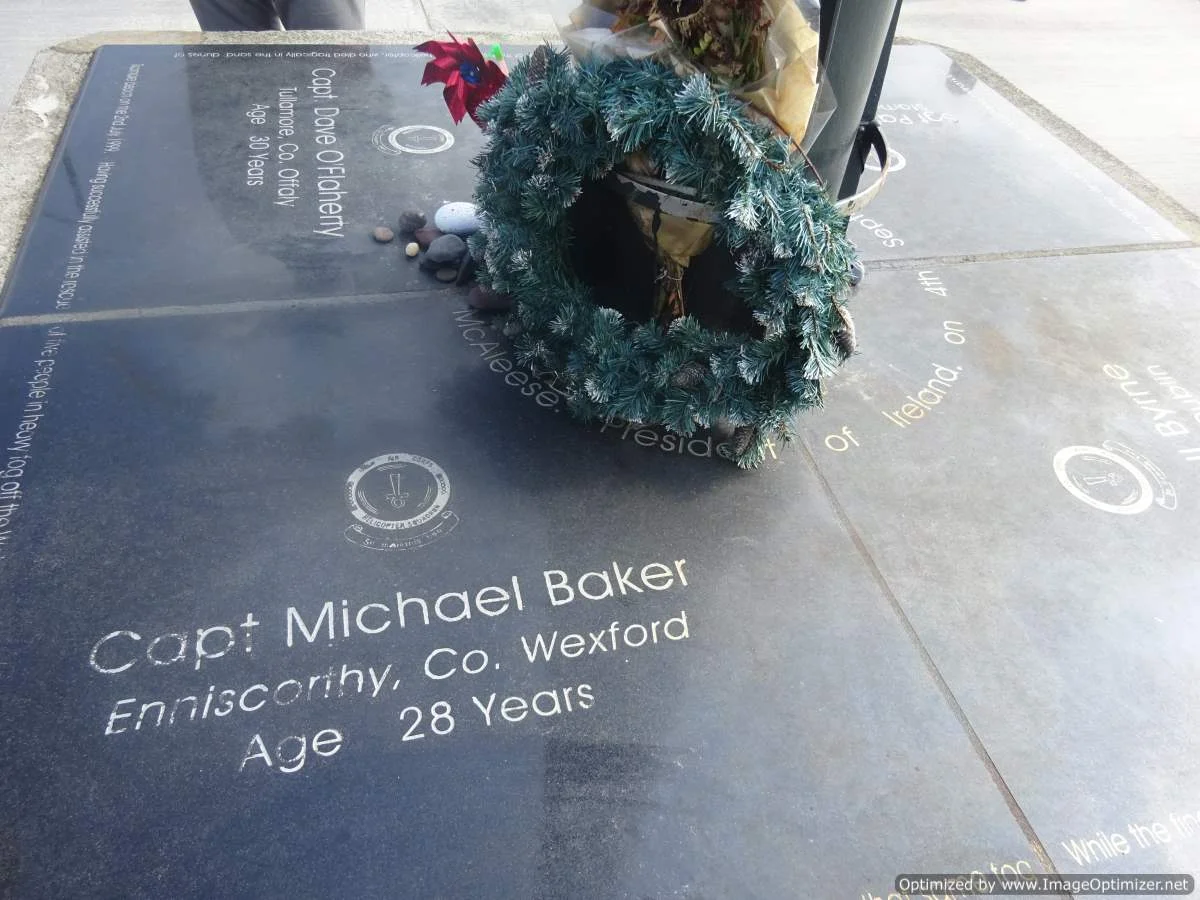
It was supposed to be a beginning. Thursday 1 July 1999 was the first day that a 24-hour search and rescue helicopter would be based at Waterford Airport - a service intended to cut response times for fishermen, swimmers, and sailors in trouble along Ireland's south coast. The Eurocopter Dauphin had been flown down that morning from the Air Corps headquarters at Casement Aerodrome in Dublin. By the early hours of the next day, the helicopter and four of its crew were gone, the wreckage scattered across the sand dunes behind Tramore beach. The men were trying to get home through heavy fog after a routine mission. Their names were Captain David O'Flaherty, Captain Michael Baker, Sergeant Patrick Mooney, and Corporal Niall Byrne. They were 30, 28, 34, and 25 years old.
The First Day
For years the Air Corps had run search and rescue from its main base at Baldonnel, the airfield west of Dublin. But the Irish south coast - the long stretch of cliffs and fishing harbours between Wexford and Kerry - was a long flight away when minutes mattered. In 1999 the government finally funded a permanent SAR detachment at Waterford Airport, an hour's flight closer to where most of the call-outs came from. The first day of the new arrangement was 1 July. The Dauphin, callsign Rescue 111, flew in from Casement that morning with a crew of seven aboard - four flying crew and three technical crew - to take up station. Through the day they would have settled into the new accommodation, briefed with local controllers, and begun the routine duty shifts. The flying crew - O'Flaherty as aircraft commander, Baker as co-pilot, Mooney as winch operator, Byrne as winchman - were among the most experienced SAR specialists the Air Corps had.
Fog at Waterford
The Dauphin was scrambled late on Thursday night to take a sick crewman off a fishing vessel further out in the Celtic Sea. The mission itself went without incident; the patient was successfully transferred and taken to hospital in Cork. By the time Rescue 111 turned for home it was already past midnight, and conditions at Waterford Airport had deteriorated badly. A thick sea fog had rolled in off the coast and visibility on the runway was effectively nil. The crew began a non-precision approach. When they could not see the runway, they initiated a missed approach and circled to try again. The Eurocopter Dauphin was not equipped for a full ILS approach in those conditions, and the procedures the crew were following had limitations the subsequent investigation would examine in detail. Some time around 00:55, while manoeuvring at very low altitude in the fog, the helicopter struck the high sand dunes behind Tramore beach.
The Dunes
The sand dunes at Tramore are an unusual feature on the Irish south coast - a long, high ridge of marram-covered sand that rises sharply behind the beach and forms a natural ridge between the bay and the inland flats. To a low-flying helicopter approaching the airport from the south in zero visibility, those dunes are precisely the kind of terrain that radar altimetry will not warn about in time. The aircraft was destroyed on impact. All four men aboard were killed instantly. The first responders found the wreckage in the early morning, scattered across the dunes a short distance from the beach where children would play that afternoon. The local Munster Express, twenty years later, would print the words of one of those responders: 'The worst silence I ever heard in all my life.'
Four Men
Captain David O'Flaherty had been a senior SAR pilot for years and was the aircraft commander that night. Captain Michael 'Mick' Baker was his co-pilot, a young officer who had only recently completed his training on the Dauphin. Sergeant Patrick Mooney, 34, was the winch operator - the crewman who lowers the rescuer to a casualty from the open door. Corporal Niall Byrne was the winchman himself, the man who would have ridden the wire to whoever needed help. They had all taken the same risk that night: a return through weather they thought they could handle, after a job already done well. In the small Irish military community, news travelled in hours; in towns from Galway to Wexford, ex-airmen and serving SAR crews put on their uniforms. The Munster Express noted later that the four crewmen were buried with the kind of state honours normally reserved for soldiers killed in action overseas. They left behind wives, children, parents, brothers and sisters.
What Followed
The Air Accident Investigation Unit's final report, published in June 2000, was unsparing. It identified failures in training, equipment, and procedure. The Dauphin's instruments were not adequate for the kind of approach the crew were trying to fly into Waterford that night. The crew themselves had received training in the published procedures, but the procedures themselves were judged inadequate for night low-visibility operations at the airport. The report led to significant changes: Irish SAR was eventually transferred from the military Air Corps to a civilian contractor under the Irish Coast Guard, equipped with full-spec Sikorsky S-92s. A memorial garden was opened at Tramore. Every year on 2 July, families and former colleagues gather there. The names are read out. It is the kind of remembrance that the people of Tramore have made part of their own calendar, because what happened in their dunes that night was a service rendered for them, and the cost of it was four lives. In March 2017, when Rescue 116 was lost off Blackrock Island in County Mayo, Tramore came back into the conversation immediately. Some lessons take more than one generation to learn.
From the Air
The crash site is at 52.15°N, 7.10°W, in the sand dunes behind Tramore beach in County Waterford, about 12 km west of the city of Waterford and about 5 km south of Waterford Airport (EIWF). From the air, look for the long curving Tramore Bay with its distinctive high dune ridge between the beach and the inland marsh. The airport sits inland on slightly higher ground. The memorial garden lies on the dune-top road. The site is on a low-altitude approach path to EIWF; pilots flying into Waterford in IMC should remember this place. Nearest civil airports: Waterford (EIWF) immediately north, Cork (EICK) about 110 km west, Shannon (EINN) about 170 km north-west.
Nearby Stories
- Kilkenny College 4.6 km away
- Mount Melleray Abbey 11 km away
- County Wexford 13 km away
- Ballycotton Lighthouse 18 km away
- Cashel, County Tipperary 18 km away
- Johnstown Castle 23 km away
- Ballycotton Lifeboat Station 55 km away
- Skomer 96 km away