
Ballycotton Lifeboat Station
The lighthouse on Ballycotton Island is 196 feet tall - sixty metres of granite tower rising from a rock half a kilometre offshore. On the morning of 10 February 1936, sea spray was being blown clean over the top of it. The wind was a measured hurricane, force twelve on the Beaufort scale, and the seven men of the Ballycotton lifeboat had walked, unsummoned, down to their boathouse and were waiting. Someone, somewhere off the East Cork coast, was going to need them. They could not have guessed that what was coming would keep them at sea for forty-nine hours, that they would attempt six separate boardings in seas they could not see across, that they would ram their own boat against a lightship in the dark, and that when it ended their coxswain Patrick Sliney would be the first man in the history of the RNLI ever to win a gold medal for an Irish service.
The Station Before the Storm
The Royal National Lifeboat Institution was founded in London in 1824 but came late to the Irish coast. By 1854, when the RNLI began a major Irish expansion, there were still only four lifeboats stationed around the entire island. A snowstorm in February 1855 stranded a barque in Ballycotton Bay - the local ship's pilot tried to muster a crew, but the tide had gone out before they could launch, and the crew of the wreck simply walked ashore. The episode persuaded the RNLI that East Cork needed its own boat. A small six-oared lifeboat was delivered in 1857; the boathouse on the quay at Ballycotton was completed in 1858. The first boat was too small for the open Atlantic; a ten-oared boat replaced it in 1866, requiring an expansion of the boathouse. A new boathouse was built in 1873, modified again in 1891 when a larger boat arrived. Modern lifeboats stay afloat at moorings rather than in boathouses, so a new station building with crew facilities was opened in 2002, the boats now stationed in the small harbour.
The Daunt Lightship
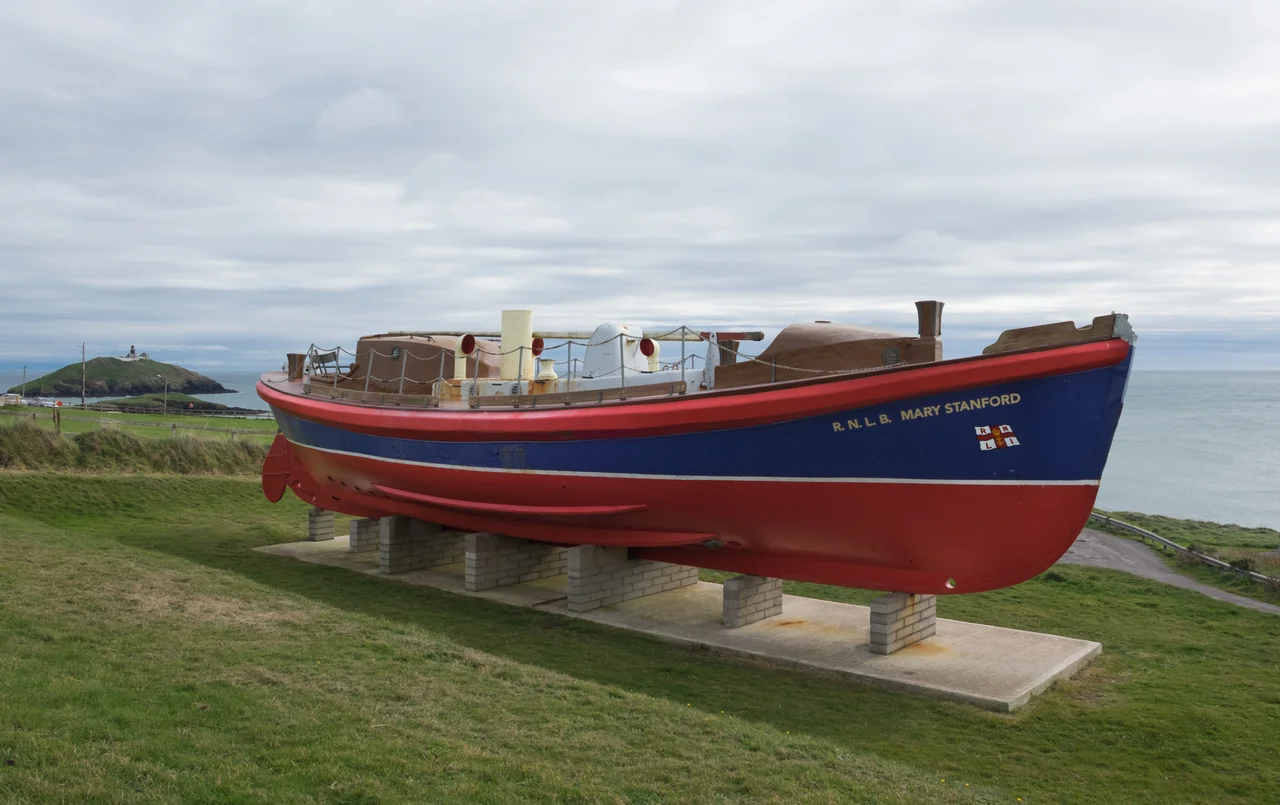
The Daunt Rock sits ten miles east-southeast of Cork Harbour entrance, a shallow ledge that has wrecked ships for as long as ships have used the harbour. A lightship - a manned floating lighthouse - had been moored over it since the nineteenth century, riding to massive anchors that held it in position. On 10 February 1936 the storm broke the anchors. The lightship began drifting toward the rocks. The Ballycotton lifeboat - the Mary Stanford, a thirty-seven-foot motorboat - launched into the hurricane and searched for two hours in visibility of yards rather than metres. Defeated, they put into Cobh harbour for word. The coastguard redirected them. They found the lightship riding to an emergency anchor; her crew refused to abandon her, knowing she would become a worse hazard if left adrift. So the lifeboat stood by. The British destroyer HMS Tenedos also came up. Both attempted to tow the lightship back into position. Both failed. Night came. The Tenedos stayed; the lifeboat returned to Cobh to refuel.
Five Attempts in the Dark
The next day they went out again, warning passing ships about the lightship's drifted position. They returned to Cobh for fuel, found the petrol was not ready, lost more hours waiting. When they got back to the lightship she had drifted again, into a position so close to the rocks that the lightship's crew now had to come off. The space between her hull and the breaking rocks was so narrow that the lifeboat could not easily come alongside. They made six separate attempts. On one, the two vessels were lifted by the same wave and collided, damaging the lifeboat. On subsequent attempts, in the lulls between seas, they managed to throw lines aboard and pull men one at a time onto their deck. Eight crewmen of the Daunt Rock lightship came off her by the time the rescue ended. The lifeboat returned to her harbour having been called out for seventy-six hours, launched for sixty-three hours, and at sea for forty-nine hours. The crew had gone most of that time without food.
The Medals
The RNLI awards medals sparingly. Gold medals - the very highest service award - are given perhaps once a decade in the entire institution. After the Daunt Rock rescue, the Institution awarded coxswain Patrick Sliney the gold medal: his rescue ranks among the dozen most decorated in two centuries of RNLI history. His second coxswain John Walsh and motor mechanic Thomas Sliney received silver medals. The other four crew - John Sliney, William Sliney, Michael Walsh and Thomas Walsh - received bronze medals. Almost all the surnames are Sliney and Walsh because lifeboat crews in small Irish coastal towns were and are family businesses. Patrick Sliney told the story on a radio broadcast on 13 March 1936, and again when the crew traveled to London in May to receive their medals from the Prince of Wales. Sliney would win two more medals over the next seven years: a bronze for rescuing eight from the Primrose in 1941, navigating through fog and German mines, and a silver in 1942 for the thirty-hour rescue of thirty-five people from the SS Irish Ash.
The Family Trade
Look at the Ballycotton medal roll and the names repeat. Slineys and Walshes again and again across the twentieth century. Coxswain Richard Harding won a silver medal in 1911 for saving nine from the Tadorna in a November storm - twelve others on the same ship were rescued by rocket apparatus from the cliffs. In 1979, when the Fastnet Race was scattered by an unforecast Atlantic storm that killed fifteen sailors, the Ballycotton boat was one of thirteen Irish and British lifeboats that put out into the chaos. The station received a commemorative certificate. In August 2001, emergency mechanic Fergal Walsh - another Walsh - won a silver medal for jumping into the sea unaided to save a man washed off the cliffs by a freak wave. Today Ballycotton remains an active RNLI station, with an all-weather Trent-class lifeboat moored in the harbour and a crew on call twenty-four hours. The Daunt Rock lightship is gone now, replaced by an automated buoy, but the memory of those forty-nine hours in February 1936 is the rescue that defines the station, and the institution.
From the Air
Located at 51.83 degrees N, 8.00 degrees W, on the harbour quay of Ballycotton village in East Cork, on the south coast of Ireland. Cork Airport (EICK) lies thirty-three kilometers west-northwest. Best viewing altitude 2,000 to 4,000 feet to see the small harbour, the distinctive black-painted Ballycotton Lighthouse on the offshore island half a kilometer south, and the cliff coast running east to Knockadoon Head. The Daunt Rock buoy lies about seventeen kilometers west, near the entrance to Cork Harbour.
Nearby Stories
- Charles Fort 9 km away
- Lismore Castle 12 km away
- Bridgetown Priory 13 km away
- The Sinking of the Lusitania: The Torpedo That Changed the War 14 km away
- 1999 Tramore helicopter crash 23 km away
- Walter Siepmann 30 km away
- Hook Lighthouse 50 km away
- SM U-27 88 km away