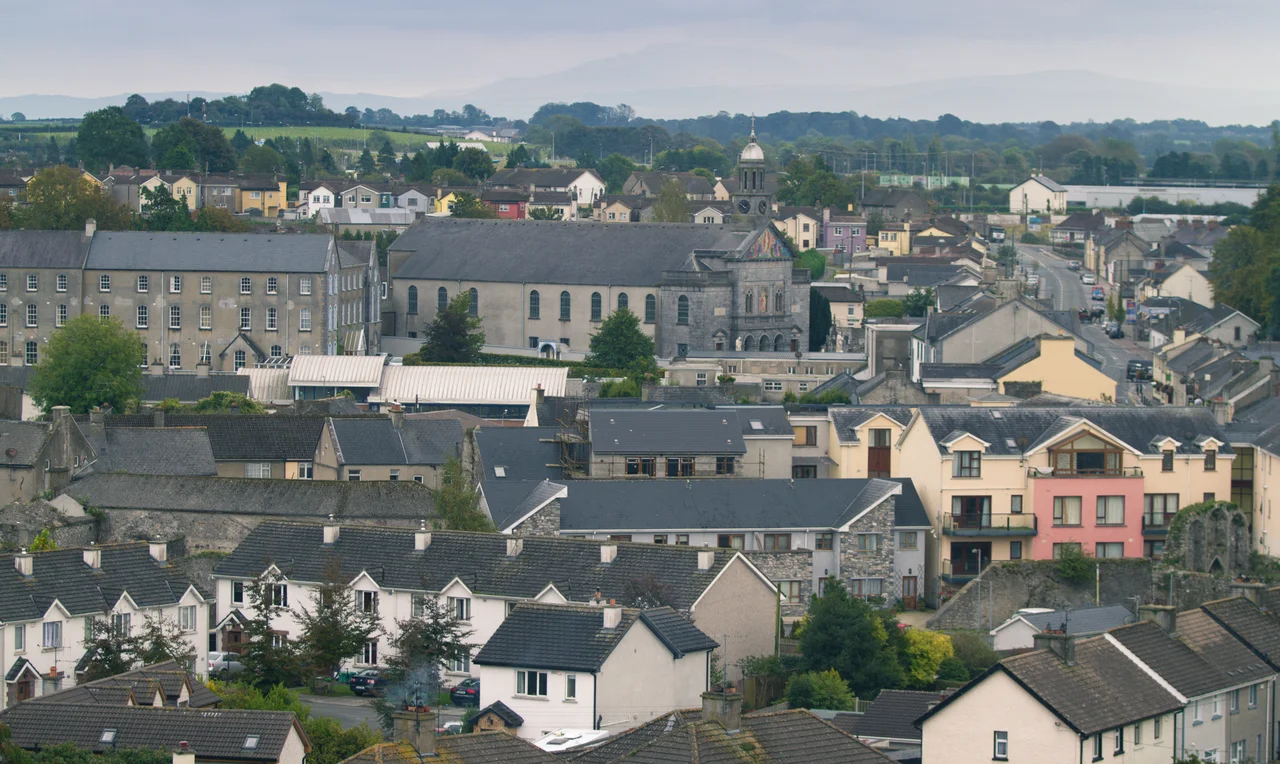

Cashel, County Tipperary
From a distance the Rock looks like a ship riding above a sea of pasture. Two hundred feet of grey limestone rises straight out of the Golden Vale, and on top of it stands a crown of ruins - a round tower, a Romanesque chapel, a roofless Gothic cathedral, the wind moving through everything. The town of Cashel sits at its foot, a quiet country place of five thousand people who have learned to live with one of the most photographed silhouettes in Ireland looming over their back gardens. Long before there was a town there was the Rock, and long before St. Patrick climbed it to baptise a king, it was simply Sid-Druim - the Fairy Hill.
City of the Kings
From the fifth century onward, the Eóganacht dynasty made the Rock their capital, and for the next six hundred years Cashel ranked with Tara and Armagh as one of the great royal courts of Ireland. Saint Patrick is said to have baptised Aengus, the third king of Cashel, on this rock around 450 - and to have accidentally driven the spike of his crozier through the king's foot, a wound the king bore in silence, believing it was part of the rite. In 977 the kingship slipped away from the old line when Brian Boru, a Dál gCais usurper from County Clare, was crowned here as the first non-Eóganacht king in five centuries. A little over a hundred years later, Brian's great-grandson made a gesture that changed Cashel forever: in 1101 King Muirchertach Ua Briain gave the Rock to the Church. Kings moved on. The bishops moved in.
A Romanesque Jewel
Cormac MacCarthy, King of Desmond, raised a small church on the Rock in 1127. When Cormac's Chapel was consecrated in 1134, it was the most ambitious piece of Romanesque architecture on the island - twin square towers, a barrel-vaulted nave, and inside, frescoes whose pigments can still be made out in raking light. By 1169 a larger Gothic cathedral was rising beside it, eventually leaving Cormac's Chapel to serve as a chapter house. The synod of 1172 was held within these walls, summoned by Henry II of England to impose Roman discipline on the Irish Church - and, less openly, to put the English king's power on display. The Dominicans arrived in 1243 and built an abbey down in the town. For a few golden centuries Cashel was a place where prayer and scholarship and royal ambition lived inside the same compound of pale limestone.
Reformation and Rebellion
The sixteenth century broke the consensus. Henry VIII's Reformation reached Cashel through Archbishop Edmund Butler, who swore allegiance to the king at Clonmel in 1539. Rival archbishops - Roman and Anglican - then claimed the see for the next two centuries. Some, like Dermot O'Hurley, paid with their lives: appointed by Pope Gregory XIII in 1581, he was tortured for refusing the Oath of Supremacy and hanged outside Dublin in 1584. In 1647, during the Irish Confederate Wars, the violence came home. Hundreds of townspeople had fled to the Rock for sanctuary when Lord Inchiquin's Parliamentarian army arrived. Over a thousand were killed in the sack that followed - soldiers, priests, women and children sheltering in the cathedral. The army left the town in flames behind them. After that day the bishops shifted their residence to Thurles, where the Catholic archbishop still lives.
The Town Below
The town that survived its catastrophes settled into something quieter. Charters granted by Charles II in 1663 and James II in 1687 are still kept in the Heritage Centre on Main Street, alongside a model showing how Cashel looked in the 1640s. The Georgian Cathedral Church of St John the Baptist replaced the Rock's cathedral in the 18th century - safer, warmer, and dry. Archbishop Patrick Leahy raised a Romanesque-style Catholic cathedral, consecrated in 1879, dedicated to Our Lady of the Assumption. Robert Peel began his parliamentary career as MP for Cashel in 1809, long before he became Prime Minister. The M8 motorway, opened in 2004, finally lifted the bottleneck of Dublin-Cork traffic from the town's narrow streets and left Cashel to its visitors and its locals - the Cashel King Cormacs hurlers, the rugby club, the children at Scoil Chormaic Special School named for the old king and chapel-builder.
Standing Beneath the Rock
Walk up John Street toward the Rock at dusk and you understand why the Eóganacht chose it. The limestone catches the last light differently from anything else for miles - warm gold on west-facing walls, blue shadow in the round tower's open windows. Bats slip out of Cormac's Chapel. Across the fields, the ruined Hore Abbey makes its own silhouette. The Bolton Library still holds books from a 17th-century archbishop's collection. And on a clear day from the top of the Rock you can see the Galtees away to the south, the Slievenamon to the east, and the whole patient green sweep of the Golden Vale - which is, after all, what brought the kings here in the first place.
From the Air
Cashel sits at 52.52°N, 7.89°W in south County Tipperary, in Ireland's Golden Vale. The Rock of Cashel is unmistakable from the air: an isolated limestone outcrop rising 60 m above flat pastureland just north-east of the town, with a tight cluster of medieval ruins on top. The M8 Dublin-Cork motorway runs just west. Nearest civil airports: Cork (EICK) about 80 km south, Shannon (EINN) about 65 km north-west, Waterford (EIWF) about 60 km south-east. The Galtee Mountains rise to the south, the Slievenamon mass to the east.
Nearby Stories
- Castletownroche 3.6 km away
- Mount Melleray Abbey 4.2 km away
- Loughmoe Castle 6.1 km away
- Killaloe 7.3 km away
- Castletown Cox 9.8 km away
- Battle of Kilmallock 12 km away
- Castlecomer 14 km away
- 1999 Tramore helicopter crash 20 km away