.JPG)
Castletownroche
On a December day in 1942, a tall, well-built man in his early thirties walked into Castletownroche and gave his name as Oskar Metzke. He told the locals he was a Czech, recently discharged from the British Army on medical grounds. His papers seemed in order. The Garda searched him anyway, which was how they discovered the map with aerial views of the local countryside, the compass, the combined torch-and-fountain-pen, and the Luger pistol. The story of how an axis intelligence operative ended up in a small village on the N72 road, where the Awbeg curves through the Blackwater Valley, is still sung locally - Tim O'Riordan released Oskar Metzke German Spy on his 2018 album Taibhse. It is one of several stories Castletownroche keeps for itself.
Cruadha's Fort, FitzGodebert's Rock
The Irish name is older than the English one. In ancient times this place was Dun Chruadha, Cruadha's Fort - the same Dun Chruadha that gave Blackwater Castle its prehistoric foundations. The current name is layered. It begins with Richard FitzGodebert, who came to Ireland with Strongbow in the late 12th century. His family in Pembrokeshire had built their castle on an outcrop of stone, which is why they were called FitzGodebert de la Roch - FitzGodebert of the Rock. Their Hiberno-Norman descendants dropped the FitzGodebert and kept the Roche. When they built their fortress on the Awbeg in the late 13th century, the village that grew up around it took both halves of the name: Castletown of the Roches. Castletownroche. The Roches, like so many Anglo-Norman families, eventually drifted into alliance with the Gaelic aristocracy and were branded rebels by the English crown. The castle they built is still standing as Blackwater Castle, on a promontory above the river.
The Bridge by the Mill
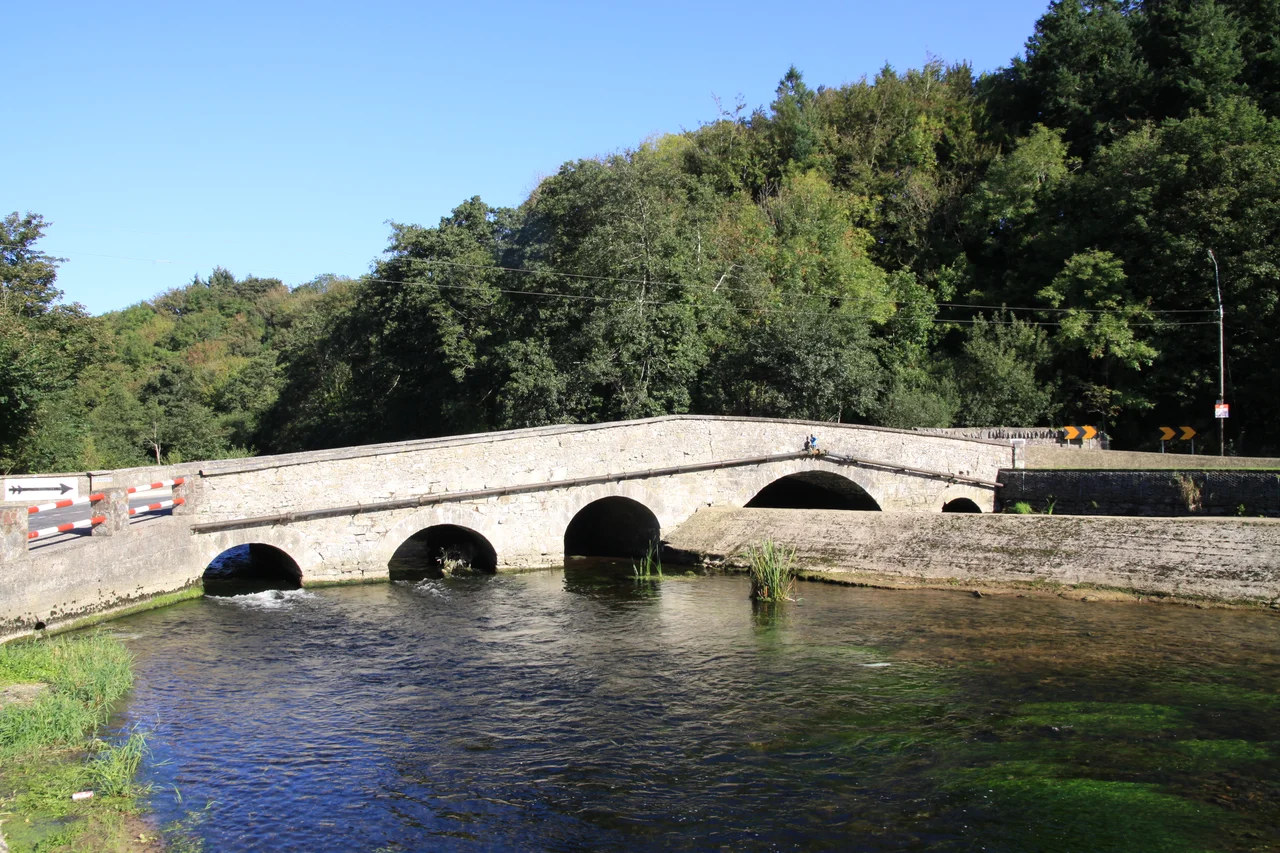
The bridge that crosses the Awbeg in the centre of the village was rebuilt in the 1830s. There has been a bridge here for centuries, and one of them gave its name not just to a priory - Bridgetown, downstream where the Awbeg meets the Blackwater - but to a song that is now a country and folk standard around the English-speaking world. Thomas P. Keenan, the songwriter and composer behind The Old Rustic Bridge by the Mill, is buried in the village. According to Failte Ireland, his song takes its name from a structure near a watermill in Castletownroche. Whether or not that structure stood at the exact spot of the present bridge is debated locally, but the village holds the claim. Jonjo O'Neill, the National Hunt jockey and trainer who won the Cheltenham Gold Cup and the Champion Hurdle in the same year, was born here too. So was Thomas Hunter, who fought in the Easter Rising and sat in the First Dail, and Richard John Uniacke, who left Cork in the 18th century and became Attorney General of Nova Scotia.
Annes Grove
A mile or so outside the village is Annes Grove, an 18th-century house with gardens laid out in the early 20th century around it. Many of its rhododendrons came from Frank Kingdon-Ward, the plant hunter who collected them on expeditions to Tibet, Burma, and the Himalayan borderlands in the 1920s and 1930s. Behind the house, paths slip past limestone cliffs and look down on the Awbeg and a chain of lily ponds. The gardens were closed to the public for years as the family struggled with the cost of upkeep. In 2016 it was proposed that the Office of Public Works take over the site, and in April 2022, after a two-million-euro restoration, Annes Grove reopened. Restoration work continues. The rhododendrons Kingdon-Ward brought back from the Brahmaputra valley nearly a century ago still flower in Cork, on the bank of a river the Roches once owned.
The Spy and the Song
Oskar Metzke is not the name on his birth certificate. The man arrested in Castletownroche in December 1942 was an axis agent - probably German rather than Czech - and he died shortly after his arrest, in custody, in murky circumstances that local journalist Jim Lysaght later examined under the title 'The Spy Who Should Not Have Died.' The Irish Examiner ran a piece on the wider Nazi infiltration plans in 2012. What the spy was doing in Castletownroche has never been entirely clear: the village sits inland, well away from the coast and any plausible landing zone. The map he carried, the compass, the disguised torch-pen - they all suggest reconnaissance, but for what is uncertain. The National Ploughing Championships came to the area in 1999, which is the kind of event the village now plans for. The railway station that opened on 1 May 1861 closed on 27 March 1967. Trains do not stop here anymore. But the bridge still spans the Awbeg, and the song still gets sung.
From the Air
Castletownroche sits at 52.18 degrees north, 8.46 degrees west, on the N72 road in north County Cork, about 8 miles (13 km) east of Mallow in the Blackwater Valley. The nearest commercial airport is Cork International (EICK), roughly 35 km south; Shannon (EINN) is about 110 km northwest, Kerry (EIKY) about 100 km west. From altitude, look for the broad valley of the Munster Blackwater running east-west, with the smaller Awbeg joining from the north just below the village. Blackwater Castle stands on a promontory at the river's edge; Bridgetown Priory sits two kilometres downstream where the Awbeg meets the main river.
Nearby Stories
- Battle of Kilmallock 3.2 km away
- Crossbarry Ambush 6.3 km away
- Ballycotton 6.5 km away
- Bansha 7.4 km away
- Lismore Castle 11 km away
- Headford Ambush 16 km away
- West Cork 19 km away
- Listowel 25 km away