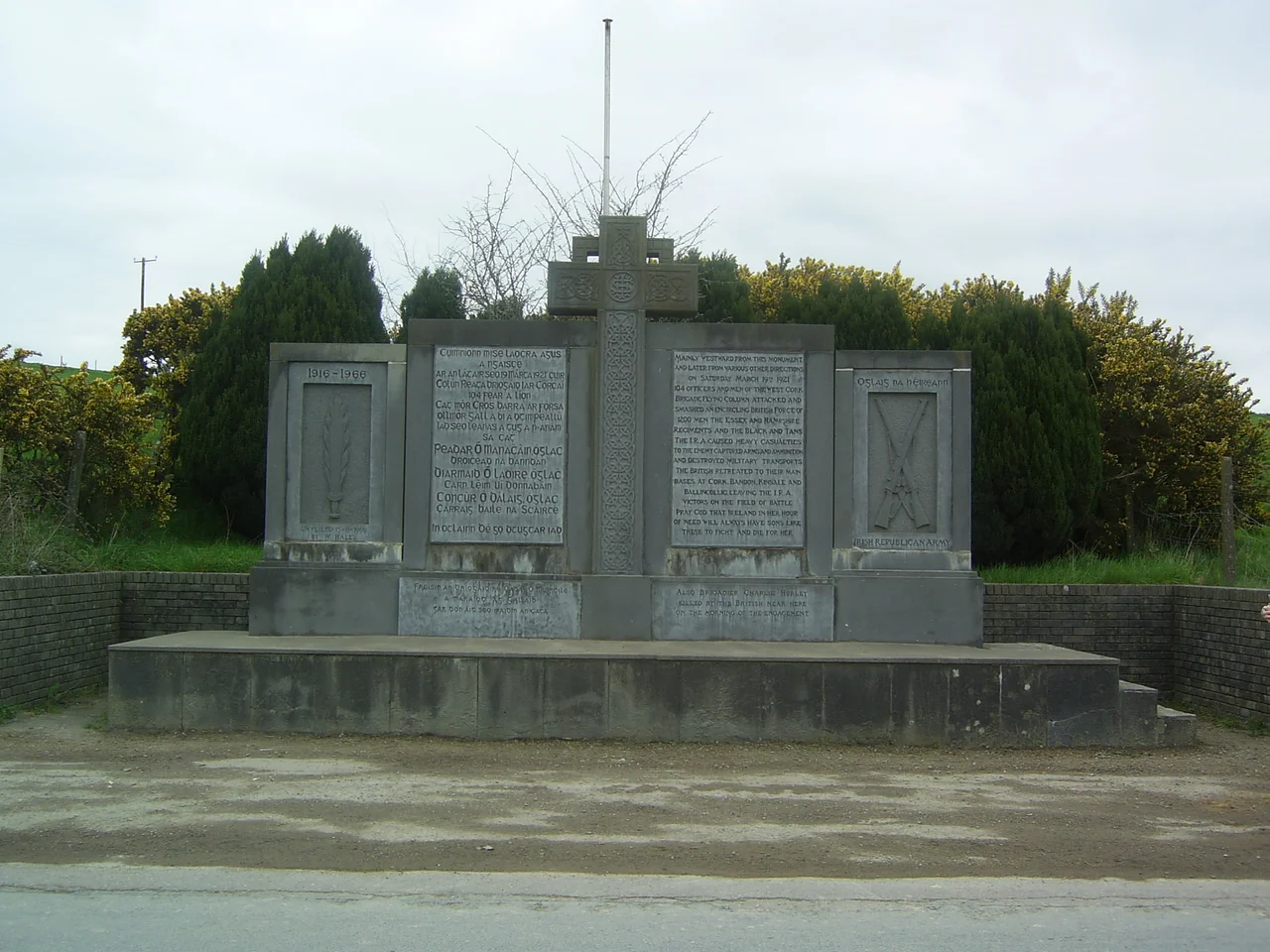

Crossbarry Ambush
By half past five in the morning, the volunteers were in position. Tom Barry's column had only forty rounds per man and roughly an hour, by his own reckoning, before British troops in twelve different directions converged on the crossroads at Crossbarry and closed the trap. About a hundred IRA men against twelve hundred soldiers and Auxiliaries. Barry had decided that running would mean dying. The only way out was through.
The Twelve Dark Days
What brought everyone to this small West Cork crossroads was a month of disasters. On 4 February 1921, the 3rd Cork Brigade's commander Charlie Hurley had been shot at a safe house. Two more men were killed in their beds on the 14th by Black and Tans. The Upton train ambush on the 15th went wrong and killed three more volunteers plus eight civilians. On the 16th, four men digging a trench at Kilbrittain were arrested and shot by the Essex Regiment. Tom Barry would later call those weeks the brigade's twelve dark days. Worse still, a captured volunteer had broken under torture, and the British now knew where the West Cork column rested. By the morning of 19 March, twelve hundred soldiers were moving from multiple directions to surround the brigade headquarters at Ballymurphy. Barry, hearing the news late, marched his hundred-odd men to Crossbarry and decided to fight.
An Hour at the Crossroads
The first British lorries appeared in the IRA's sights at eight o'clock. Twelve vehicles, by Barry's count. The volunteers opened fire from between five and ten yards. At that range nobody missed much. The British took heavy casualties and many men fled. The volunteers stripped the abandoned lorries of arms and ammunition and set them ablaze. Then a second British column of about two hundred attacked from the southwest. This was where the IRA suffered its three deaths of the day. The volunteers held. Two more British units, converging from the southeast, tried to dislodge the column and could not. Barry then marched his men out to safety in the Gurranereigh area while the surviving British units were still untangling themselves. Major Arthur Percival of the Essex Regiment - the same officer who would surrender Singapore to Japan in 1942 - rushed to the scene too late to do anything but watch the column escape. He blamed the failure on an Auxiliary contingent that had drifted to the wrong rendezvous, leaving a gap in the encirclement Barry had spotted and used.
Counting the Cost
Casualty figures from Crossbarry vary, as they often do for fast and chaotic actions. The British acknowledged ten dead and three wounded. The Royal Irish Constabulary memorial later recorded one RIC constable and six soldiers killed. The New York Times, reporting the next day, gave seven soldiers and one policeman dead, alongside seven IRA volunteers - the latter number disputed by both sides. Three IRA volunteers died at Crossbarry: men whose names entered the long Cork memory of the War of Independence. The British also lost three lorries, claimed by contemporary press reports to have been blown up by a mine planted under a nearby bridge, although Barry's own account omits explosives entirely. The historian Michael Hopkinson concluded, with some understatement, that Crossbarry was a victory for the IRA and could also be read as a missed opportunity for the British.
What the Ambush Meant
Crossbarry was one of the largest engagements of the Irish War of Independence. It mattered less for what it killed than for what it proved. A flying column with little ammunition and no fixed position had broken out of a planned encirclement by a force more than ten times its size. The propaganda value was enormous. Tom Barry's book Guerilla Days in Ireland turned the action into something close to legend. Today a stone monument stands at the crossroads. The small village of Crossbarry still gathers there each March to remember Tom Kelleher and the others who fought, and the volunteers who did not march out with the rest of the column - and to acknowledge, as commemorations now often do, the British soldiers who died in the lanes around them. Both sides came home with fewer men. That is what every battle, however small, comes down to.
From the Air
Crossbarry sits at 51.802 N, 8.645 W, about 20 km south-southwest of Cork City along the road to Bandon. Cork Airport (EICK) is 15 km to the east-northeast. From the air the crossroads village is small and largely unchanged. The surrounding countryside of low hills, hedged fields, and small lanes looks much as it did in 1921, and a stone monument at the road junction marks the ambush site.
Nearby Stories
- Ballycotton 8.7 km away
- West Cork 8.8 km away
- Cloghan Castle, Lough Hyne 11 km away
- Mourne Abbey 12 km away
- The Sinking of the Lusitania: The Torpedo That Changed the War 12 km away
- Headford Ambush 14 km away
- Lismore Castle 16 km away
- SM U-27 101 km away