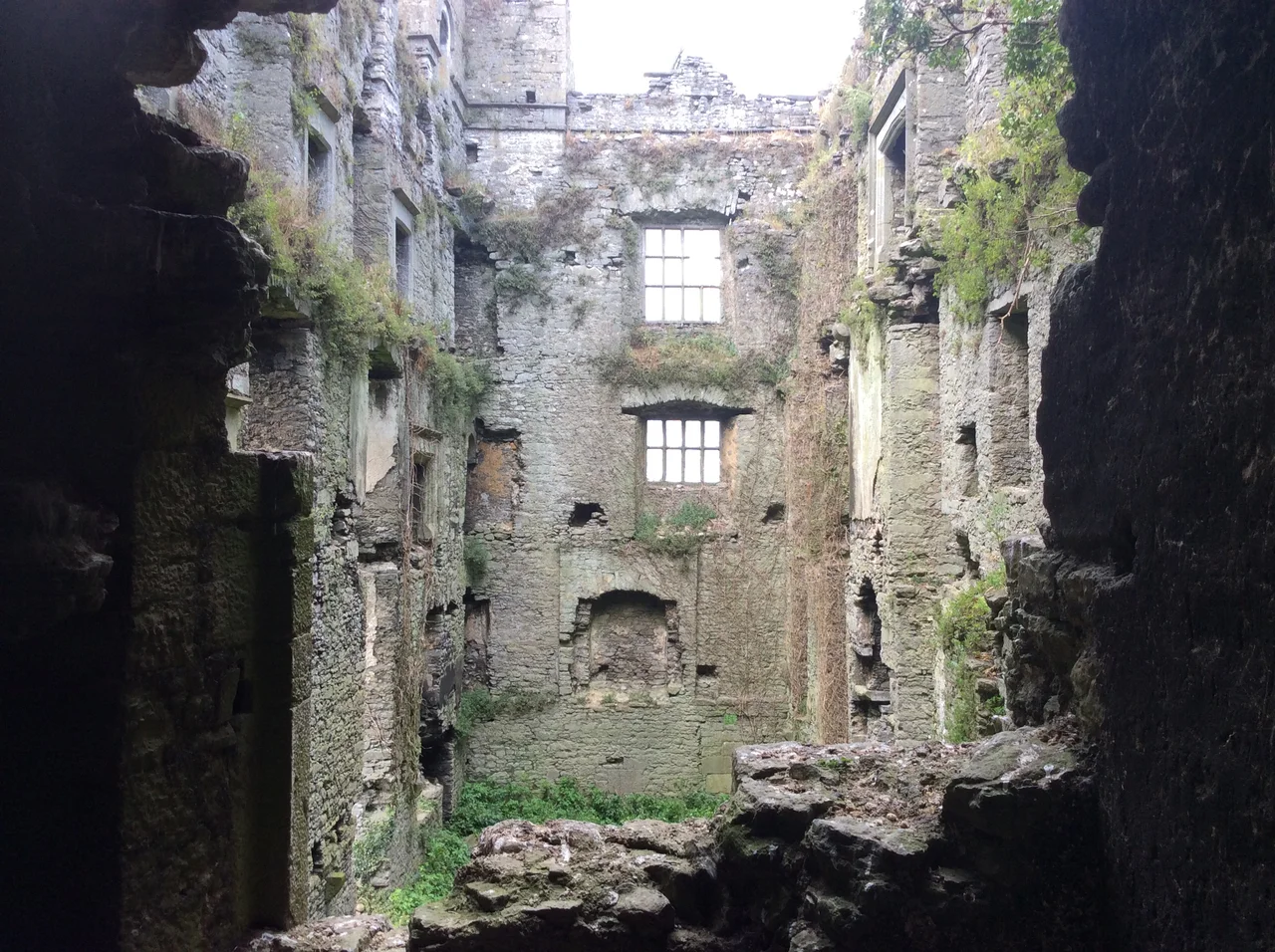

Loughmoe Castle
The Purcell coat of arms shows four boars' heads. The legend behind those heads goes like this: long ago, when Loughmoe was thick forest and the castle was ruled by a king, a giant wild boar and his sow terrorised the country, uprooting crops and killing anyone they met. The king promised his only daughter and the castle and the surrounding land to any man who could kill them both. Many tried; many failed. Then a young man named Purcell took up the challenge. He found the sow first and killed her with an arrow. The boar, hearing her death squeals, charged through the forest in a frenzy until he found Purcell at the place where his mate had died. Purcell shot him in the jaw; the boar ran off and died in the wood. Purcell married the princess. He inherited the castle. The area where it stands is still called, in Irish, Luach Maigh - the field of the reward.
1204: how the family really got the land
The folktale is good. The historical record is more prosaic. In 1204 Sir Hugh Purcell received the lands of Loughmoe as a dowry on his marriage to Beatrix FitzWalter, daughter of Theobald FitzWalter - the same Theobald who had been made first Chief Butler of Ireland. The Butlers controlled most of north Munster after the Norman invasion of 1169, and the Purcells became their loyal tenants, building their tower house here in the thirteenth century. In 1328, James Butler, first Earl of Ormond and palatine Lord of Tipperary, granted Sir Hugh's descendant Richard Purcell the feudal title of Baron of Loughmoe. The Purcells were now barons - though the title was an Irish feudal barony, granted by a palatine lord rather than the English crown, and therefore not formally recognised by the British state. It was nonetheless real in every other sense: the Purcells held the title and the lands for almost five hundred years.
The architecture of a long dynasty
The oldest part of Loughmoe Castle is the four-storey tower house, built in the thirteenth century when the Purcells first took possession. In the seventeenth century, the family added a manor wing - a long range of more comfortable, less defensive rooms - turning the medieval keep into a country house with a fortified base. You can still see the seam in the stonework where the two ages meet. The Great Hall fireplace, called the Baron's bedchamber fireplace by locals, is a substantial carved stone overmantel that gives some sense of what the seventeenth-century interior aspired to. The castle sits on flat ground between the River Suir and the Cork-to-Dublin railway line - a position that today makes it one of the most photographed ruins in Tipperary, since every train going past gets a postcard view.
The Purcells of the Jacobite cause
The Purcells were Catholic when most of Ireland's gentry were quietly drifting Protestant, and they paid for it. The most prominent of the Jacobite-era Purcells was Nicholas Purcell of Loughmoe, born in 1651 (just after the Cromwellian conquest ended) and dying in 1722. Nicholas served as a colonel of horse in the Jacobite army of James II during the Williamite War of 1689-1691 and was one of the negotiators of the Treaty of Limerick in October 1691 - the agreement that ended the war and that the Catholic Irish believed had guaranteed their religious and property rights, before the Irish Parliament repudiated it within years. The Barony of Loughmoe may have been raised to a Jacobite peerage by James II in exile in 1690, though the records are unclear. Nicholas survived the war, kept his estate, but lived out his life as the last of his line. When he died in 1722 the Barony of Loughmoe died with him. The Purcells continued to live in the castle until around 1760 and then abandoned it.
What Charlemagne has to do with it
The Irish genealogist Dubhaltach Mac Fhirbhisigh, working in the seventeenth century, traced the Purcell pedigree back to Charlemagne, Emperor of the Holy Roman Empire, who died in 814. The claim was characteristic of the Gaelic and Anglo-Norman pedigree-makers, who frequently extended their patrons' lineages through legend into something approaching prehistory. Whether the Charlemagne descent is genealogically real is, in the technical sense, irrelevant: what mattered to the seventeenth-century Purcells was that they could be presented as people whose ancestors had been crowned by a Pope. The pedigree was an instrument. It said: we are not new here, we are not provincial, we are people whose family was crowned in Rome on Christmas Day in the year 800.
The ruin in the field
Today Loughmoe Castle is a ruin in the open care of the Office of Public Works. You can walk up to it from the road - it is unlocked and unfenced - and look at the fireplace, the window seats, the spiral stair (no longer climbable after the 1980s for safety reasons). The interior is roofless. Grass grows in the courtyard. The setting is beautiful: flat green fields, the River Suir close by, the Devil's Bit mountains visible to the west. From the railway line the castle is visible to passengers on the Dublin-Cork express - a Norman-Jacobite-Cromwellian fossil framed in the carriage window for a few seconds at 100 km/h. Most passengers do not notice. The legend of the boar would not survive their inattention. Neither, in another way, would the historical Purcells - except that the stone is still here, in the field that was their reward.
The Cormack brothers' parish
Loughmore is the village beside the castle. It is a small parish but it carries a heavy nineteenth-century story: in 1858, two local brothers, Daniel and William Cormack, were hanged at Nenagh Prison for the murder of John Ellis, a land agent hated for evicting tenants. Most local people believed - and the evidence later supported - that the brothers had been framed; a tenant named Michael Gleeson confessed to the killing years later. In 1910 the parish exhumed the Cormacks from Nenagh Gaol and brought them home in plumed hearses. They are buried now in a mausoleum in the churchyard, with an inscription proclaiming their innocence. People still visit. The Purcells' castle, the Cormack brothers' grave, and the railway line all sit within a few kilometres of each other in this quiet parish - three different layers of Irish memory in one small piece of ground.
From the Air
Loughmoe Castle is at 52.755°N, 7.826°W, between Templemore (6 km north) and Thurles (11.5 km south), in the Golden Vale of County Tipperary. Best cruise altitude 1,500-3,000 ft. The castle sits on flat ground between the River Suir and the Dublin-Cork railway line - both visible from the air. The Devil's Bit mountains rise to the west. The M8 motorway is east of the area. Nearest airports: Shannon (EINN) ~75 km west, Cork (EICK) ~115 km south, Dublin (EIDW) ~140 km northeast.
Nearby Stories
- Birr, County Offaly 0.6 km away
- Killaloe 2.6 km away
- Sack of Cashel 4.5 km away
- Abbeyleix 10 km away
- 2003 Derrybrien Landslide 12 km away
- Knocktopher 14 km away
- Portarlington, County Laois 15 km away
- Croom Castle 20 km away