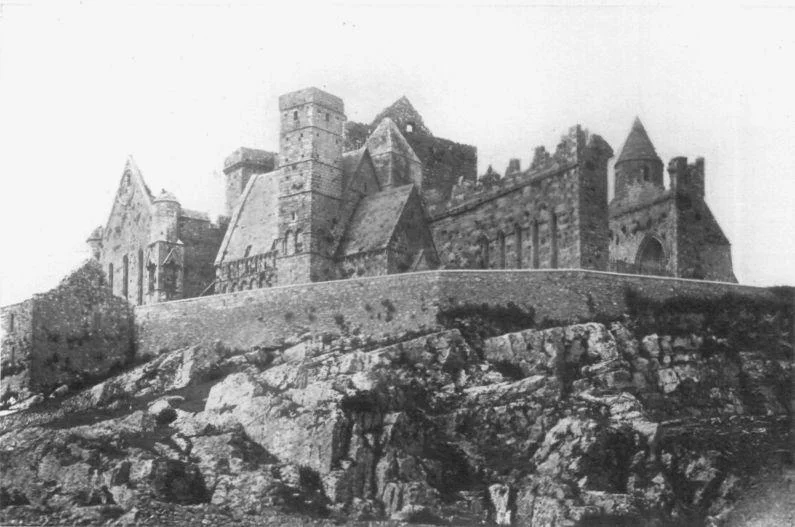

Sack of Cashel
The civilians ran for the Rock because the Rock had always been safe. For more than a thousand years it had been the seat of kings, a fortress, a cathedral - the great limestone island rising out of the Tipperary plain. When word came in September 1647 that Lord Inchiquin's Parliamentarian army was burning its way through the county, hundreds of Cashel townspeople packed up what they could carry and climbed the hill, certain that walls so old and so high would hold. By the next afternoon, witnesses counted the bodies in the churchyard piled five and six deep.
A Confederation Tearing Itself Apart
By 1647, the Irish Confederate Wars had been going on for six years, and the Catholic Confederation that ran most of Ireland was tearing itself apart over how to make peace with Charles I. One faction, led by the papal nuncio Rinuccini, wanted Ireland to become a Catholic kingdom under the Stuarts. The other, led by powerful Munster nobles like the Viscount Muskerry, would settle for toleration. Through the summer that political quarrel paralysed the Munster army just when it needed to move. Command was shuffled from the unpopular Earl of Glamorgan to Muskerry to the ineffective Lord Taaffe, who one historian called among the most incompetent generals of the decade. While the Confederates argued, Murrough O'Brien, the Baron of Inchiquin, was free to do as he pleased. He was a Protestant commander whom Catholic Ireland would soon nickname Murchadh na Dóiteáin - Murrough of the Burnings.
The March on Cashel
Inchiquin spent the summer of 1647 smashing Catholic strongholds in Limerick and Clare. In early September he took Cahir Castle, which gave him a base inside Tipperary. From there he moved north toward Cashel, an ecclesiastical and market town that mattered both economically and symbolically - the Rock of Cashel was one of the holiest sites in Catholic Ireland. On the way his troops stormed nearby Roche Castle, putting the fifty defenders to the sword. The news raced ahead of him. Country people scattered for whatever hiding places they knew, but hundreds chose the Rock. Lord Taaffe had placed six companies of infantry in the fortified churchyard and judged it defensible. Then Taaffe left, handing command to Lieutenant-Colonel Butler. He would not be there for what came next.
The Assault
Inchiquin reached the Rock and gave the defenders one hour to surrender. They tried to negotiate; he refused. On the afternoon of 15 September his officers reminded their men of earlier Protestant deaths at Catholic hands, then sent in the attack. About 150 dismounted cavalry led the way in heavy armour, with infantry close behind and horse riding the flanks to keep them moving. The Irish soldiers met them with pikes from the walls; inside the compound, civilians hurled rocks down on the attackers. The Parliamentarians answered with firebrands, setting buildings alight. Gradually they fought their way over the walls and drove the defenders back into the cathedral. For a while the doors held. Then the attackers raised ladders to the high windows and poured in. The fighting went another half hour, ending with the last sixty soldiers retreating up the bell tower. They surrendered, came down, threw away their swords - and were killed where they stood.
Inside the Cathedral
What followed was not a battle but something else. Most of the soldiers were dead. The Bishop and Mayor of Cashel survived only because they found a hidden place to shelter. A handful of women were spared after being stripped of their clothes; a few wealthy civilians were taken for ransom. Everyone else - women and children and old men who had run uphill carrying what valuables they could - died in the church and the yard around it. Among the dead was Teabóid Gálldubh, a priest and pioneer of Irish-language orthography, who would be beatified by Pope John Paul II in 1992 as one of the Irish Catholic Martyrs. A witness who walked the churchyard afterward said the bodies lay five or six deep. Close to a thousand people had been killed in a single afternoon. The soldiers then plundered the cathedral - chalices, vestments, the mayor's mace and sword, the bishop's coach - smashed statues, defaced pictures, and burned what was left of the town below.
Aftermath and Memory
The sack at Cashel shocked Ireland in a way nothing in the previous six years had managed. It was the worst single atrocity since the war began in 1641, and because the Rock was one of the chief holy places of Catholic Ireland, it cut into a wound that was not just political. The Catholic and Royalist factions of the Confederation grew further apart, not closer. Lord Taaffe was pushed to take the field against Inchiquin and was crushed at the Battle of Knocknanuss that November, his army destroyed. By 1648 the Confederates had no choice but to sign a truce with the man who had ordered the killings - a peace that helped trigger their own brief civil war. Inchiquin himself converted to Roman Catholicism in French exile in 1656. The Rock of Cashel was never restored as a place of worship. The roofless cathedral remains as it was left, and the people who died there are part of why.
From the Air
The Rock of Cashel stands at 52.52°N, 7.89°W in south County Tipperary - an isolated limestone outcrop rising about 60 m above the surrounding pasture of the Golden Vale, just north-east of Cashel town. From the air the medieval ruins on top - the round tower, Cormac's Chapel, the roofless Gothic cathedral - cluster into an unmistakable silhouette. The M8 Dublin-Cork motorway runs just west. Nearest civil airports: Cork (EICK) about 80 km south, Shannon (EINN) about 65 km north-west, Waterford (EIWF) about 60 km south-east.
Nearby Stories
- Castletownroche 3.6 km away
- Mount Melleray Abbey 4.2 km away
- Loughmoe Castle 6.1 km away
- Killaloe 7.3 km away
- Castletown Cox 9.8 km away
- Battle of Kilmallock 12 km away
- Castlecomer 14 km away
- 1999 Tramore helicopter crash 20 km away