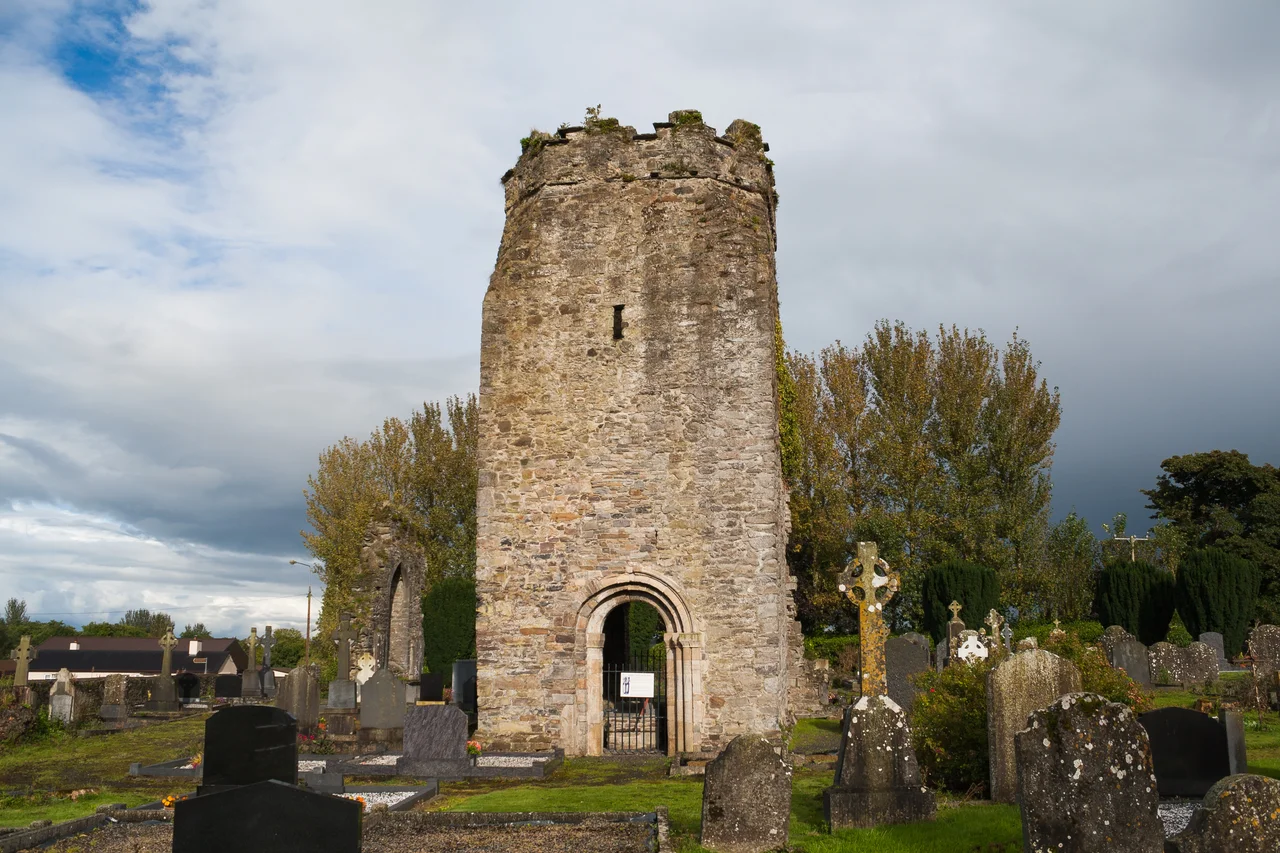

Knocktopher
In 1542 the Crown dissolved the Carmelite friary at Knocktopher, part of Henry VIII's wholesale closure of the religious houses across England, Wales, and Ireland. The friars dispersed. The lands passed to a Pale family with a useful title. The buildings were quarried for stone. Two centuries later -- in 1735, with the Penal Laws still in force, with public Catholic worship still discouraged -- the Carmelites returned to Knocktopher. They are still here. That kind of patient persistence is the through-line of a village that has been quietly outlasting bigger events for most of a millennium.
James Butler's Friary
Knocktopher was important enough by 1356 that James Butler, 2nd Earl of Ormond, built a Carmelite friary in the village. Before that, in the early years of Norman rule, the Barony of Knocktopher had been created and granted to Griffin FitzWilliam, brother of Raymond le Gros. By the early 14th century, ownership of the manor had been bought by Nigel le Brun and his wife Amicia from Walter de la Haye, Justiciar of Ireland. In 1312 a survey listed four farmers holding between 5 and 74 acres of arable land, 45 free tenants holding plots ranging from 2,520 acres down to a single house, 97 burgesses on 360 acres, and a settlement of betaghs farming 120 acres -- a fully formed Anglo-Norman manor. By the 15th century the family of 'Walsh of the Mountain' held half the barony, with castles at Ballyhale, Castlebanny, Castlemorris, and many more. Most of those lands were confiscated under Oliver Cromwell around 1640.
The Langrishes of the Abbey
The Langrishe family arrived in Knocktopher in the 17th century and held the abbey and its lands for nearly 300 years. John Langrishe (1660-1735) was the first; his son Robert succeeded; his grandson Hercules Langrishe (1731-1811) sat in the Irish House of Commons for Knocktopher for forty years until the Act of Union dissolved it. Hercules became the 1st Langrishe Baronet in 1777 and is best remembered for his pro-Catholic Relief stance and his correspondence on the question with Edmund Burke. He introduced the landmark Catholic Relief Bill of 1792 and seconded the second bill in 1793, which passed as the Roman Catholic Relief Act 1793, giving the vote to all Catholic landowners of a certain value. Five of the eight Langrishe Baronets were named Hercules. The 5th Baronet, Hercules Robert, was friendly with King Edward VII; in 1904 the king and Queen Alexandra agreed to visit Knocktopher Abbey, but the visit collapsed over a prank and never happened.
Tennis Champions and Hurling Subs
Sport is woven through the village's story. According to family records, Mary Langrishe, sister of the 5th Baronet, was the Irish Lawn Tennis Ladies Champion on three separate occasions in the 1880s -- a remarkable achievement for the era. Knocktopher footballers won the Kilkenny Senior Football Championship four times -- 1901, 1908, 1910, and 1911 -- and were the backbone of the County Kilkenny football team that won the Leinster Senior Football Championship in 1911, beating Kildare. They lost the All-Ireland football semi-final that year to Antrim, a feat never since matched by Kilkenny footballers. Three Knocktopher-born hurlers have won Senior Hurling All-Ireland medals with the Kilkenny senior team: Frank Cummins, with medals from 1967 to 1983; Denis Heaslip with two; and Sean O' (John) Farrell with one in 1933 as a non-playing substitute.
An Ogham Stone Down the Road
About a mile south of Knocktopher stands the Ballyboodan Ogham Stone, set up in the early medieval period -- a slim pillar carved with the angular linear alphabet that the early Irish used to inscribe names along stone edges. A mile to the west is Sheepstown Church, another medieval survival. Knocktopher Abbey itself, the Langrishe seat for nearly three centuries until 1981, is today a time-share resort, which is one way a 13th-century Norman foundation can end up. The village sits on the R713 between Stoneyford and Ballyhale, with two pubs, two shops, a petrol station, a three-star hotel, a restaurant, and a glass gallery. The M9 motorway bypasses it now; Junction 10 puts Dublin, Kilkenny, and Waterford within easy reach. And the Carmelites, who came back in 1735 to take up where the Reformation had stopped them in 1542, are still part of the village's daily life.
From the Air
Located at 52.48 degrees N, 7.22 degrees W in County Kilkenny, Ireland, on the R713 road between Stoneyford and Ballyhale. From altitude Knocktopher appears as a compact village in rolling Kilkenny country, with the M9 motorway running west of the village and Junction 10 nearby. Nearest airports: Waterford (EIWF) approximately 28 km south; Cork (EICK) approximately 110 km southwest; Dublin (EIDW) approximately 130 km northeast. Best viewed below 2,500 ft AGL.
Nearby Stories
- County Wexford 3.4 km away
- Loughmoe Castle 6.6 km away
- Castlecomer 8 km away
- Waterford Airport 8.5 km away
- Mount Melleray Abbey 8.7 km away
- Cashel, County Tipperary 12 km away
- Wicklow Gold Rush 27 km away
- HMS H47 92 km away