.jpg)
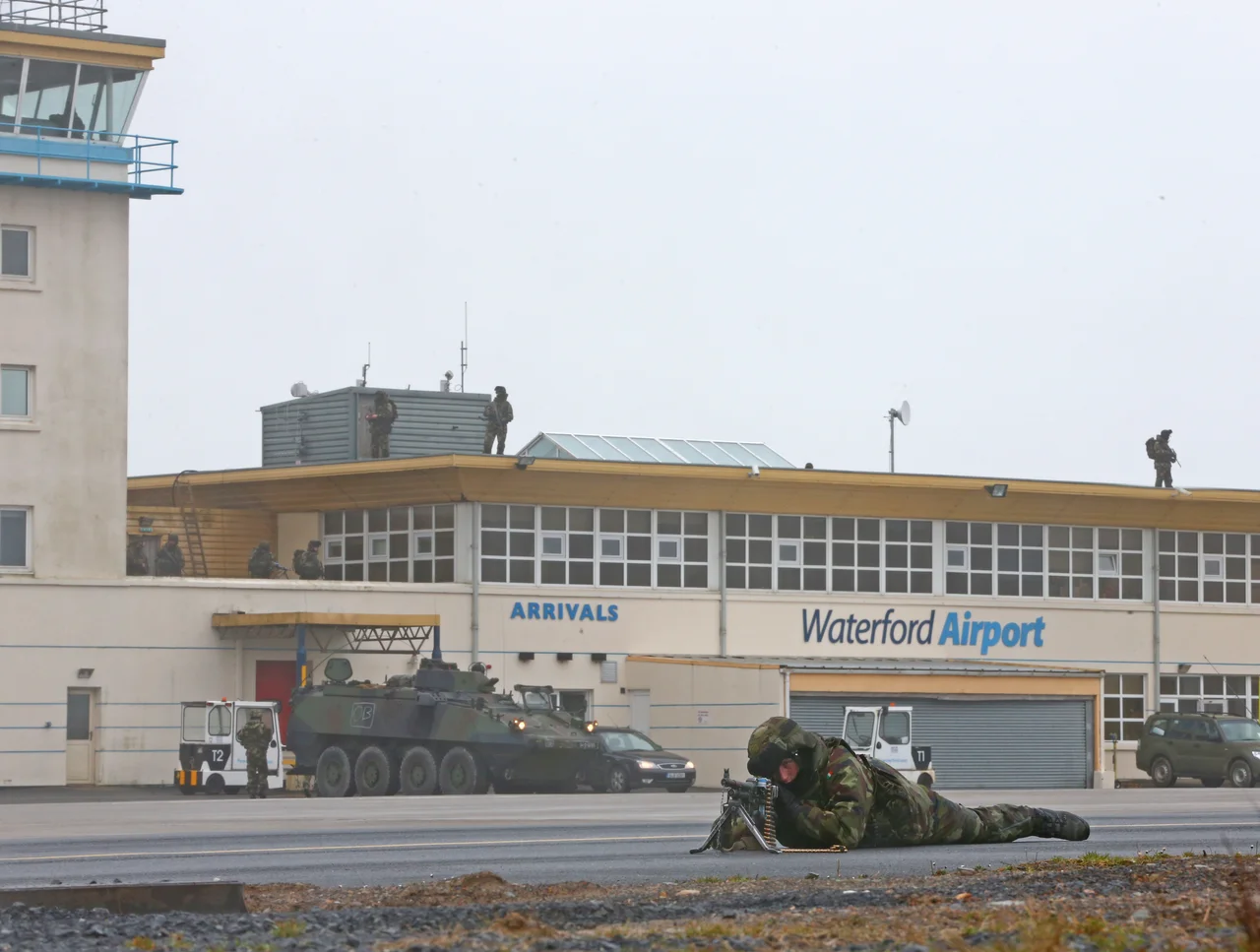
Waterford Airport
Without scheduled traffic since 2016, Waterford Airport has the look of a place waiting for something. The single-storey terminal is tidy; the four check-in desks are dark; the two boarding gates wait for a flight that may finally come back in 2027 when, if the latest funding deal holds, the runway will be 854 metres longer than it is now. Beyond that question of when commercial aviation returns to Ireland's south-east, EIWF carries other histories. It was the launching point for the first 24-hour Irish search and rescue helicopter operation on the south coast. It was also where that operation suffered its first and worst loss. The dunes that took Rescue 111 are visible from the runway threshold.
A Small South-East Airport
Waterford Airport sits at Killowen, four nautical miles south-east of Waterford City, with its single runway oriented roughly east-west. It opened in 1981 to give the south-east of Ireland its own commercial airfield. The R708 connecting road - upgraded in 2008 - now puts the airport ten minutes from Waterford city centre at off-peak times. For two decades EIWF supported a rotating cast of small carriers: Aer Arann under the Aer Lingus Regional brand, then Belgian-operated VLM, then a brief and ill-fated attempt by Aer Southeast that never quite got off the ground because of licensing issues. Routes came and went: Birmingham, Manchester, London Luton, London Southend, Bordeaux, Faro, Málaga, Amsterdam. The last scheduled flight left in June 2016. Since then EIWF has served the Waterford Aero Club, the AFTA pilot training school, and ad-hoc business aviation.
The Runway Question
Most of the story of Waterford Airport in the 21st century is the story of trying to lengthen its runway. At 1,433 metres, the strip is too short for most modern jets - it can take ATR turboprops comfortably and Boeing 737s only with significant restrictions. A series of plans rose and fell through the 2010s: a 150-metre extension funded by the state in 2013, a more ambitious 850-metre extension announced in 2019 with backing from Glanbia, Coolmore Stud and Dawn Meats. In August 2022 the billionaire Comer brothers agreed to take a majority stake. In October 2025, Bolster Group announced a comprehensive €30 million funding package finally large enough to deliver the full project - a runway extended to 2,287 metres, longer than Cork. Waterford City and County Council approved the deal that month, though with public concerns about the anonymity of the US investor and the council's decision to sell €2.3 million of public land for €50,000. Construction is scheduled to start in 2026 and flights are targeted for summer 2027.
Rescue 111
On 1 July 1999, EIWF hosted the first day of 24-hour helicopter search and rescue coverage from the south-east. A Eurocopter Dauphin from the Irish Air Corps, Rescue 111, had flown down from Casement Aerodrome in Dublin that morning with seven crew aboard. Just before one in the morning on 2 July, returning from a successful medical evacuation off a fishing vessel, Rescue 111 hit the high sand dunes behind Tramore beach in heavy fog while trying to find the runway. All four flying crew were killed: Captain David O'Flaherty, Captain Michael Baker, Sergeant Patrick Mooney, and Corporal Niall Byrne. The Air Accident Investigation Unit report, published in June 2000, was unsparing: no air traffic controller on duty, inadequate weather reports, faulty approach lighting, a crew already 15 hours into a long flying day, training inadequate for the conditions. Civilian SAR was eventually transferred from the Air Corps to a contractor under the Irish Coast Guard. A memorial sits above the dunes.
On the Field Today
Walk into the terminal on a working day and you will find a coffee bar, the AFTA pilot trainees in white shirts comparing notes about touch-and-goes, and perhaps a single business jet on the apron. Aero Club Cessnas come and go from the western end of the runway. The Air Corps no longer maintains a permanent detachment, but military helicopters drop in regularly for fuel. The ILS and the new approach lighting from the post-1999 reforms are still in service. R708 leads out toward Tramore and the coast; R710 ring road connects to the M9 motorway and the rest of the network. Eight kilometres west, in Carrick-on-Suir, the Sean Kelly Sports Centre carries the name of the cyclist who rode out from Curraghduff on these same back roads.
What Comes Next
The arguments about whether a regional airport in Ireland's south-east can survive in the long term are not new ones. In July 2025, Ryanair's chief executive Michael O'Leary said publicly that Waterford 'will never be a commercial proposition,' pointing out that Dublin and Cork airports both sit within a two-hour drive. The counter-argument runs that the south-east, with a population of nearly half a million people, deserves its own connection - and that the longer runway, when it arrives, will give the airport a chance it has never had before. The question will probably be settled by what airlines actually do once the runway opens. In the meantime EIWF continues its quieter work: training the next generation of Irish commercial pilots, hosting aero club fly-ins on summer weekends, and keeping, in plain sight from its threshold, a memorial that explains why air traffic control here is now a 24-hour job.
From the Air
Waterford Airport (EIWF / WAT) sits at 52.19°N, 7.09°W in Killowen, County Waterford, about 7 km south-east of Waterford City. The single runway 03/21 is currently 1,433 m long. ATR-class turboprops are well within its capacity; jets are restricted. The R708 road runs to the terminal. The Tramore dunes lie about 5 km south on the coast - the Rescue 111 crash site - and remain part of the local approach picture. From the air, the airport is small but readily identifiable by its position between Waterford City to the north-west and the broad sweep of Tramore Bay to the south. Nearest civil airports: Cork (EICK) about 105 km west, Shannon (EINN) about 170 km north-west, Dublin (EIDW) about 160 km north-east.
Nearby Stories
- Kilkenny College 4.6 km away
- Mount Melleray Abbey 11 km away
- County Wexford 13 km away
- Ballycotton Lighthouse 18 km away
- Cashel, County Tipperary 18 km away
- Johnstown Castle 23 km away
- Ballycotton Lifeboat Station 55 km away
- Skomer 96 km away