
Birr, County Offaly
On 31 August 1869, Mary Ward fell from a steam-powered carriage on a bend near her cousin's castle in Birr, County Offaly. The vehicle had been built by the Parsons family at Birr Castle. The wheels traversed Ward's body, killing her on the spot. She was 42, a scientific illustrator and microscopist of international reputation, and her death is recorded as the first road traffic fatality in human history. The cousin whose engineers built the carriage was William Parsons, 3rd Earl of Rosse, the same astronomer whose 72-inch reflector—the Leviathan of Parsonstown—was the largest telescope in the world from 1845 to 1917. From this small town of cool winters and graceful Georgian streets came the most consequential telescope of the nineteenth century and one of the most tragic firsts in the history of the automobile.
The Plain of Water
Birr—Biorra in Irish, meaning 'plain of water'—takes its name from the meeting of the Camcor and Little Brosna rivers, which flow on into the Shannon. Between 1620 and 1899 it was officially called Parsonstown, after the Parsons family who had received the lands and the title Earl of Rosse during the seventeenth-century plantations. The town was named back to Birr in 1899, but the Parsons still live at the castle. St Brendan of Birr—not St Brendan the Navigator, a different sixth-century figure—founded the original monastery here. It produced the MacRegol Gospels, named after the abbot at the turn of the eighth and ninth centuries, which now sit in the Bodleian Library in Oxford. In 697 the Synod of Birr proclaimed the Cáin Adomnáin, the Law of Innocents, protecting non-combatants in warfare. Birr was a centre of canon law fourteen centuries before it had electric lights.
The Leviathan and the Spiral Nebulae
William Parsons, 3rd Earl of Rosse, completed his great reflecting telescope at Birr Castle in 1845. The Leviathan of Parsonstown had a 72-inch mirror—183 centimetres—and was the largest telescope in the world for the next 72 years, until the Hooker 100-inch went into operation at Mount Wilson in 1917. From the Leviathan's eyepiece, Rosse and his assistants made one of the foundational observations of modern astronomy: the spiral structure of nebulae. The 'whirlpool nebula' M51 was the first object recognised as having spiral arms, in 1845. The discovery is what the Hubble Space Telescope's most famous images still echo. The Leviathan was dismantled in 1908 but has been reconstructed at Birr Castle as a working educational instrument. Patrick Moore wrote the book on its history in 1971; a PBS documentary devoted an episode to it in 2011.
The Georgian Streets
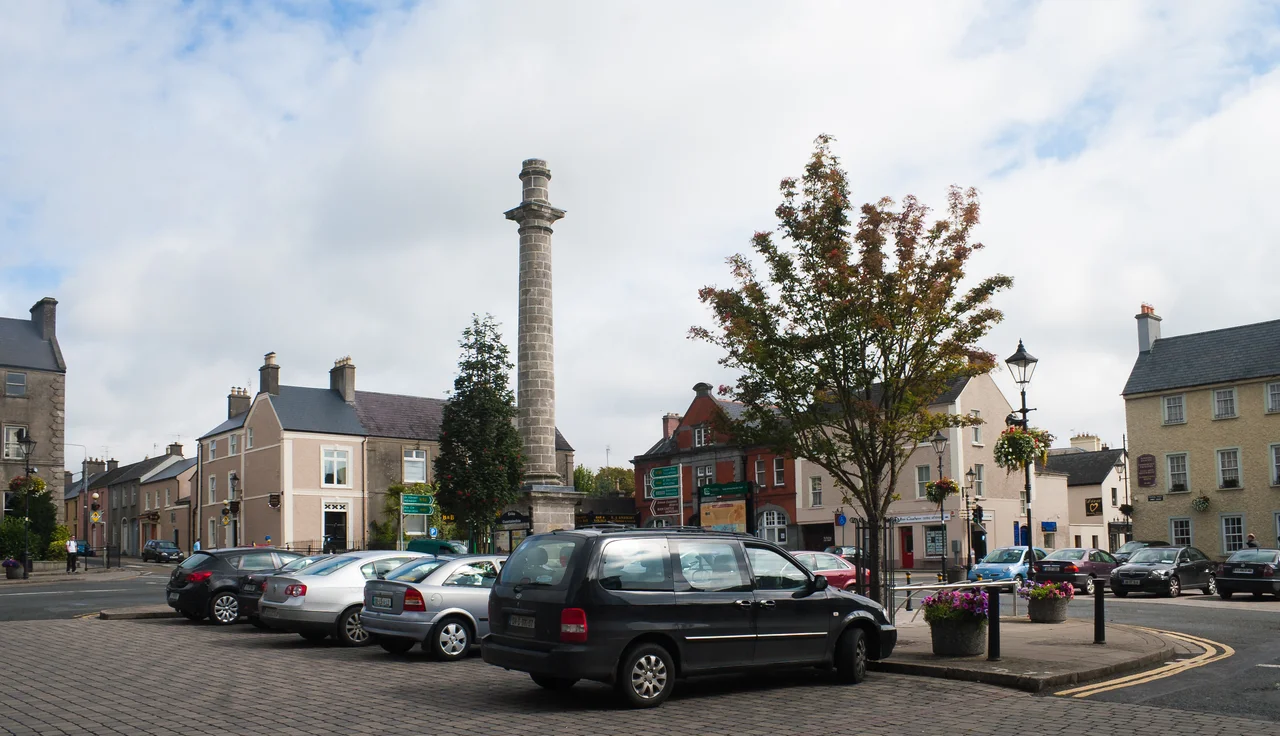
Birr is a designated Irish Heritage Town for its preserved Georgian architecture, particularly along Emmet Square, Emmet Street, John's Place, and the Oxmantown Mall. The column at the centre of Emmet Square dates from 1747 and was built to carry a statue of the Duke of Cumberland—the 'Bloody Duke,' victor of the Battle of Culloden in 1746. The statue was removed in 1915 as it was in danger of collapse. The Oxmantown Mall was laid out in the early nineteenth century as a tree-lined promenade between Birr Castle gates and the Church of Ireland, with Georgian terraces on the opposite side. The Birr Theatre and Arts Centre, built in 1889 in Victorian style on the Mall, still operates as a 220-seat venue. The Workhouse in Syngefield opened in 1842, just before the Famine. It is now mainly derelict.
Charles Carroll's Long Address
On 4 July 1776, when the Continental Congress signed the United States Declaration of Independence, fifty-six men put their names to the document. Only one was Catholic: Charles Carroll, who signed his name in full as 'Charles Carroll of Carrollton'—the only signatory to include his address. He did so to distinguish himself from his father, Charles Carroll of Annapolis. The Carrolls were a Maryland family of Catholic immigrants who had risen to be among the largest landowners in colonial America. They traced their descent to the O'Carrolls of Éile, the petty kingdom whose territory included Birr. The O'Carrolls had a castle on what is now the Birr Castle site. The grandest signature on the founding document of American democracy is, in a sense, a Birr signature—made by a descendant of the chieftains who had held this country before the Parsons family arrived.
The Hurling Field and the Rising
On Easter Sunday, 1 April 1888, the first All-Ireland Hurling Final ever played took place in John Farrell's field in Birr—the site now occupied by a Tesco supermarket. Tipperary beat Galway by 1 goal, 1 point, and 1 forfeit point to nil—the lowest scoring final in hurling history, played under rules different from the modern game and recorded in the Guinness Book of Records. Birr GAA has since won the All-Ireland Senior Club Hurling Championship four times. Eamon Bulfin, an Irish republican activist born in Birr, was the man who raised the Irish Tricolour over the GPO during the 1916 Easter Rising. Birr Barracks—home of the Prince of Wales's Leinster Regiment (Royal Canadians) from 1881—was burned down in 1922 during the Irish Civil War. The perimeter wall survives, and a monument outside honours the Leinster Regiment soldiers killed in two world wars. Wreaths are laid annually. The hurling field hosted history. The barracks did too. The Tricolour Bulfin raised at the GPO is the one the country still flies.
From the Air
Birr lies at 53.09°N, 7.91°W in County Offaly, on the N52 and N62 national secondary roads. Cruise at 3,000–6,000 feet and the town presents as a compact Georgian grid laid out around Emmet Square, with Birr Castle's substantial demesne—containing the reconstructed Leviathan telescope—visible as a large enclosed parkland to the west of the town centre. The Camcor and Little Brosna rivers meet just south. Nearest airports are Shannon (EINN) about 70 km south-west and Casement Aerodrome (EIME) near Dublin to the east. Birr Aerodrome (the home of the Ormond Flying Club for over thirty years) lies 4 km north of the town. The Slieve Bloom Mountains rise 10 km south.
Nearby Stories
- Mountbellew 5.5 km away
- Loughrea 9 km away
- Mullingar 9.9 km away
- Killaloe 12 km away
- Portarlington, County Laois 13 km away
- McCan Barracks 14 km away
- Castlecomer 16 km away
- County Westmeath 28 km away