
Mountbellew
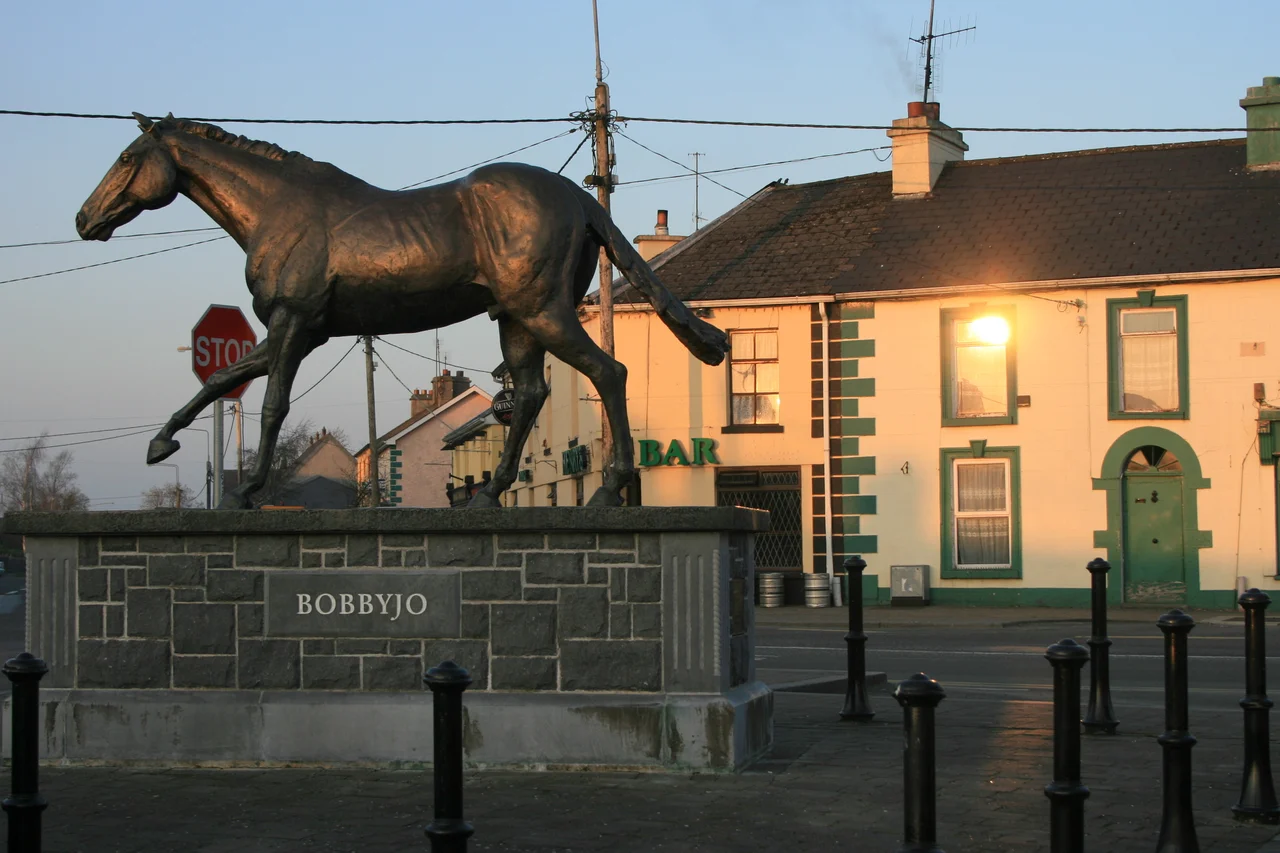
Walk through the triangular square in Mountbellew on a Tuesday and you walk through one of Ireland's longest-running market days, organised in the early nineteenth century by the local landlord Christopher Dillon Bellew. Stand at one corner of that square and you can see a monument to a horse. The horse is Bobbyjo - a Mayo-bred steeplechaser who won both the Irish Grand National in 1998 and the Aintree Grand National in 1999, becoming the first Irish-trained winner of the English race in twenty-four years. The man who trained him is from the area. Hence the statue. That is Mountbellew in miniature: a planned market town with deep agricultural roots, modest in scale at 774 people, but with a knack for producing things that matter beyond its own square.
The Bellews and the Square
Mountbellew, officially Mountbellew Bridge, sits on the N63 between Roscommon and Galway, mostly within the townland of Treanrevagh - Trian Riabhach, the grey-striped third. The Bellew family, after whom the town is named, were Galway parliamentarians through the eighteenth and nineteenth centuries. Their Bellew Estate held the demesne lands that are now a wooded public park of forest walks and picnic clearings. The village bridge has a single milestone embedded in the middle of its parapet, a quiet survivor of the old coach-road era. The triangular layout of the central square is unusual and deliberate, designed to give traders and stock-dealers room to spread out for the markets. The old weigh-house still stands across from the square, a stone witness to days when oats, cattle and turf had to be measured before money changed hands.
Ireland's First Agricultural College
In 1818, the Franciscan Brothers arrived from Milltown in Dublin at the invitation of the Bellew family, who gave them land and a house. The brothers ran a free primary school in the town until 1884. In 1875 they opened a secondary boarding school. Then in 1904, they did something no Irish religious order had done before: they pivoted the secondary school into an agricultural college. The Franciscan Brothers' Agricultural College in Mountbellew was the first of its kind in Ireland. In 1986 it partnered with what would become Galway-Mayo Institute of Technology, creating the Higher Certificate in Business Studies (Agribusiness). When GMIT merged with IT Sligo and Letterkenny IT in April 2022 to form the Atlantic Technological University - eight campuses across four counties - the Mountbellew campus came with it. A small Galway town houses one of the older nodes in Ireland's distinctive farming-education tradition.
The Drapery That Never Closed
On the main street of Mountbellew is Briggs Drapers, the kind of shop that bigger Irish towns have mostly lost. Peter Briggs has worked behind the counter since 1952 - over seventy years. He opens at seven in the morning. He cooks breakfasts for whoever needs one, including the students from the agricultural college across the road. Articles about him have appeared in the regional papers as he passes successive decades behind the same counter. It is the kind of fact that says more about a place than any census reading: a town where the same person has been opening the drapery before dawn for the better part of three lifetimes. In 2021, Aldi announced a seven-million-euro discount supermarket nearby. The arrival was contested - planning objections went to An Bord Pleanala over noise and incompatibility - but the new store opened anyway. The Tuesday market still happens. Briggs is still open at seven.
Bobbyjo and the Grand National
The monument to Bobbyjo is one of the more unusual statues in Galway. The horse was an Irish steeplechaser who won both the Irish Grand National and the Aintree Grand National - the great English steeplechase over Becher's Brook and the Canal Turn. The Mountbellew connection runs through the local racing community that backed and celebrated him; the monument in the town centre is part civic pride, part racing history, and part shrine to a sport that runs deep in east Galway. The Mountbellew-Moylough GAA club has its own roll - five Galway Senior Football Championships in 1964, 1965, 1974, 1986 and 2021 - and they wear black and amber out on the pitch at Mountbellew/Moylough grounds. But it is the racehorse that gets the statue, and the racehorse, in this corner of east Galway, that locals are most likely to bring up first.
Sons of the Town
Thomas J. Kelly, born in Mountbellew in 1833, became leader of the Irish Republican Brotherhood, the secret society that organised the Fenian rising of 1867. James Lawlor Kiernan, born here in 1837, fought as a Brigadier General in the Union Army during the American Civil War. Niamh Kilkenny went to school locally before winning an All-Ireland Senior Camogie Championship for Galway. The town twins with Eliant in Brittany under the long-running Irish-French parish twinning programme. None of these connections are loud. They are simply what accumulates in a small place over two centuries of paying attention to itself - a triangular square, a Tuesday market, an agricultural college, a famous horse, a counter at the drapery that has been opening before dawn since the year Elizabeth II was crowned.
From the Air
Located at 53.47 degrees north, 8.50 degrees west, in east County Galway on the N63 national primary road. The triangular central square is visible from low altitudes. Ireland West Airport (EIKN) lies about 60 km north-west; Galway city is 40 km south-west. Carrownagappul Bog SAC lies about 3 km north of the town.
Nearby Stories
- Clonfert Cathedral 3 km away
- Loughglinn 5.2 km away
- Neale, County Mayo 7.7 km away
- Loughrea 7.8 km away
- Castlebar 13 km away
- Athlone Castle 15 km away
- Lough Rynn Castle 20 km away
- The Burren 21 km away