
Neale, County Mayo
The Neale, a small village in south County Mayo, has a step pyramid. A 30-foot stone pyramid built in the late eighteenth century stands inside the old demesne wall, rising in tiered steps from a base nearly 40 feet wide. It once carried a lead statue of Apollo at its summit. It was designed by the Earl of Charlemont and built by Sir John Browne, 1st Baron of Kilmaine, possibly as a memorial to his brother, possibly to relieve local poverty, possibly both. The pyramid is the most visible of the village's many follies, but it is far from the strangest thing in The Neale. The village also holds a stone said to mark the grave of an Irish god, a temple of Doric columns, and the church of the parish priest who coined a word now used worldwide.
The Word Boycott Was Born Here
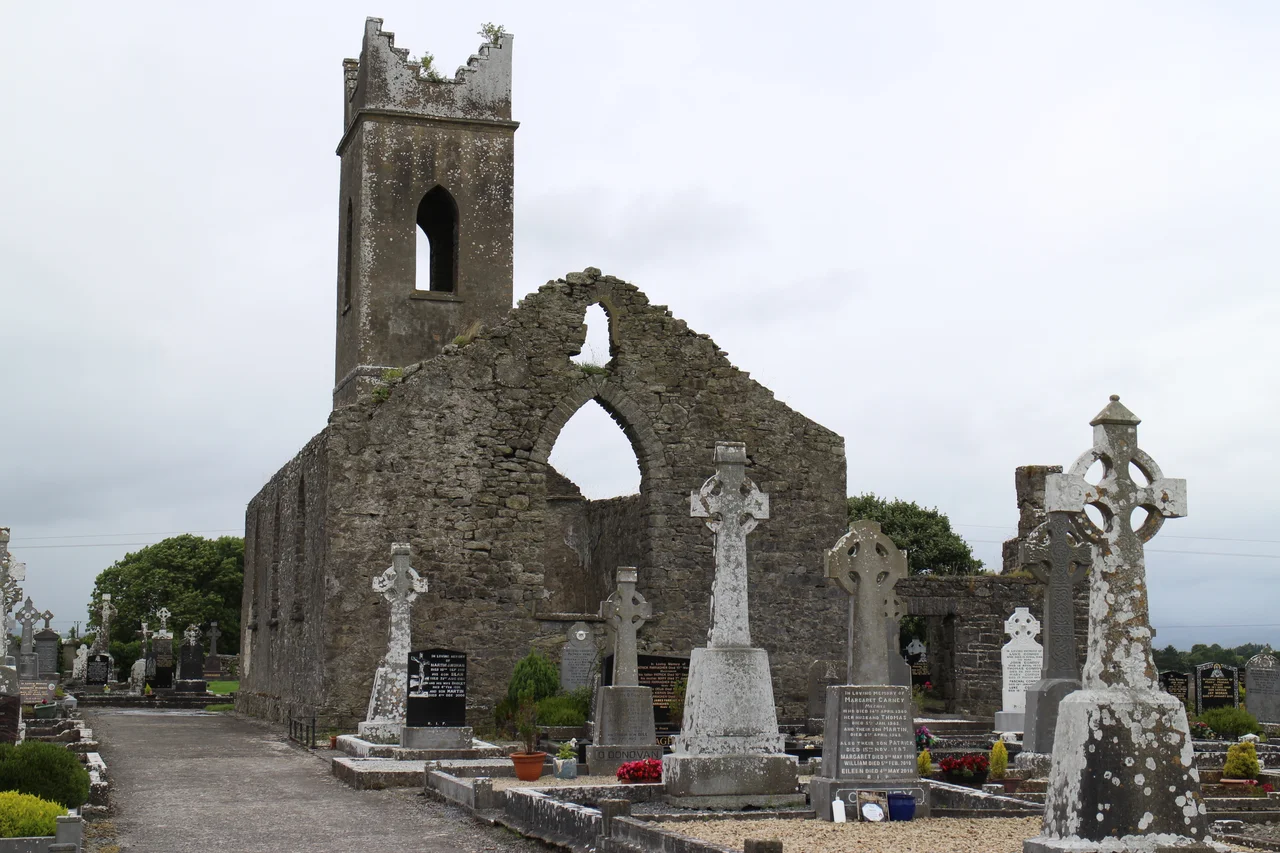
In 1880, Captain Charles Boycott was the land agent for Lord Erne's estate at Lough Mask, a few kilometres from The Neale. When Boycott attempted to raise the rents on his tenants, the Land League, led nationally by Charles Stewart Parnell, urged a new kind of resistance: complete social ostracism. Refuse to work for the landlord. Refuse to trade with him. Refuse to deal with him in any way. The strategy was first put into practical operation at Lough Mask House. The parish priest of The Neale, Father John O'Malley, gave the tactic its name. He coined the word boycotting. The campaign drew journalists from across Europe and America to the tiny village. Boycott was eventually escorted to Dublin under armed guard, his crops harvested by an expensive expedition of Ulster Orangemen and protected by hundreds of soldiers. The government had reportedly spent 10,000 pounds to save 500 pounds worth of turnips. Father O'Malley's word entered the English language permanently, and it spread from there to French (boycotter), German (boykottieren), Spanish (boicotear), and nearly every other major language. He was buried in The Neale. The church he built in 1875 still stands.
The Pyramid as Charity
Multiple stories surround the pyramid's construction around 1760. One holds it was a memorial built by Sir John Browne to honour his brother Sir George Browne, designed by Browne's brother-in-law, the Earl of Charlemont. Another, perhaps complementary, says that Lord Kilmaine was anxious to relieve the extreme poverty of his tenants in the post-famine years. He employed local men to gather up stones from around the estate and pile them into a pyramid. The work paid them a little. The result was the pyramid. In its later years a weathervane was added to the top, allowing the landlord to indulge his passion for meteorology, recording weather systems over thirty years. The pyramid is listed on the Record of Protected Structures for County Mayo and was restored by the Office of Public Works in 1990. It is constructed on top of an older tumulus, an ancient burial mound, layering eighteenth-century philanthropy and aristocratic eccentricity on prehistoric ground.
The Gods of The Neale
About 200 yards east of the village, inside the old demesne wall and near the ruins of Lord Kilmaine's house, stands a stone structure containing a collection of carved slabs. The carvings depict three mythical figures: a griffin, a unicorn, and an angel. An inscription identifies them as Deithe Feile and Diana Ffeale, the Gods of The Neale, from which the village derives its name. The inscription mentions other figures from Irish mythology, including Loo Lave Adda, the anglicised form of Lu Lamhfhada, Lugh of the Long Hand. The Long Stone, at the fork of the roads from Cross and Cong south of the village, is said to mark the burial place of Lugh, son of Nuadha, King of the Tuatha De Danann, slain at the Battle of Moyturna. The stone, the carved gods, and the village name all preserve a layer of pre-Christian mythology that has survived in local memory long after most of Ireland forgot it.
The Temple and the Big House
The 400-acre Neale estate was surrounded by a high double wall. Inside the wall, the Browne family built a collection of follies and monuments. The Temple, the last folly to be built, was constructed in 1865 by John Browne, Baron of Kilmaine, to honour his first title, Lord Mount Temple. It is hexagonal, with six plain Doric columns, and once had a timber roof. The base, with its arches, is older than the columns, which were probably added to give the older structure elevation. The Temple served as a place where the ladies of the Big House would gather for family meetings, knitting, and relaxation. They also walked the Cavendish Walks, both inside and outside the estate. The Big House itself is now a ruin, but the Temple, the Pyramid, and the Gods of The Neale still stand on the old demesne, monuments to the particular blend of classical learning, eccentricity, and stark inequality that characterised Anglo-Irish landlord culture.
Football and a Thatched Pub
In October 2012, the Neale GAA Junior team won the County Mayo Junior Club Championship, beating Ardnaree 2-09 to 1-17 in extra time at MacHale Park in Castlebar. It was the first championship of any kind for the club in its 110 years of existence at Junior level. They were promoted to Intermediate level for 2013. In October 2019, the club claimed the County Intermediate Title for the first time, beating Ballyhaunis 1-12 to 1-11. For a village of a few hundred people, the back-to-back wins were the kind of community achievement that gets remembered for decades. Gibbons Bar, the local pub with a thatched roof, is listed on the Record of Protected Structures by Mayo County Council. The village green, the church, the racecourse at nearby Ballinrobe, all knit together the daily life of a place that punches well above its size in cultural and historical density.
From the Air
Coordinates: 53.573 N, 9.225 W. The Neale sits about 5 km north of Ballinrobe and 4 km northeast of Cong, in the lowland between Lough Mask and Lough Carra. From the air the village is small, but the demesne walls and the surviving structures, including the pyramid, give the immediate surroundings an unusual architectural texture. Nearest airports: Ireland West Knock (EIKN) about 50 km northeast, Galway (EICM, GA only) about 40 km south. Recommended viewing altitude 2,000 to 3,500 ft.
Nearby Stories
- Kylemore Abbey 5 km away
- Granuaile's Castle 7.2 km away
- Castlebar 8.1 km away
- Knockmoy Abbey 9.9 km away
- Kilmovee 13 km away
- Salthill 16 km away
- Loughrea 17 km away
- RMS Carinthia (1925) 55 km away