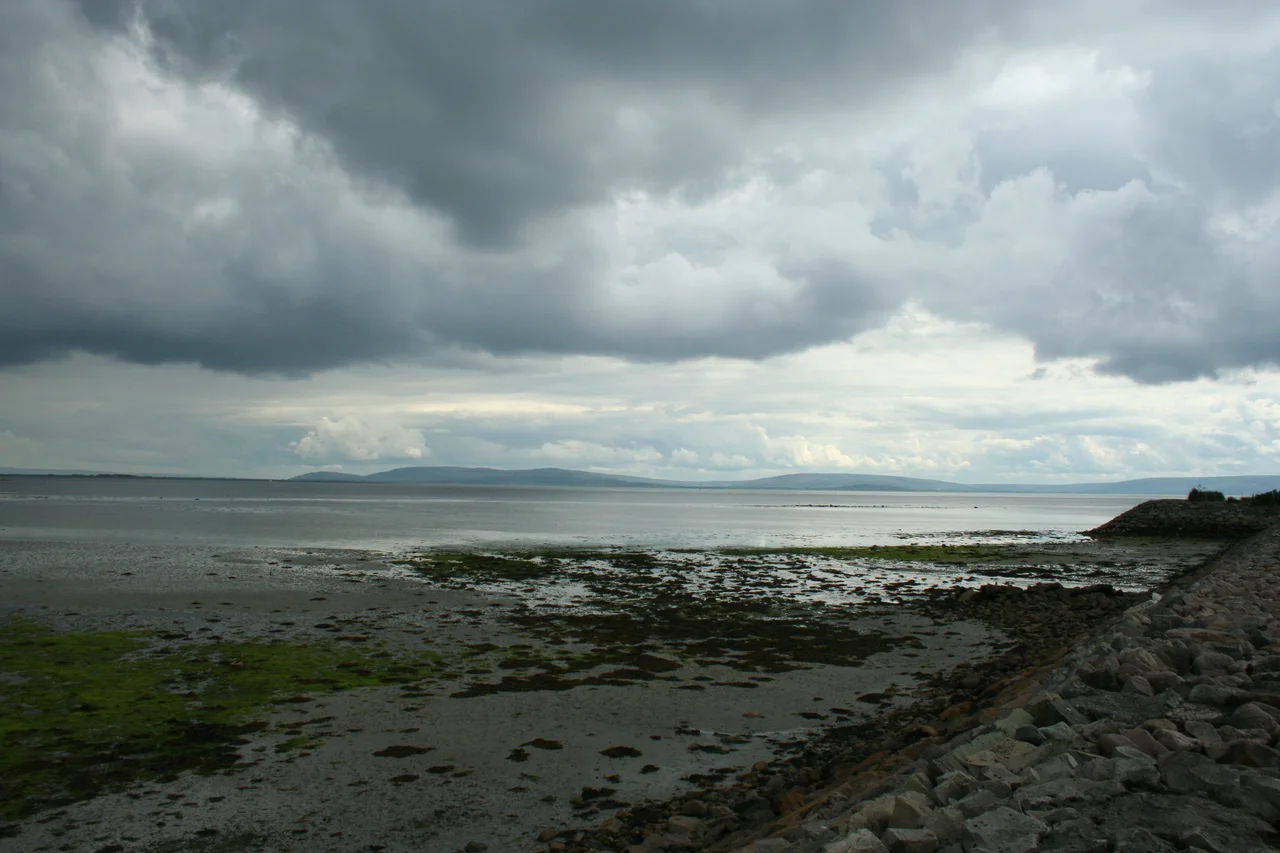

Salthill
Two kilometres of promenade, locally just 'the Prom,' run along Galway Bay south-west of the city centre. People walk it. They do not stroll - they walk, fast and purposefully, often in matching rain jackets, often with a small dog, often into a wind blowing straight off the Atlantic. There is a tradition of kicking the wall at the far end before turning around. Nobody can quite explain when it started. The medicinal baths that put Salthill on the map opened in 1831 and burned down in 1870. The promenade itself opened in 1856. The tradition of walking it appears to be older than either.
Salt Hill, with Baths
Until 1819 the village was Salt Hill, two words, and it sat distinctly apart from Galway city - an outlying hamlet on the bay. Doctor Robert Rogers Gray opened his artificial medicinal baths in 1831 on what is now Claude Toft Park - reclaimed land at the eastern end of the prom. The baths attracted Victorian patients to a coast that had previously been only fishing and farming, and the village grew up around the tourist trade. Bathing lodges sprouted along what is now Upper Salthill Road. The Freeman's Journal of the day described them, primly, as 'more substantial than showy, and are one and all of comfortable presence and most cosily placed.' Gort Ard, Lisgorm, and St Mary's survive as examples. The medicinal baths burned down in 1870 and were never rebuilt - the tourists kept coming anyway, by then attracted to the sea itself.
Trams and Hotels
By the 1870s, four-wheeled horse buses carrying twenty-five passengers were shuttling between Salthill and Galway city. In 1877 William Leadbetter Barrington, inspired by the tramways opening in Dublin and Belfast, pushed a bill through the British Parliament to electrify the connection. Fifteen thousand pounds and two years later, the tramway opened on 1 October 1879. It ran for almost forty years before closing in April 1918. The same day the tramway opened, Salthill got its railway station - which also closed in 1918, leaving the village to be served by buses ever after. John Gill's Eglinton Hotel had opened in 1860 and was described as 'crowded with tourists' through the late nineteenth-century summers. A succession of hotels followed, and then in the 1970s came the casinos, the amusement arcades, and the leisure centres that still characterise the seaward end of the village.
Blackrock Tower on Christmas Day
At the far western end of the promenade stands Blackrock Diving Tower - a concrete platform built out over the sea, two or three storeys high, with a flat top for jumping from. Every Christmas Day a swarm of people, some of them in Santa hats, some of them with hangovers from the night before, jump off it into the Atlantic. The water in December is around nine degrees Celsius. The tradition is now a charity fundraiser. Through the summer the prom swims happen - open-water races between Blackrock Tower and Grattan Beach, ranging from 500 metres to 2.5 kilometres, run parallel to the shore. Every July the Galway Bay Swim covers 10.5 kilometres from Aughinish in County Clare to Blackrock Tower in Salthill, a fundraiser for local charities and a test of cold-water endurance that draws specialist swimmers from around the world.
Pearse Stadium and the Air Show
Salthill-Knocknacarra GAA, the local club, won the All-Ireland Senior Club Football Championship in 2006 - beating Antrim's St Gall's in the final, in a result that put the Galway suburb briefly into the centre of the Gaelic football conversation. The club's Ladies team took the Junior All-Ireland in 2022. Pearse Stadium, on Dr Mannix Road in Salthill, is one of Galway GAA's two main grounds and hosts senior county games when the championship swings through. Salthill Devon FC, the soccer club, climbed to the League of Ireland First Division between 2010 and 2013 before merging into the rebuilt Galway FC. Until 2007 Salthill hosted one of Ireland's biggest free air shows - aircraft running display lines over the bay every June, more than 100,000 spectators on the prom and grass, around a million euros in local economic activity. It ran for years until logistics and rising costs ended it.
Galway Girl
Salthill was a centre point for the 2008-09 Volvo Ocean Race when the fleet stopped over in Galway, and again for the Round-Ireland Powerboat Race in 2010. The bay opens to the west and the sunsets across it have given Galway one of the recognisable images Ireland exports. Steve Earle wrote a song called 'Galway Girl' in 2000 that mentions the Salthill prom and the Long Walk along the Spanish Arch - a song since covered by Mundy and Sharon Shannon and absolutely no relation to the more recent Ed Sheeran track of the same name, which annoys traditionalists. The Galway Lawn Tennis Club on Threadneedle Road won Irish Tennis Club of the Year in 2002. Bus Eireann's route 401 runs from Salthill to Eyre Square every twenty minutes or so. Walk the prom, kick the wall, eat a 99 from Coppola's. It is a small ritual, repeated daily by a few thousand people, and it is what Salthill is.
From the Air
Salthill is at 53.26 N, 9.07 W on the south-western edge of Galway city, along the inner north coast of Galway Bay in County Galway. Galway Airport (EICM) lies about 8 km east. The promenade itself - a straight two-kilometre line of seafront paralleled by hotels and Pearse Stadium - is a distinctive linear feature visible from altitude, running roughly east-west. Blackrock Diving Tower at the western end shows as a small concrete platform over the water. The Long Walk and Spanish Arch are immediately to the north-east at the head of the city. Best viewed in clear westerly conditions; Atlantic mist can close the bay in minutes.
Nearby Stories
- Connemara Railway 3.8 km away
- Ennis 7.2 km away
- Headford 10 km away
- Inishmaan 12 km away
- Ballygar 12 km away
- Ardgraigue Bog 13 km away
- Nenagh 17 km away
- Kilkee 27 km away