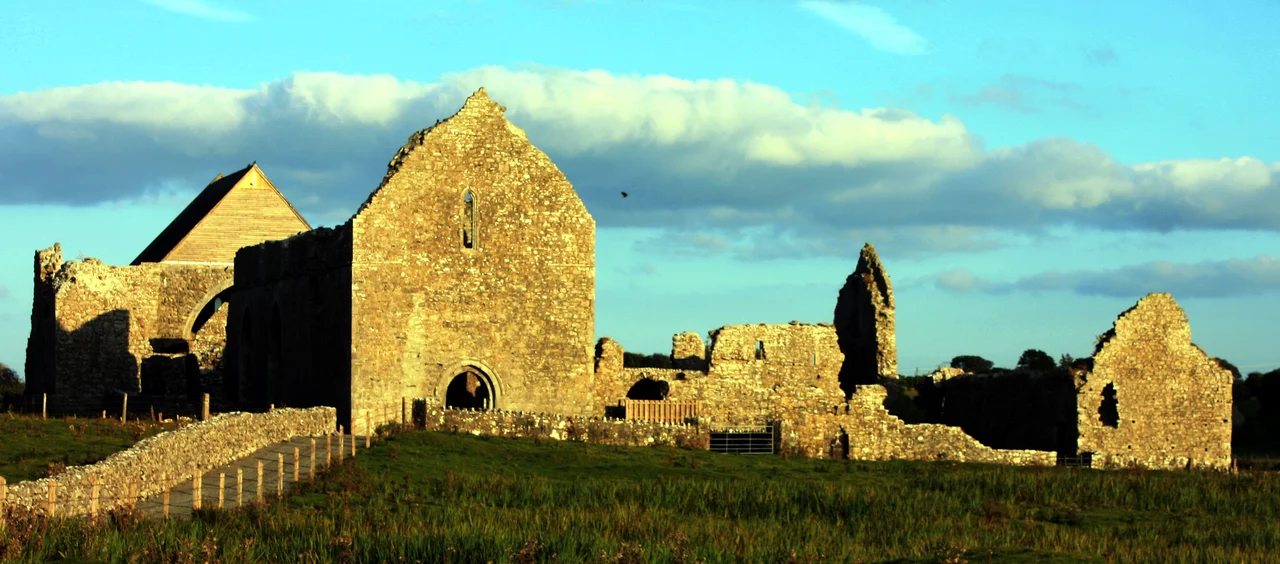

Knockmoy Abbey
Cathal Crobderg O'Conor won a battle here, on a hill above the River Abbert in north-east County Galway, and decided the moment deserved an abbey. The year was 1189. He brought in Cistercian monks from Boyle Abbey in County Roscommon to settle the new house, and named it after the victory: Mainistir Chnoc Muaidhe, the Monastery of the Hill of Victory, or in Latin, Monasterium Collis Victoriae. After the dissolution, parishioners knew it as Porta Magna - the Great Door. Today, locals still call it Teampollandorusmoir, the Chapel with the Big Door, though the building is mostly roofless. What endures, weathered into the stone of the chancel's north wall, is a series of medieval paintings unlike anything else surviving in Ireland.
A King's Victory in Stone
The bulk of the buildings rose in the early 13th century, with later additions in the 15th and 16th centuries. Knockmoy followed the standard Cistercian template - claustral layout, church on the north side, cloister to the south, refectory, chapter room, dormitories above the chancel. The nave is unusually wide and the transepts narrow, a quirk of the local builders. On the southwest corner of the church stands a carved head that may represent Cathal O'Conor himself; the nose and chin have weathered away, but the crown, hair and eyes survive. Cistercian abbeys typically avoided towers, but architectural historians believe Knockmoy probably had a low one, in keeping with the order's restraint. The cloister, which once enclosed the daily walk of the monks, is now a burial ground.
Plunder and Survival
The abbey was prosperous and conspicuous, which made it a target. In either 1202 or 1203 - the chronicles disagree - the Anglo-Norman William de Burgh raided Knockmoy and stripped it of valuables. Other raids followed, the next recorded in 1228. The Cistercians rebuilt and continued. They were still there in May 1542, when Henry VIII's dissolution of the monasteries reached the west of Ireland. Hugh O'Kelly, who held the abbacy in commendam (a kind of absentee benefice), surrendered the abbey to the crown on 24 May 1542. The community of monks dispersed. Local people kept using parts of the church for burial and worship, which is one reason so much of the structure survives compared with abbeys that were stripped for building stone.
The Paintings on the Chancel Wall
What sets Knockmoy apart from every other Cistercian ruin in Ireland is the paintings. They once covered the entire north wall of the chancel - a sequence of figures and scenes that include three kings standing in dignity, and a darker scene depicting the death of a son of Diarmait Mac Murchada, the king whose invitation to Strongbow brought the Anglo-Normans to Ireland in the first place. They are commonly called frescoes, but technically they are not: true fresco requires pigment applied to wet plaster, and no medieval church in Ireland has any. The Knockmoy works are tempera, painted in dry pigments bound with egg, and they are one of only four such surviving artworks in the country. The paintings are weathered and partially destroyed, the colours mostly gone. In the 1980s, the Office of Public Works built a protective shelter over the chancel wall to slow the loss.
Walking the Ruin Today
The abbey sits in the small village of Abbeyknockmoy, about thirty kilometres north-east of Galway city. The site is open to walkers, and the ruin rewards patient exploration. The chapter room retains its vaulting and its original three-light window with elaborate jambs, even though later cross-walls block two of the lights. The sacristy is also vaulted, with the remains of dormitory floors above. The refectory has a wide nine-foot opening where a stairway once climbed to a reading pulpit - monks ate in silence while one of their number read aloud from the scriptures. On the east side, projecting outward, stand the walls of the garderobe, the medieval toilet block, dating from the 14th century. A modern mill works the river just downstream, supposedly on the site of the abbey's own mill, which kept the monks in flour for over three centuries.
What the Hill Remembers
Cathal Crobderg O'Conor is buried in his own foundation. He died in 1224 having ruled Connacht through the turbulent decades that brought English power decisively into Ireland. The abbey he raised in thanksgiving for one twelfth-century skirmish has outlived his kingdom, his line, and the order of monks who tended it. The paintings on the chancel wall - whoever commissioned them, whoever painted them - have survived 800 years of Atlantic weather, royal confiscation, neglect, and finally a glass shelter. They are not the most spectacular medieval murals in Europe. But they are among the only ones in Ireland, and the abbey that holds them still stands where Cathal Crobderg said it should.
From the Air
Located at 53.44 degrees north, 8.74 degrees west, in north-east County Galway near the village of Abbeyknockmoy on the north bank of the River Abbert. The roofless church and cloister sit on a gentle rise visible from low altitudes - look for the rectangular grey stone footprint surrounded by greener pasture. Galway Airport (former EICM, now closed) is about 30 km south-west; Ireland West Airport (EIKN) is about 65 km north.
Nearby Stories
- Clonfert Cathedral 3 km away
- Loughglinn 5.2 km away
- Neale, County Mayo 7.7 km away
- Loughrea 7.8 km away
- Castlebar 13 km away
- Athlone Castle 15 km away
- Lough Rynn Castle 20 km away
- The Burren 21 km away