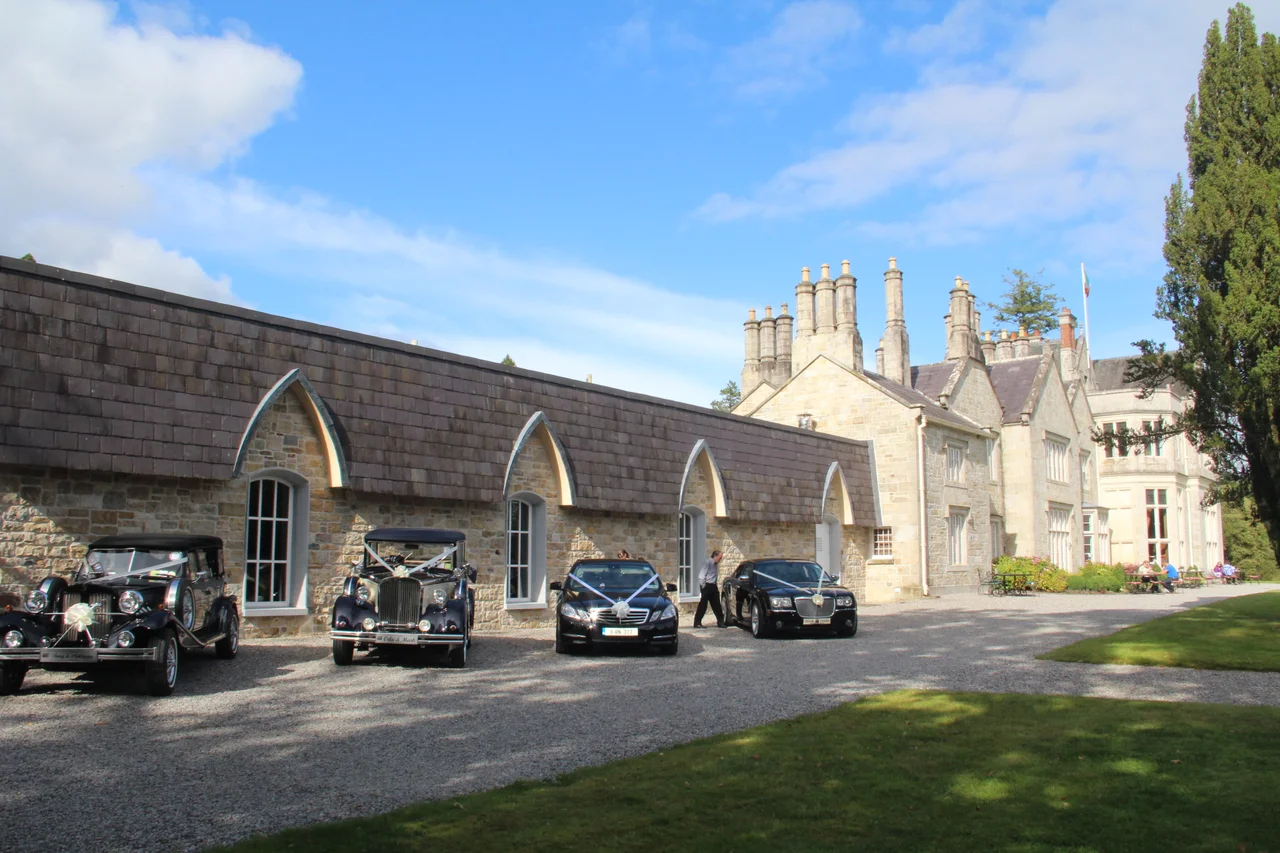

Lough Rynn Castle
Two lakes in south Leitrim, a narrow neck of land between them, a four-hundred-year-old oak tree on a hill, a Bronze Age druid's altar buried under bracken nearby, and a great Victorian baronial pile that was finished in 1889 for one of the most hated landlords in modern Irish history. Lough Rynn Castle is many places at once. It is the ancestral land of the Mac Raghnaill, the Gaelic ruling family of Muintir Eolais. It is a confiscated Plantation estate granted by Charles I to an English family in 1621. It is the country house of William Sydney Clements, the third Earl of Leitrim, who was shot dead by three of his Donegal tenants in 1878. And it is a luxury wedding hotel today - because there is nothing in Ireland that has not had at least three lives.
The Mac Raghnaill of Muintir Eolais
The estate that holds the present castle was for centuries part of the lands of Clan Maelsechlainn-Oge Mac Raghnaill, the pre-Conquest rulers of this corner of Leitrim known as Muintir Eolais. About five hundred metres from the modern hotel, on another shore of Lough Rynn, the ruins of their medieval castle still stand. It is first mentioned in the annals in 1474, though the site is much older - some old maps mark a 'Crannoge' or 'Crane Island' offshore, suggesting an Iron Age or early medieval wooden lake-dwelling that preceded the stone castle. The historian Fiona Slevin describes the structure as fairly standard for its time but with two unusual features: although it was a square tower, its corners were rounded - making it harder for artillery to break - and instead of the usual spiral stair in one corner, it had a straight stairway carved into the hollow of a wall. The Mac Raghnaill held the land for centuries and played a significant role in the Nine Years' War of the 1590s as allies of Hugh O'Neill in the great Gaelic confederacy against the Tudor reconquest. They lost in the end. In 1621 their lands were confiscated in the English Plantation and granted to an English family called Crofton.
The Earl Who Lost His Head
In 1750 the Lough Rynn estate was acquired by Nathaniel Clements, who lived in Cavan but bought the Leitrim land as an investment. The Clements family settled in. In 1795 Robert Clements became the first Earl of Leitrim. When the third Earl, William Sydney Clements, inherited in 1854, he came into the ownership of a colossal ninety-thousand-acre estate spread across four counties. He used it badly. The Nation, the great nationalist newspaper of mid-century Ireland, wrote that Lord Leitrim was 'already famous for such proceedings towards his tenantry as not many even of his own order dare imitate.' In Donegal in particular - where he held vast tracts of poor coastal land - he was so feared and resented that he travelled with an armed military escort. In 1878, during the second great famine of the nineteenth century in northwest Ireland, he carried out wholesale evictions of starving tenants. On the morning of 2 April 1878, three local men - Michael Heraghty, Michael McElwee and Neil Sheils - ambushed him at Cratlagh Wood near Milford in Donegal, and shot him dead. The killers were never convicted. The case became a national parable about Irish landlordism. The Victorian baronial mansion at Lough Rynn was completed in 1889 - eleven years after the assassination - for his successor.
A Library Named for McGahern
The completed house had on its principal floor a great hall, a baronial hall, a chapel, reception rooms, drawing rooms, and dining rooms; the basement held the wine cellar and stores; upstairs were fourteen bedrooms and four bathrooms. The Clements held it until the twentieth century. After a long quiet decline it was bought by the Hanly Group, who refurbished and reopened it as a luxury hotel in the mid-2000s. It now has forty-two bedrooms, the Sandstone restaurant, function rooms for weddings of up to three hundred, and - in a perfect Leitrim touch - a library named after John McGahern, the novelist who grew up nearby and whose books returned again and again to the small farms and small towns of this country. The hotel has a baronial hall and a piano room. Weddings are the steady business. The lake is the view from every window.
Druid's Altar and Walled Garden
The estate grounds are extraordinary and largely free to walk. There are sawmills, a farmyard, an arboretum, a greenhouse, French stable yards, nature trails, and terraced gardens. A four-hundred-year-old oak tree stands on the grounds. A Bronze Age portal tomb called Cloch an Draoi, the Druid's Altar, sits on Druid's Hill between Lough Erril and Lough Rynn; it dates somewhere between 1900 and 300 BC. Two bridges cross the small Rynn river that connects the two lakes - the Red Bridge and the Blue Bridge. The principal walk loops past the ha-ha wall, the old crannog still visible in Lough Rynn, the boathouse, the ruins of the medieval Mac Raghnaill castle, the rockery, and the Wishing Chair beside the lake. The centrepiece is the enormous three-tiered walled garden, originally built by the Clements between 1855 and 1860 and restored to reopen on 5 August 2008. When they reopened, they were the largest privately-owned walled gardens in Ireland. An eighteen-hole golf course was abandoned in 2010 when the money ran out at sixty percent built. Its overgrown fairways are now closed; one of the planned entrances has become a fishing spot.
From the Air
Located at 53.893 degrees north, 7.847 degrees west, on an isthmus between Lough Rynn and Lough Erril in south County Leitrim, about 4 km southwest of Mohill village. The two lakes are the most useful aerial reference - a pair of small connected water bodies in the rolling farmland. Best viewed at 2,000-4,000 feet. Nearest airports: Ireland West Knock (EIKN) about 100 km west, Dublin (EIDW) about 145 km southeast. The N4 motorway passes through Mohill town.
Nearby Stories
- Markree Castle 4 km away
- Glangevlin 5.9 km away
- Ballaghaderreen Branch Line 7.6 km away
- Glenamaddy 7.6 km away
- County Cavan 9.8 km away
- Cathedral of Christ the King, Mullingar 9.9 km away
- Clones, County Monaghan 11 km away
- Moydrum Castle 21 km away