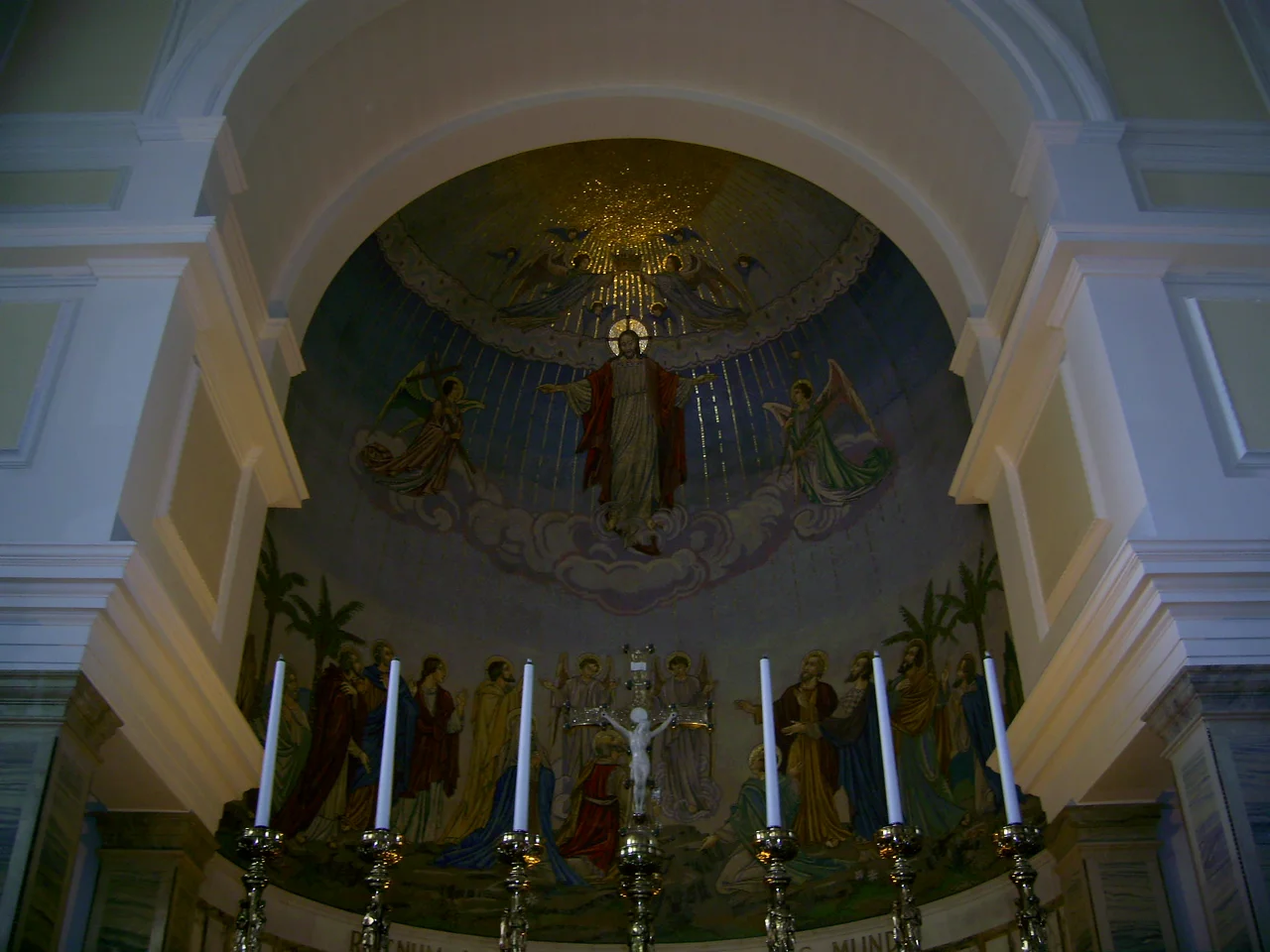

Cathedral of Christ the King, Mullingar
Look closely at the mosaic of Saint Anne in the Cathedral of Christ the King, and you may notice that her name is spelled wrong. Or rather, spelled differently — "Anna" rather than "Anne," the Russian form rather than the English. There is a reason. The face of the saint, gazing down at pilgrims in a quiet provincial town in the Irish midlands, is the face of the poet Anna Akhmatova, a woman the artist had loved during the First World War, lost to the Bolshevik Revolution, and never spoken to again. He smuggled her into a Mullingar chapel because it was the only place left where he could.
The Pope's Particular Request
Planning began in 1920 to replace the older Cathedral of the Immaculate Conception. By 1933, Bishop Thomas Mulvany was laying the foundation stone of something altogether grander: a basilica-form cathedral in Renaissance Revival style, designed by William Byrne & Sons of Dublin, faced in granite hauled from the Barnacullia quarries above Dublin. Twin towers rose to 55 metres, crowned with bronze crosses. The seating capacity was 5,000, an enormous number for a town that then had only a few thousand inhabitants. When it opened on 6 September 1936, at the specific request of Pope Pius XI, it became the first cathedral in the world to be dedicated to Christ the King — a feast the Pope had instituted only a decade earlier. The total cost was £275,000, a staggering sum for a parish in 1930s Ireland, raised across years of collections and emigrant donations.
Boris Anrep and the Russian Past
The mosaics in the side chapels were the work of Boris Anrep, a Russian-born artist who had become one of Europe's foremost mosaicists. His work covers the floors of the National Gallery in London and the chapels of Westminster Cathedral. In Mullingar he was given two chapels: one for Saint Patrick, one for Saint Anne. The Saint Patrick mosaic shows the saint at the moment of his greatest defiance, lighting the Paschal fire on the Hill of Slane against the king's order. Patrick lifts the cross in one hand and grips a torch in the other; the firewood at his feet has been arranged in the shape of a Christogram, the symbol he was about to plant in Irish soil. It is a piece of pure narrative drama in coloured glass.
The Face in the Other Chapel
The Saint Anne mosaic is something else. Anrep had met Anna Akhmatova in Saint Petersburg before the First World War, and during the war they had a brief, intense affair. He left Russia just before the Bolsheviks took power. She stayed, became one of the great poets of the twentieth century, was persecuted by Stalin, watched her son sent to the camps. They never saw each other again. They never even corresponded for forty-eight years. But Akhmatova haunted Anrep's imagination, and her face appeared again and again in his mosaics across Europe. Mullingar is the only one of them to give her name — spelled Anna in the Russian way, hidden in plain sight inside an Irish cathedral. She, for her part, wrote some thirty-four poems about him. It is the kind of secret a small town can keep without quite knowing it has one.
Quiet Faith in a Cathedral Town
Today the cathedral still dominates Mullingar's skyline beside the Royal Canal, those twin towers visible from kilometres out across the lowland Westmeath countryside. The seating capacity is rarely tested any more — Ireland's vocations crisis and the long erosion of regular Mass attendance have left this building, like so many built in its era, larger than it needs to be. But the mosaics endure, more visited now perhaps for their story than for their devotion. The cathedral remains the principal church of the Diocese of Meath, and it was solemnly consecrated on 13 August 1939, three weeks before the world went to war again.
Where to Find Her
Visitors come down Mary Street and find the cathedral set back from the road behind a small forecourt. Inside, the nave is high and bright, the granite walls catching the light from the clerestory windows. The Saint Anne chapel is to one side, modest in scale, easy to miss. Stand in front of the mosaic and look at the saint's face — long oval, dark eyes, the slight asymmetry of a real human likeness rather than an idealised holy figure. The script reads "Anna." Then walk back out into the Westmeath drizzle and consider that a Russian poet, a Bavarian-trained Russian artist, an Irish bishop, and an English mosaic firm all conspired across one of the most violent decades in European history to put a memorial to lost love into a midlands cathedral. Few buildings carry quite so unlikely a story.
From the Air
The Cathedral of Christ the King sits at 53.53°N, 7.35°W in the centre of Mullingar, County Westmeath, beside the Royal Canal. From the air, its twin 55-metre towers and pale granite walls are unmistakeable against the green flat plain of the Westmeath lowlands. Cruise altitudes of 3,000–5,000 ft give a clear view of the town's compact grid and the lakes — Lough Owel to the north, Lough Ennell to the south. The nearest controlled airspace is Dublin (EIDW), about 80 km southeast; Casement Aerodrome (EIME) lies due east. Knock (EIKN) is to the west. Conditions are typically marginal VFR — low ceilings, drizzle — so a high-pressure day rewards the patient pilot with a fine view of midland Ireland.
Nearby Stories
- Dunsany Castle and Demesne 4.1 km away
- Virginia, County Cavan 9.5 km away
- Mount Temple, County Westmeath 11 km away
- Portarlington, County Laois 11 km away
- Lough Rynn Castle 14 km away
- Kilbride, County Wicklow 16 km away
- Athclare Castle 19 km away
- Saighir 21 km away