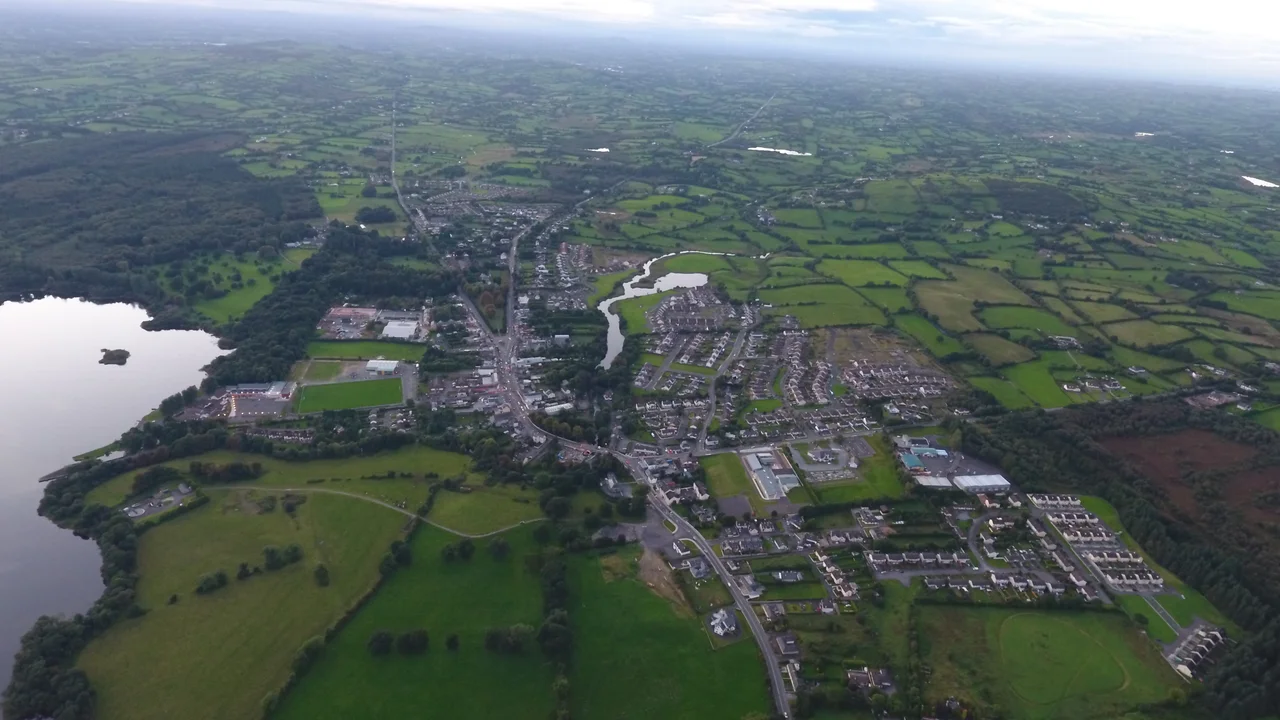

Virginia, County Cavan
Some Irish towns wear their history on their sleeves; Virginia hides hers in a milk carton. Drive into this Cavan town today and you find a tidy Main Street, a lake at the edge of the parish, and a Tirlán factory humming away at the southern outskirts. That factory turns local milk into the cream that goes into Baileys Irish Cream, sold in 180 countries. None of that gives away the fact that you are standing in a 17th-century plantation experiment, named for an English queen who had died fifteen years before the first wooden cabin went up.
A Town Built on a Promise
Virginia began as a paperwork problem. In the early 1600s, after the flight of the Gaelic earls cleared the way for the Plantation of Ulster, an Englishman named Ridgeway received a patent to plant a town near a ruined O'Reilly castle. The conditions were precise: bring English tradespeople, build a borough, do it on a deadline. Ridgeway managed a corn mill and a few cabins. He gave up. Captain Hugh Culme tried next, moved the site closer to the Blackwater River, and also failed. The land outside the Pale was considered hostile country, and English settlers were not lining up to come. When the patent finally landed in 1622 with the Catholic Anglo-Irish Plunkett family, complaints from the few existing inhabitants had already reached the commission. The Anglican Bishop of Kilmore, William Bedell, was ordered to lay out the streets himself. Then the 1641 rebellion arrived, government forces burned the castle in 1642, and the whole project was effectively erased.
Swift at Quilca
What rebuilt Virginia was not military force but a road and a friendship. In the 1720s, the cleric Thomas Sheridan kept a house called Quilca a few miles from town. His most famous guest was Jonathan Swift, who came up from Dublin on long visits and wrote much of Gulliver's Travels in the surrounding countryside. The local wayside inn, run in 1727 by a Cornelius Donnellan, became part of Swift's regular round. A century later, after the Plunketts sold the estate around 1750 to pay debts, the Taylour family poured money into drainage, afforestation, and flax growing. Rents went up sharply, but so did employment. Virginia doubled in population between 1821 and 1841, and its Main Street took on the shape it still has, looking down toward seven kilometres of Lough Ramor.
The Famine That Almost Wasn't
When the potato failed in 1845, Virginia did something unusual: it almost avoided starvation. The local Famine Relief Committee handed out Indian meal in exchange for hard labour, and women and children broke stones for road-making and helped build the new Catholic church on land donated by the landlord. Typhus and cholera still came, brought by poor sanitation, but mass starvation did not. A railway arrived in 1863 connecting Kells to Oldcastle, and Virginia prospered briefly as a cattle and butter market. The line closed in 1958 after Ireland's population bottomed out, and Virginia itself shrank to just under 300 people by 1951. The town that recovered was not the same town. The current Virginia, with a population over 3,000 in the 2022 census, owes its growth to the M3 motorway that opened in 2010 and put Dublin within easy commuting distance.
The Soldier Who Made Lincoln Smile
Virginia's most famous export left as a baby. Philip Sheridan was born in 1831, the son of emigrants from nearby Killinkere who had sailed for America around 1830. He became a Union general in the American Civil War, and his cavalry pursuit at Appomattox helped force Lee's surrender. Abraham Lincoln, watching him operate, reportedly summed him up: 'This Sheridan is a little Irishman, but a big fighter.' He ended his career as Commanding General of the U.S. Army. Virginia also lays claim to a deeper literary connection through Richard Brinsley Sheridan, the playwright, who was Thomas Sheridan's grandson. The town's connection to comic genius, in other words, goes back through three generations and across an ocean.
Pumpkins and Persistence
Modern Virginia has the cheerful eccentricity of a small town that knows it has to make its own fun. The Ramor Theatre, opened in 1999, is the only professional performance space in County Cavan, and home to Livin' Dred Theatre Company. The Virginia Agricultural Show has run for over seventy years. And from 2007 the town hosted Ireland's only pumpkin festival every Halloween bank holiday weekend, an unexpected import that put orange decorations along the lake. The festival paused in 2017 and has not yet resumed. Drive along Main Street today and you'll see the same broad street the Taylours laid out, the Park Hotel that began life as a hunting lodge for the Marquesses of Headfort, and trucks turning into the Tirlán factory to pick up the cream that ends up in bottles in bars on six continents. Founded as an English plantation town, named for an English queen, Virginia turned out to be quietly, irrepressibly Irish.
From the Air
Virginia sits at 53.83°N, 7.08°W in northeast County Cavan, on the N3 about 85 km northwest of Dublin and 65 km from Cavan town. Lough Ramor is the obvious landmark at the town's southern edge, a 7-km lake feeding into the Blackwater and Boyne river systems. The town is now bypassed by the M3 motorway. Nearest commercial airport is Dublin (EIDW) to the southeast. From cruise altitude in clear weather the rectangle of cultivated fields around the lake stands out from the surrounding hill country. Best viewing altitude 1,500-3,000 ft, where the Main Street grid is clearly distinguishable from the modern housing developments south of town.
Nearby Stories
- Clones, County Monaghan 4.7 km away
- Lough Rynn Castle 7.6 km away
- Cuilcagh 8.3 km away
- Dunsany Castle and Demesne 9.5 km away
- Edward Pakenham 12 km away
- County Louth 17 km away
- Kingsmill Massacre 17 km away
- Mount Temple, County Westmeath 21 km away