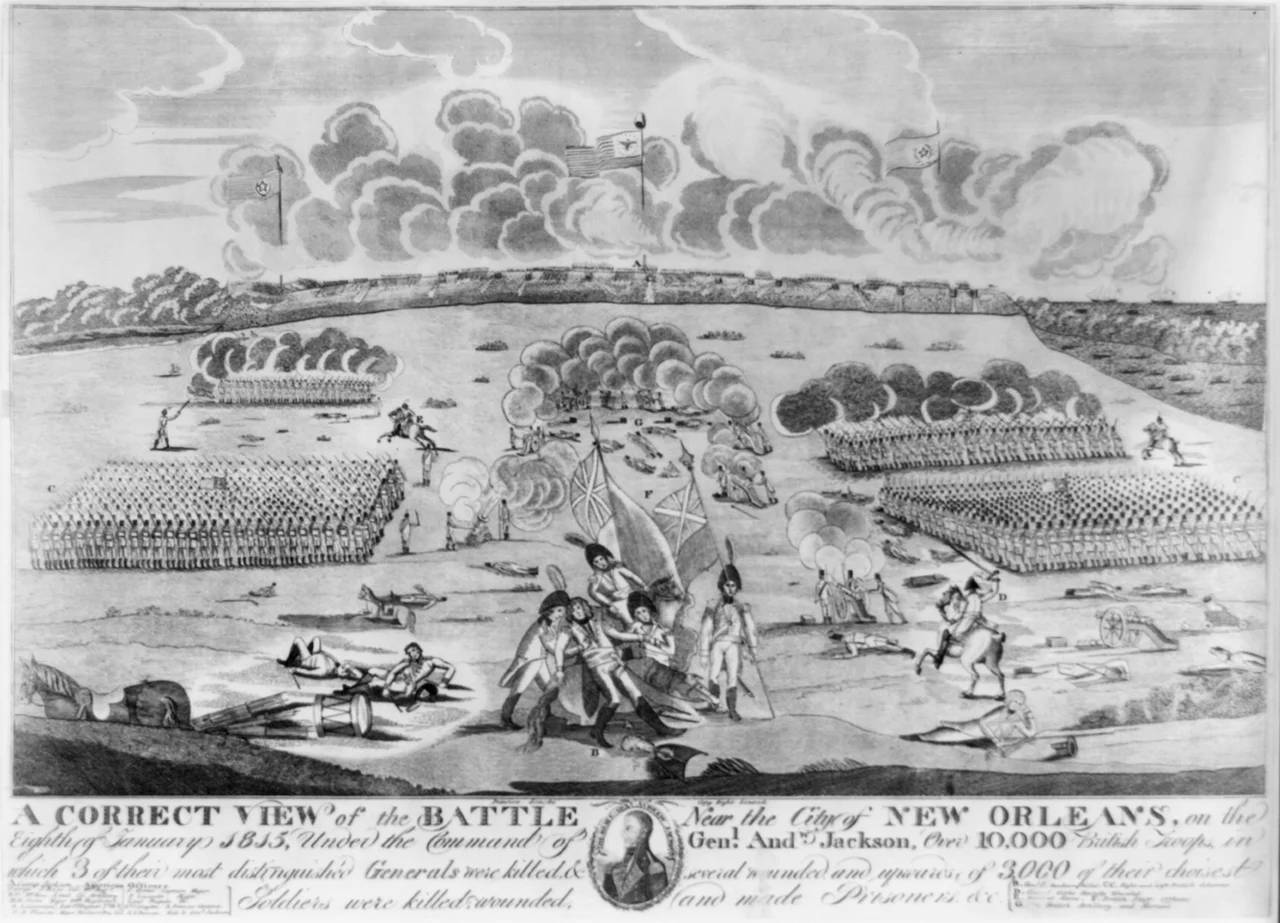

Edward Pakenham
The treaty had already been signed. On 24 December 1814, British and American diplomats had put their names to the Treaty of Ghent and ended the War of 1812. The news had not yet crossed the Atlantic. So when Major-General Sir Edward Pakenham — Anglo-Irish aristocrat, brother-in-law of the Duke of Wellington, hero of Salamanca — led his veteran soldiers forward through the morning mist outside New Orleans on 8 January 1815, he and they were fighting a war that no longer technically existed. He died that morning at the age of 36, hit three times by grapeshot, slumped on his aide-de-camp's borrowed horse. His body was sent home to County Westmeath preserved in a cask of rum.
Born at Pakenham Hall
Pakenham was born on 19 March 1778 at Pakenham Hall — the great Gothic Revival pile near Castlepollard that is now called Tullynally Castle, still the seat of the Pakenham family after more than three centuries. His father was the 2nd Baron Longford. His mother was Catherine Rowley. He was educated at the Royal School in Armagh, and his family bought him a lieutenant's commission in the 92nd Regiment of Foot when he was sixteen years old. None of this was unusual for a young man of his rank and connections. What was unusual was the talent that turned out to be inside him. By the time he was thirty-five he had survived the 1798 Rebellion, three campaigns in the Caribbean (wounded twice), the bombardment of Copenhagen, and seven major battles in the Peninsular War.
The Duke's Brother
In 1806 his sister Catherine married Arthur Wellesley, a rising British officer who would later become the Duke of Wellington. The connection took Pakenham to the Peninsular War as his brother-in-law's adjutant-general. He commanded a regiment at Bussaco in 1810, fought at Fuentes de Oñoro to defend the besieged fortress of Almeida, and at Salamanca in 1812 he led the Third Division in a hammer-blow flanking attack that broke the French line and made his reputation. Wellington was sparing with praise, but Pakenham earned it. By the end of the Peninsular campaign he held the Army Gold Cross with clasps for Martinique, Busaco, Fuentes de Oñoro, Salamanca, Pyrenees, Nivelle, Nive, Orthez, and Toulouse — a record that put him in the front rank of British field commanders.
An Expedition That Should Not Have Sailed
In September 1814 he was promoted major general and given command of the British army in North America. His predecessor, General Robert Ross, had been killed in a skirmish near Baltimore. Pakenham accepted the post even though the campaign that awaited him — an attack on New Orleans designed to challenge the legality of the Louisiana Purchase and pry control of the Mississippi from the young United States — was already going wrong. He arrived on Christmas Day to find his subordinate generals dug in opposite a fortified American line commanded by Andrew Jackson. A reconnaissance-in-force on 28 December collapsed in panic on the left flank, and Pakenham, against his own instincts, was overruled by Vice-Admiral Cochrane on the question of how to attack. Cochrane insisted the veteran British infantry would simply walk through Jackson's defences. They did not.
Grapeshot at Line Jackson
The main assault on 8 January 1815 was a disaster from the first minutes. The brigade carrying the fascines and scaling ladders fell into confusion. Without ladders, the British infantry could not climb Jackson's earthworks; they advanced into a storm of musketry and cannon fire and stood there being shot down. Pakenham rode forward to rally them. A blast of grapeshot shattered his left knee and killed his horse. His senior aide, Major Duncan MacDougall, helped him to his feet and mounted him on a second horse; a second wound tore his right arm; a third volley of grapeshot ripped through his spine. He was carried off the field on a stretcher. His last words, by tradition, were instructions to MacDougall to find General Lambert and bring up the reserves. Two thousand British soldiers fell that morning. The Americans lost fewer than a hundred. The news of the Treaty of Ghent reached the combatants in February, several weeks too late.
Home in a Cask of Rum
Wellington, hearing of his brother-in-law's death, wrote in genuine grief: "He fell as he lived, in the honourable discharge of his duty." He reserved his real fury for Admiral Cochrane, whose plan he believed had killed Pakenham. The body was preserved in rum for the long Atlantic voyage and buried in the Pakenham family vault at Killucan in County Westmeath, a few miles from the house where he had been born. A statue stands in the south transept of St Paul's Cathedral in London. The village of Pakenham in Ontario, the suburb of Pakenham in Melbourne, and Packenham Avenue and Packenham Drive in Chalmette, Louisiana — the actual battlefield where he died — all carry his name. So, in the British alternate version of Johnny Horton's 1959 novelty hit "The Battle of New Orleans," does the line about Colonel "Pakeningham," misspelled and demoted by Horton in cheerful disregard of the facts.
From the Air
Pakenham's birthplace at Tullynally Castle sits at approximately 53.51°N, 7.14°W, a few kilometres west of Castlepollard in County Westmeath. The grounds are extensive, and from cruise altitudes of 3,000–5,000 ft the castle's Gothic Revival silhouette and its 12-hectare gardens stand out clearly against the surrounding farmland. Lough Derravaragh lies a few kilometres east. The nearest controlled airspace is Dublin (EIDW), about 95 km southeast; Casement Aerodrome (EIME) lies due east. The Pakenham family vault at Killucan is a short distance south. Typical Irish midlands weather — low ceilings, drizzle — applies; a clear day reveals the lakes and demesnes that shaped the Anglo-Irish gentry's eighteenth and nineteenth centuries.
Nearby Stories
- Dunsany Castle and Demesne 4.1 km away
- Virginia, County Cavan 9.5 km away
- Mount Temple, County Westmeath 11 km away
- Portarlington, County Laois 11 km away
- Lough Rynn Castle 14 km away
- Kilbride, County Wicklow 16 km away
- Athclare Castle 19 km away
- Saighir 21 km away