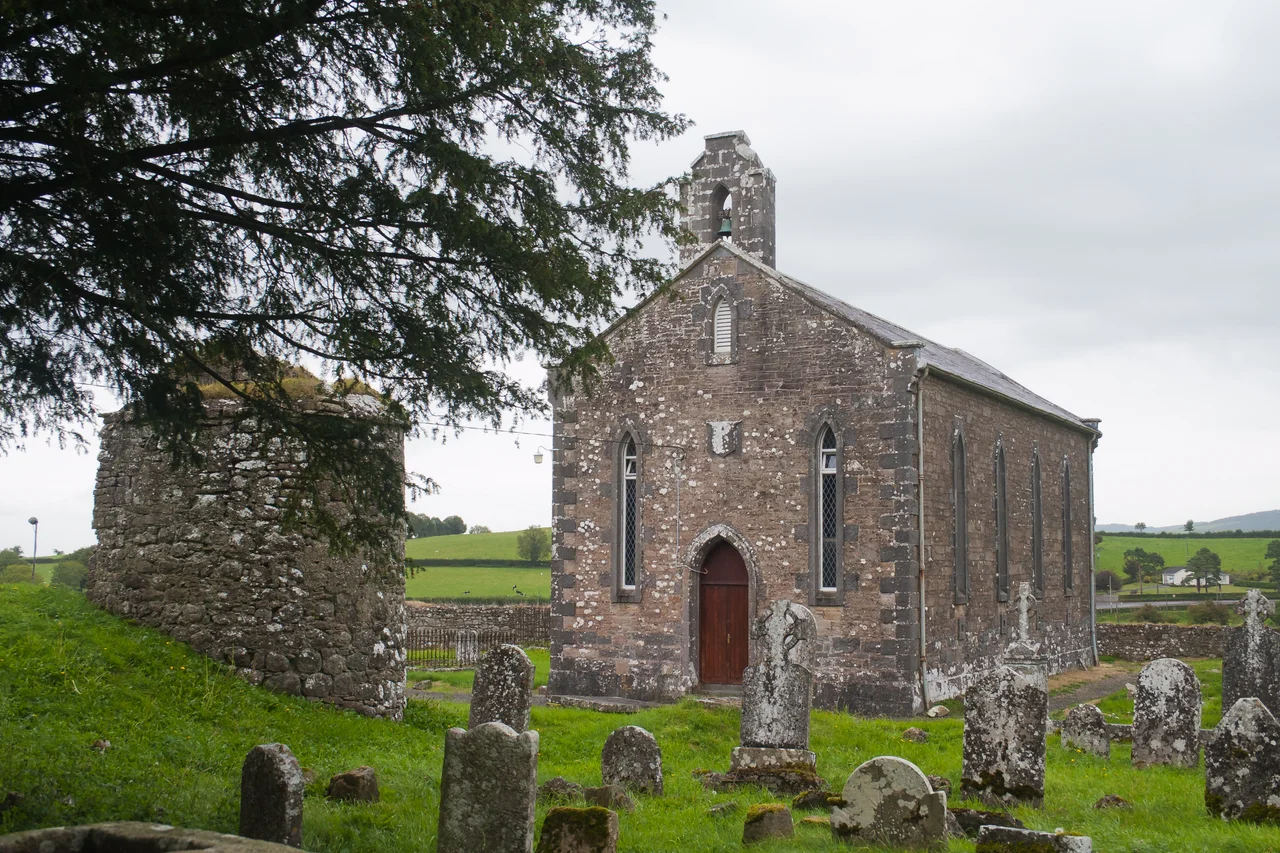

Saighir
The bell had no clapper. According to the hagiographies, Saint Patrick had given it to Ciarán in Italy with a clear instruction: walk into Ireland, evangelise your own people, and where the silent bell rings of its own accord, build your church. A cold spring would be nearby to mark the spot. Ciarán of Saigir walked through the territory of his paternal kinsmen, the Osraige, climbed over the Slieve Bloom Mountains, and the tongueless bell sounded somewhere on the eastern slopes. There was a spring of cold water. There he founded a monastery. The year was sometime before 489. Most historians believe Ciarán's foundation predates Patrick's mission entirely.
The First Saint of Ireland
Ciarán is counted among the 'Twelve Apostles of Ireland,' but his story has the texture of someone older. He was born in pagan Ireland, the tradition holds, and travelled to Rome to be baptised. He spent twenty or thirty years there, was ordained bishop, and returned home through Italy where Patrick gave him the bell. What survives is a layered legend: the wild boar that became his first monk, scraping out a clearing for the foundation; the wolves and stags that joined as labourers; the warmth Ciarán supposedly summoned from snow. Beneath the miracles is a verifiable institutional fact. Saighir Chiaráin, the monastery in what is now Clareen, County Offaly, became one of the great religious centres of early Christian Ireland and the chief church of the Kingdom of Osraige.
The Burial Place of Kings
For five centuries, the kings of Osraige—the dynasty of the Dál Birn—were buried at Saighir. The Annals of the Four Masters record abbot after abbot dying in office: Tnuthghal in 771, Maccog in 788, Cobhthach in 812, the long chain of Gaelic Christian succession unbroken across the eighth and ninth centuries until the Vikings arrived. In 842 the Annals record 'the plundering of Birr and Saighir by the Gentiles'—the standard early-medieval term for the Norse raiders. The monastery was sacked, rebuilt, sacked again. In 952 it was plundered once more, this time by the men of Munster. In 974 King Donnchadh of Ossory died at advanced age and was buried, as his forefathers had been, at Saighir. The institution outlasted everything that attacked it, until eventually time itself did the work.
The Queen and the Demons
Sometime in the 940s, Queen Sadhbh—wife of the High King Donnchadh and daughter of the King of Ossory—looked at the great Irish churches and noticed that her family's burying-place at Saighir had no wall. Every other principal church in Ireland was encircled by stone; Saighir lay open. She prevailed on her husband to send the masons of Meath, and they set to work. While the wall was rising, her father King Donnchadh died and was brought to Saighir for burial. The next night, according to Geoffrey Keating's seventeenth-century history Foras Feasa ar Éirinn, nine 'hairy jet-black crosans' appeared on the grave and began to chant. Their eyes and teeth were white as snow; their limbs blacker than coals. The clergy fasted for three days. An angel told a servant of God the chanters were demons of the Ui Coingheoidh, returned from hell. Mass was said, water blessed, the grave sprinkled, and the figures rose into the air as jet-black birds and vanished. The story is later medieval embroidery, but Keating recorded it because at Saighir, the line between kingship and the supernatural ran very thin.
What Time Left Behind
Around 1052, the chief monastic role in Osraige shifted to Aghaboe Abbey, and Saighir entered a slow decline. The See of Ossory itself moved to Aghaboe at the Synod of Rathbreasail in 1118, and later to Kilkenny entirely. Around 1170, the old Irish monastic community at Saighir was replaced by Augustinian Canons Regular, who held the site as a priory until the Dissolution of the Irish monasteries in 1568. After that, the buildings were quarried for stone, the lands changed hands, and what had been one of the most powerful religious centres in Ireland gradually faded into the landscape. Today the visible ruins are a base of a round tower, the stub of a ninth-century high cross, foundations of the priory church, fragments of fortification, and an Anglo-Norman motte on the perimeter. A small nineteenth-century church stands close to the site of the priory's medieval predecessor.
The Whitethorn and the Well
On 5 March each year, Ciarán's feast day, people still come to Saighir. They tie cloth strips—clooties—to a holy whitethorn bush at the site, an act with roots older than Christianity in Ireland and never quite extinguished. Nearby is Ciarán's holy well, still flowing from the same spring that the silent bell was said to identify fifteen centuries ago. The whitethorn, the well, the round-tower base, the priory's foundations: these are what survive of a monastery whose abbots once sat among the most powerful churchmen of Gaelic Ireland. The kings of Osraige sleep here. The Vikings burned the place repeatedly and gave up. The clooties on the whitethorn are still being tied.
From the Air
Saighir is at 53.07°N, 7.80°W, in Clareen, County Offaly, just east of the Slieve Bloom Mountains. Cruise at 3,000–5,000 feet over the central midlands and the site appears as a small walled enclosure with surrounding earthworks, west of the village of Birr. The R421 regional road passes close by. Nearest airports are Casement Aerodrome (EIME) near Dublin and Shannon (EINN) to the south-west. From altitude, look for the cluster of trees and the small modern church at the heart of the monastic enclosure, with the Slieve Bloom ridge rising to the south-east as Ciarán himself crossed it.
Nearby Stories
- Portlaoise 6.6 km away
- Clonmacnoise 8.8 km away
- Thurles 8.9 km away
- Castletroy 11 km away
- St Canice's Cathedral 12 km away
- 2003 Derrybrien Landslide 16 km away
- Mountbellew 24 km away
- Mullingar 29 km away