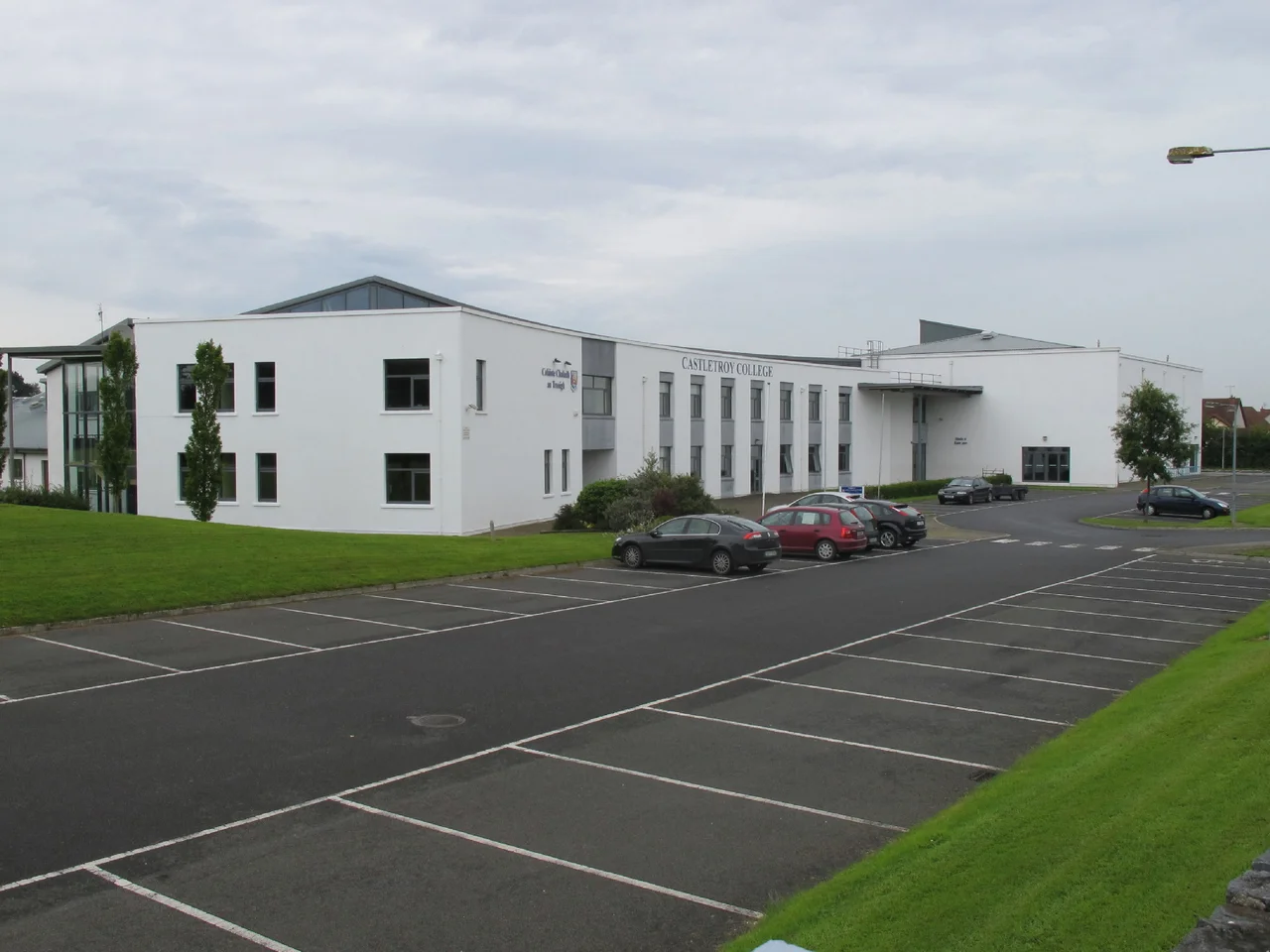

Castletroy
There is a verse in Hogan's Lays and Legends of Thomond that calls Castletroy 'grey Castletroy by war, tide and time batter'd' and likens its ruined walls to an old chief 'with his armour all shatter'd.' The chief in question is the Black Castle, a thirteenth-century tower house on the south bank of the River Shannon that Cromwell's general Henry Ireton reduced to a stump in 1651. Around it grew - very slowly, over centuries - the modern suburb of Castletroy, a name that means 'castle of the bend' or possibly 'castle of the O'Turrain.' In the twentieth century it was open country with two villages. Then in the 1970s the University of Limerick opened on the old Plassey estate next door, and Castletroy became Limerick's leafy studentville, with motorways, shopping centres, and a small Jewish graveyard that is one of the quieter stories on the Shannon.
The Black Castle
A member of the O'Brien family built the original tower in the thirteenth century, during the reign of King Henry III of England, on a strategic spit of the Shannon's south bank about two kilometres east of where the University of Limerick now stands. The MacKeoghs, a local Gaelic family often in conflict with their neighbours, held it for generations. Before the reign of Elizabeth I, their overlord the Earl of Desmond took possession of the castle directly. When the Desmonds rebelled against the Tudors and lost - the savage cycle of the Desmond Rebellions ended with mass land confiscations across Munster - Castle Troy passed to a planter family, Sir John Bourke of Brittas. Then in 1651, during the Cromwellian conquest of Ireland, Henry Ireton's army positioned cannons on Harty's Hill and shelled the castle into ruin. It has been a ruin ever since. In 1666 King Charles II granted the property to his brother James, Duke of York. In 1703 it was sold to the Hollow Blade Company, an English sword-making concern that had branched into Irish real estate.
Before the Castle
The name Castletroy may actually be older than the castle. Local toponymy suggests the area was once used by the O'Turrain clan, who used a sheltered cove of the Shannon as a safe harbour for boats navigating the upper estuary. The clan was gone by the time the Black Castle went up. Earlier evidence of settlement is even more striking - in the townlands of Castletroy, Newcastle and Rivers, archaeologists have catalogued ringforts, tower houses and bawn enclosures dating back into Ireland's deep iron-age past. The land is good. The river is wide. People have lived here for a very long time. The current Church of Ireland church in the suburb is a Board of First Fruits building from 1812, deconsecrated and now serving as an arts and heritage centre.
From Farmland to Suburb
For most of the twentieth century Castletroy was farmland with the small villages of Annacotty and Monaleen attached. Then came the institutional decision that transformed the area: in the 1970s the new University of Limerick took over the old Plassey House estate next door, on the north bank of the Shannon. Student accommodation, faculty housing, technology businesses and supporting infrastructure spread southward into Castletroy. The National Technology Park took root, eventually drawing tenants like Johnson & Johnson's contact-lens division Vistakon, the Chicago-based bank Northern Trust, and the online ticket marketplace Viagogo. Castletroy Town Centre opened off the Dublin Road - SuperValu, McDonald's, an eight-screen Odeon cinema. By the 2020s Castletroy was no longer a townland with a ruined castle; it was a sizeable Limerick suburb of around 17,000 people, dominated by the rhythms of the academic year.
The Jewish Graveyard
On a quiet plot in Castletroy stands one of the more poignant heritage sites in the area: a small Jewish graveyard, dating from the late nineteenth century, when Limerick was home to a few hundred Jewish residents, mostly recent immigrants from Lithuania. The Limerick Jewish community thrived briefly, then dwindled. The 1904 Limerick boycott - an antisemitic campaign by a local Catholic priest that pressured Jewish families to leave the city - cast a long shadow. The community shrank through the twentieth century but did not vanish; a handful of Jewish families still lived in Castletroy into the 1980s. The cemetery includes the grave of an 'Unknown Jewish Soul' of Limerick. In 1990 Chief Rabbi Jonathan Mervis came to rededicate the renovated burial ground. The headstones are small, the inscriptions in Hebrew and English. The place asks to be remembered, gently, by anyone who finds it.
What Remains
The Black Castle is open ground to anyone who wants to walk down to the Shannon and look. It sits in a small field on the river's south bank, broken stones and earthworks where a tower used to be. Sport now uses the surrounding land - Shannon Rugby Club plays on what was once the grounds of nearby Coreen Castle, and Coonagh United run their soccer pitches a few kilometres downstream. The students of UL stream into Castletroy bars on Friday nights; the technology park empties at six o'clock on weekdays. The suburb works the way modern suburbs work. The ruined chief in the corner field, armour all shattered, watches the traffic pass.
From the Air
Castletroy lies at 52.67 degrees north, 8.55 degrees west, on the south bank of the River Shannon roughly 5 km northeast of Limerick city centre. Shannon Airport (EINN) is 30 km west-northwest. From altitude, the University of Limerick campus is the dominant landmark - large modern buildings, the Living Bridge crossing the Shannon, a substantial sports complex - with the leafy suburban layout of Castletroy spreading south from the river.
Nearby Stories
- Cloughjordan 4.8 km away
- Charleville 5.6 km away
- Kilfenora Cathedral 10 km away
- Shanbally Castle 10 km away
- Abbeyfeale 11 km away
- Holy Cross Abbey 15 km away
- 2003 Derrybrien Landslide 20 km away
- Kilrush 23 km away