
Kilrush
There is a 1,500-year-old monastic settlement on a small island a quarter of an hour offshore by boat. There is a 120-berth marina with automatic lock gates. There is a Heritage Town designation, an annual famine commemoration, and a colony of bottlenose dolphins that live in the estuary year-round and let tourists come and look at them. There is also, less photogenically, the memory of the Vandeleur evictions of the 1880s, when one of Ireland's most notorious landlord families turned an already broken County Clare town into a national scandal. Kilrush, near the mouth of the River Shannon in southwest County Clare, has worn all these identities over four hundred years.
From Dutch to Landlord
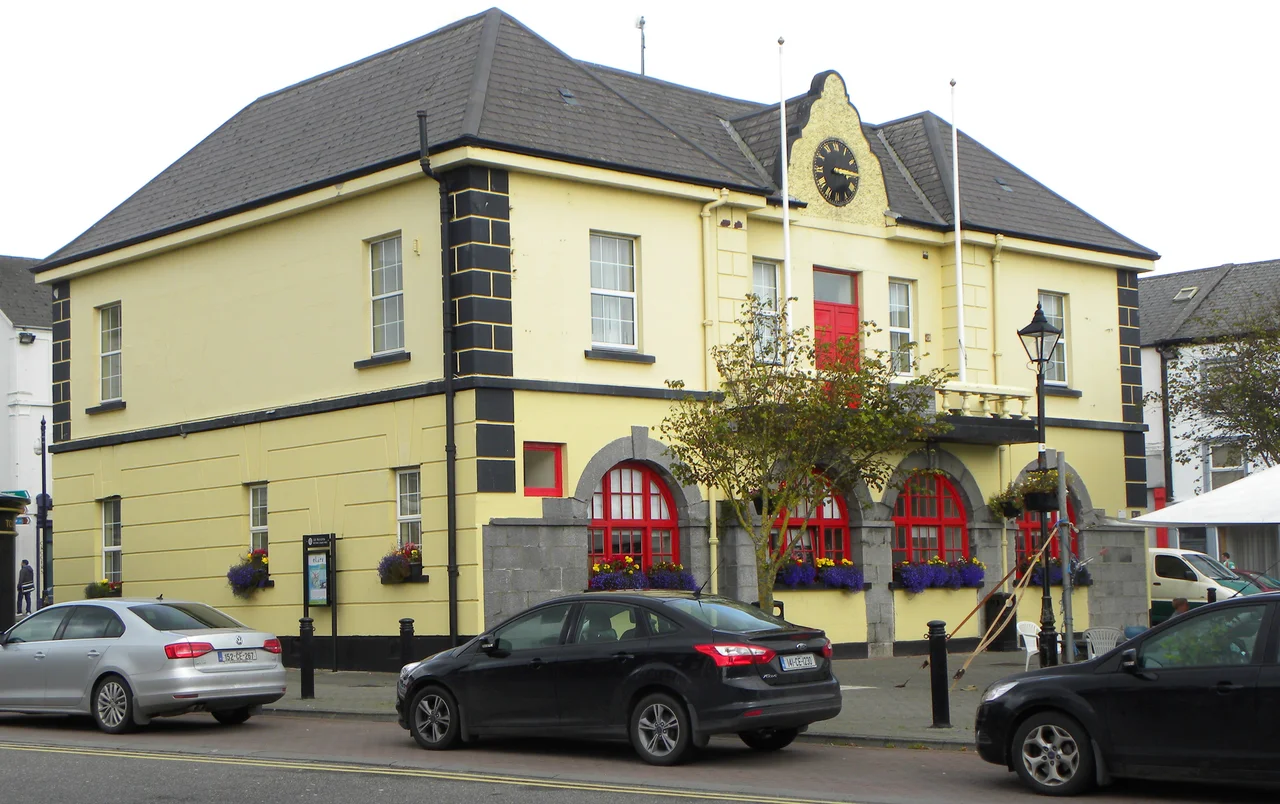
The Vandeleurs arrived in Ireland from the Netherlands in the 17th century. By around 1656, Giles Vandeleur was settled as a tenant to the Earl of Thomond at Ballynote near Kilrush. His son was made prebend - a clerical position in the Church of Ireland - in 1687 and was buried at Kilrush in 1727. By 1749, a grandson called John Vandeleur had bought up much of West Clare with the fortune his father had made as a Commissioner for applotting quit rents in Ireland - which is to say, a tax official with access to lucrative inside information. By 1808, John Ormsby Vandeleur was the wealthiest landlord in the district. He designed the layout of modern Kilrush, named streets after members of his family, and built Kilrush House and Town Hall. The Vandeleur name was on everything. Kilrush, for the next century, was effectively a Vandeleur company town - prosperous when the family was generous, devastating when they weren't.
The Steamboat Age
The Napoleonic Wars improved agricultural prices, and Kilrush boomed. A Scottish businessman named James Paterson - formerly a Royal Navy gunboat lieutenant until 1802 - moved to Kilrush and became Vandeleur's right hand in the town's development. Paterson built a six-storey building on the Square in 1802. He went into the oats trade, made money, and by 1817 had a steamboat running regularly between Limerick and Kilrush. The boats brought trade, tourists for the Kilkee beach resort just down the road, and a sense of connection to the wider world. Hely Dutton, an agricultural surveyor, wrote in 1808 that Kilrush was 'rising fast into some consequence.' By 1837, Samuel Lewis described it as a seaport, market town, and post town with industries including flannel manufacturing, stockings, hides, rock salt refining, a tanyard, a soap factory, and a nail factory. Branches of the national and agricultural banks had opened. A jail had been built in 1825. A courthouse went up in 1831. Kilrush had become a proper town.
Famine and Eviction
The Great Famine of 1845-1849 hit West Clare devastatingly hard. Potato blight destroyed the staple crop. Fever and cholera followed. The Kilrush Poor Law Union workhouse, designed to hold 800, was holding more than 3,000 by 1849, with deaths recorded in the dozens every week. Captain Arthur Edward Kennedy, sent as Poor Law Inspector from November 1847 to September 1850, witnessed the conditions and reported them in stark detail to London - reports that helped shape public horror at the famine in England. Things did not improve when the famine ended. In the late 1880s, under Hector Vandeleur, the estate became synonymous with the worst of landlord evictions. Photographs from 1888 show battering rams being used by police and soldiers to break down the doors of tenant cottages. The Vandeleur evictions became a national scandal and were one of the proximate causes of the Land War. The population of southwest Clare never recovered to its pre-famine numbers. The radio dramatist Brian Comerford later turned the story into 'Famine in Kilrush - An Inquiry.'
Scattery Island
Out in the Shannon estuary, about fifteen minutes by boat from the marina, lies Scattery Island. In Irish it is Inis Cathaigh - the island of Cathach, a monster St. Senan is said to have driven into the sea before founding his monastery here in the 6th century. The monastic settlement that grew up around Senan's church lasted more than a thousand years and produced one of the oldest and tallest round towers in Ireland - over 35 metres of perfectly cylindrical stone, with its entrance door at ground level, uniquely so among Irish round towers. Five medieval church ruins also survive on the island, along with a graveyard still in occasional use. Vikings raided Scattery repeatedly between the 9th and 11th centuries. The island was inhabited until the 1970s; the last residents moved to the mainland and the houses are now empty. Boat trips run from Kilrush marina in summer, and the OPW operates a visitor centre on the island.
Moneypoint and the Power Cut
In 1979, construction began on Moneypoint Power Station, 5 km west of Kilrush on the Shannon estuary - Ireland's largest electricity generating station and its only coal-fired plant. When commissioned between 1985 and 1987, Moneypoint employed hundreds of people directly and many more through service contracts, fundamentally reshaping the local economy of West Clare. For thirty years it was one of the region's largest employers. Then climate policy caught up. The Irish government committed to ending coal burning at Moneypoint by 2025. Output started falling. In 2019, the workforce was cut by more than half. By 2020, the plant had stopped producing electricity for weeks at a time. The transition has been managed carefully, but Kilrush is a place that has watched two waves of major economic change in living memory - first the West Clare Railway's closure in 1961, now Moneypoint - and the town is acutely aware of how dependent rural Irish economies are on a handful of big employers.
Dolphins and a Gold Medal
What Kilrush has now is the dolphins. A resident pod of around 200 bottlenose dolphins lives in the Shannon estuary year-round, one of the few resident dolphin populations in Europe. Dolphin-watching tour boats run daily from the marina. The Shannon Dolphin and Wildlife Foundation has an information centre nearby. Tesco opened in 2008. Aldi in 2009. The Western Yacht Club, one of the oldest in the world, has been quietly rejuvenated. In 2015, Kilrush won an Entente Florale gold medal for horticultural and environmental excellence, representing Ireland in the village category. Michael Tubridy, an original member of the Chieftains, was born here. So was the historian Richard Barry O'Brien, the famine-era novelist Charles Lever (who practised medicine here during the 1832 cholera epidemic), the Irish Labour politicians Pat and Mary Upton, and the showjumping captain Mick Tubridy. The Vandeleur walled garden is open to visitors. Kilrush House, gutted by fire in the late 19th century, was finally demolished in the 1970s, and the central car park now stands where it was - a quiet ending to a long story.
From the Air
Kilrush sits at 52.64°N, 9.49°W on the southwest coast of County Clare, near the mouth of the Shannon estuary. From the air look for the town centred on Market Square, the lock-gated marina giving access to the estuary, and Scattery Island with its prominent Round Tower 3 km offshore. Shannon Airport (EINN) is 40 km east. Kerry Airport (EIKY) is across the estuary at Farranfore, accessible by the Killimer-Tarbert ferry. Loop Head with its lighthouse is 30 km west at the end of the peninsula. Best viewing altitude is 2,500-4,500 feet for the estuary, the marina, and the islands offshore.
Nearby Stories
- Abbeyfeale 1 km away
- Lahinch 3.5 km away
- Charleville 7.7 km away
- Adare Friary 8.7 km away
- Fenit Island 11 km away
- 2003 Derrybrien Landslide 23 km away
- Illauntannig Monastic Site 38 km away
- Saint Macdara's Island 44 km away