
Lahinch
Lahinch Golf Club was founded in 1892, and in 1894 the Scottish golfer Old Tom Morris was invited to design its first links course. Morris had already shaped the Old Course at St Andrews configuration and a dozen other classic links. The course he set down at Lahinch was modest in budget but ambitious in landscape. Thirty-three years later, in 1927, Alister MacKenzie - the man who would co-design Augusta National with Bobby Jones - was paid 2,000 pounds to redesign and extend the Lahinch links. The course MacKenzie left behind is what golfers still play today.
The Half Island
The name in Irish, Leath Inse, means half island or peninsula - a description of the village's position between the Inagh River and the open Atlantic. The Annals of the Four Masters recorded the place as Leith Innse in the seventeenth century. Some modern road signs still use the alternative spelling Lehinch. Several earth forts in the area suggest occupation going back to the Iron Age or earlier; in 2020, archaeologists identified what appears to be a cliff ring fort previously unrecorded, possibly several thousand years old.
Lahinch was a hamlet of a few fishermen's huts as late as the eighteenth century. By 1835 the population had risen to over a thousand. The real growth came with the West Clare Railway, which opened in 1887 and connected the town to Ennis. Suddenly Lahinch was accessible from Dublin and beyond, and the town reinvented itself as a Victorian seaside resort. In 1883 a severe storm destroyed the sea wall and promenade; local governor William Edward Ellis oversaw the rebuild. The new promenade was inaugurated by the wife of the Viceroy, Lady Aberdeen, in July 1893.
The Course at Lahinch
Lahinch Golf Club opened in 1892, on land that was reportedly being used for grazing sheep right up to the moment the founders set it out. In 1894 Old Tom Morris was brought in to design the course proper. By 1927 the membership wanted something more ambitious, and they hired MacKenzie. He found the Atlantic dunescape perfect for what he was developing into a design philosophy - holes that asked thoughtful questions, gave the player visual cues but also room to misread them, and worked with the existing terrain rather than fighting it.
The famous Klondyke and Dell holes - blind shots over and around natural sand hills - were Morris's original creations and remained untouched by MacKenzie's redesign. The course hosts the South of Ireland Championship, an amateur tournament running since 1895. In July 2019 it hosted the Dubai Duty Free Irish Open, with Jon Rahm winning. Lahinch now has 36 holes - the original Championship Course remodelled by MacKenzie, and the additional Castle Course. The ruins of Dough Castle, a fifteenth-century O'Brien clan tower, stand within the golf grounds.
Surfers and Storms
Sometime in the 1990s, surfers discovered Lahinch. The beach faces the open Atlantic, the Liscannor Bay swells refract around Hag's Head and break in long peeling lines that on the right day rival anything in Europe. The town now has a surf school, surf shops, and the population of beach-tan twenty-somethings any Irish surf town acquires in summer. On 14 May 2006, 44 surfers managed to ride one small wave together, setting a Guinness world record for the most people simultaneously surfing the same wave - a record that has since been broken elsewhere, but the photograph remains on Lahinch walls.
The Atlantic gives Lahinch its sport and occasionally takes pieces of the town back. In January 2014 a major winter storm produced waves that crashed over the promenade, flooding the seafront. The images made international news. The 1996 Lahinch Seaworld and Leisure Centre, with its aquarium and indoor pool, sits behind the dunes. Lahinch Sea Rescue, an independent lifeboat service, covers the bay - Atlantic conditions can turn quickly, and not everyone who enters the water leaves it safely.
The Lehane House
On the night of 22 September 1920, four kilometers from Lahinch's main street, the Rineen ambush had just ended. In Cragg, on the outskirts of Lahinch, Dan Lehane was in his house. His two sons had been in the IRA ambush party that afternoon. A mixed force of police and soldiers - the Black and Tans and RIC Auxiliaries that had been deployed across Clare - arrived to find them. The sons were not home. The father was. They shot Dan Lehane in his doorway. They set fire to his house. His son Patrick, who was inside, burned to death in the attic when the roof came down.
A plaque at Flanagans' bar in Lahinch, unveiled in 2020 on the centenary, names Pakie Lehane among the dead. The historian Aideen Carrol described the Black and Tans as having run "amok in Lahinch and Milltown Malbay in an orgy of burning and beating" that night. Several other houses in Lahinch were burned. A century later, the town is best known for golf and surfing, but the Lehane plaque is part of what walking through Lahinch involves remembering. The 1965 movie I Was Happy Here was filmed in town; so was an episode of Father Ted; the Lahinch beach scenes have a tourist landmark feel now. The town carries all of it forward together - the famine memorial in nearby Ennistymon, the Lehane plaque here, MacKenzie's golf holes in the dunes, surfers in wetsuits paddling out at first light.
From the Air
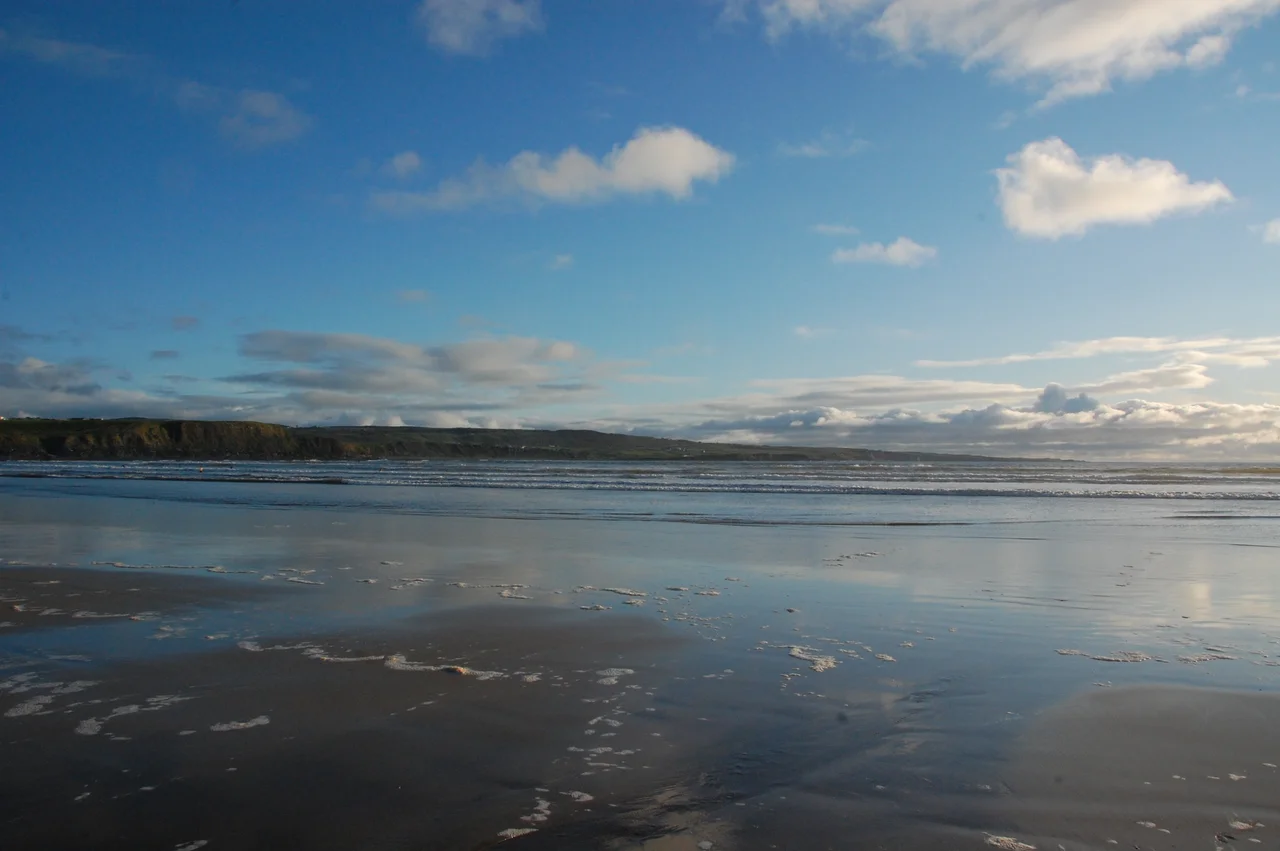
Lahinch sits at 52.94 N, 9.35 W, on Liscannor Bay on the northwest coast of County Clare. Shannon Airport (EINN) is 55 km southeast; Galway (EICM) is 75 km northeast; Connemara (EICA) is 35 km north. Recommended viewing altitude is 1,500 to 3,000 feet AGL. The town is identifiable by its broad sandy beach (Lahinch Strand) running along Liscannor Bay, the promenade above it, and the Lahinch Golf Club dunes immediately north and east of the town centre. The Cliffs of Moher lie 8 km north-northwest. Ennistymon is 4 km east. The ruins of Dough Castle stand within the golf course. Atlantic weather is the dominant variable - cloud bases below 2,000 feet are routine, and winter storms occasionally close the promenade. The surf break at Lahinch Beach is one of the most consistent in Ireland; expect surfboards in the water in most conditions short of full gale.
Nearby Stories
- Saint Macdara's Island 6.8 km away
- Limerick Institute of Technology 12 km away
- County Galway 15 km away
- 2003 Derrybrien Landslide 15 km away
- Kilrush 16 km away
- Knockmoy Abbey 20 km away
- Mace Head Atmospheric Research Station 37 km away
- Illauntannig Monastic Site 47 km away