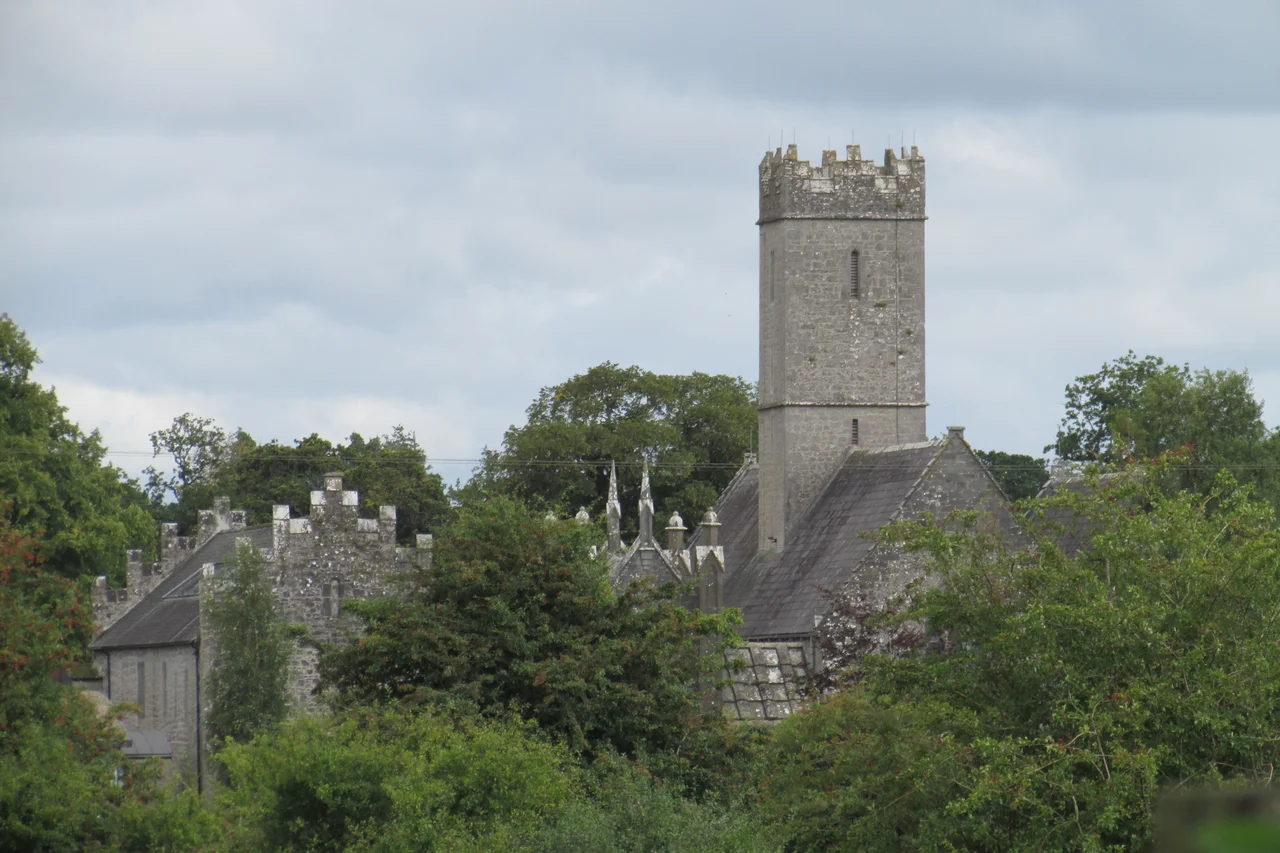

Adare Friary
Look closely at the inner spandrels of the east arcade in the small cloister and you can still find the carved arms of the FitzGeralds, the family who paid for the friary in 1316. Seven hundred years and three religious reformations later, the building is still in use - though not by the Augustinians who first walked its ambulatories, and not as a friary at all. The medieval Black Abbey of Adare became, after the Tudor suppression, a Church of Ireland parish church called St Nicholas, and the friars' old refectory became a national school. Children walk into class through corridors where wooden choir stalls once stood. The Mouseman of Yorkshire carved a lectern in here in the twentieth century, and his signature - a tiny mouse - hides somewhere on the wood, waiting to be found.
The Geraldine Foundation
John FitzThomas FitzGerald, 1st Earl of Kildare, founded the friary in 1316. The Augustinian Order of Hermits, recently arrived in Ireland from England via Dublin, had built a reputation for pastoral work and serious scholarship; an Augustinian house in a busy market town like Adare was a strategic religious investment. The FitzGeralds were the dominant Anglo-Norman family in the region, and their patronage was generous - eighty acres of farmland by 1541, cottages, gardens, a fishing weir on the River Maigue. In return, the family expected what every medieval patron expected: spiritual support, prayers for the souls of their ancestors, and burial within the church walls. The first two Earls of Kildare were laid to rest here. The Geraldine arms still mark the cloister, carved by a fourteenth-century mason as a permanent reminder of who paid for the stonework.
The Black Abbey
The Augustinians wore black habits, and from this came the Adare friary's first nickname: the Black Abbey. The architecture they left behind is unusually well preserved for a building of its age. The fifteenth-century cloister is small, square, and intimate, with narrow buttress-like piers, four-centred arches, and unglazed mullioned windows whose heads are pleasingly cinque-cusped. The ambulatories - the covered walks where friars paced in prayer - are flat-vaulted, groined on two sides and three-centred on the others. In the south aisle, look for a string course of stone bosses including a Tudor rose - a fragment of late-medieval decoration that survived everything that came after. Inside the church, the walls were once painted with murals in red and yellow with black lining, a brightness that the Reformation whitewashed and that almost nothing now suggests.
Suppression and Survival
The Tudor dissolution of the monasteries arrived in Ireland in waves. The Augustinians of Adare held on into the late sixteenth century, but by 1633 they had given up and moved to Limerick city, where Catholic religious life was still possible in the recesses of urban anonymity. The friary at Adare passed to Protestant hands. It became, eventually, the parish church of the Church of Ireland - St Nicholas - and that is what it remains. Through the nineteenth century the Dunraven family, Anglo-Irish gentry headquartered nearby at Adare Manor, undertook careful restoration work. They paid for repairs to the medieval fabric and were buried inside in turn: three Earls of Dunraven lie under the same flagstones as the FitzGerald earls of seven centuries earlier. The Pietà inside is sixteenth-century Flemish, a sensitive wooden carving of Mary holding the dead Christ. Nobody knows when it arrived in Adare or by whose hand.
A School in the Refectory
In 1814 the Earl of Dunraven founded a school in the old refectory of the friary - the long stone hall where Augustinian friars had eaten in silence five hundred years earlier. It became a national school in 1862. For nearly two centuries the children of Adare learned to read and write in the same room that had once heard liturgical chanting and the daily reading of saints' lives. By 2007 the medieval room had grown too small. A new building rose behind the monastery, three classrooms with sedum growing on its green roof, opened in December 2008 by Mary Hanafin, then the Minister for Education and Science. The original refectory now serves as a hall for PE and drama. The Augustinians might find it odd. They might also have appreciated the continuity. Stone walls that have housed prayer, dissolution, restoration, learning, and now small-feet running, are stone walls that have done their work.
Finding the Mouse
Among the modern furniture of St Nicholas's church are two pieces by Robert Thompson, the great Yorkshire furniture maker known to admirers as the Mouseman. Thompson signed every piece he made by carving a tiny mouse somewhere on the wood - on a chair leg, under a tabletop, on the base of a candle stand. Two of his mice live in Adare Friary: one on the base of a lectern, the other on an upright of a railing. Finding them is the kind of small treasure hunt that gives a medieval church an unexpected layer of recent history. The wood is twentieth-century. The signature - that little carved English mouse, looking out from a fourteenth-century Irish Augustinian friary - is a quiet joke about how long buildings live and how many hands work on them.
From the Air
Adare Friary stands at 52.57 degrees north, 8.78 degrees west, in the village of Adare on the River Maigue in central County Limerick. Shannon Airport (EINN) is 30 km north; the town sits on the N21 road between Limerick city (16 km east) and Tralee. Adare is famous as one of Ireland's most picturesque thatched-cottage villages, and the friary's Gothic stonework rises above the village trees as a visible landmark from low altitude.
Nearby Stories
- Cloughjordan 4.8 km away
- Charleville 5.6 km away
- Kilfenora Cathedral 10 km away
- Shanbally Castle 10 km away
- Abbeyfeale 11 km away
- Holy Cross Abbey 15 km away
- 2003 Derrybrien Landslide 20 km away
- Kilrush 23 km away